A Domestic Violence Victim's Pre-Trial Statement Now Stands Even If They Refuse to Testify, Portugal's Supreme Court Has Ruled
Acórdão do Supremo Tribunal de Justiça n.º 6/2026, published on Friday, fixes case law: a court may weigh declarações para memória futura taken before a judge during the investigation even when the victim later exercises the right to refuse to give evidence at trial.
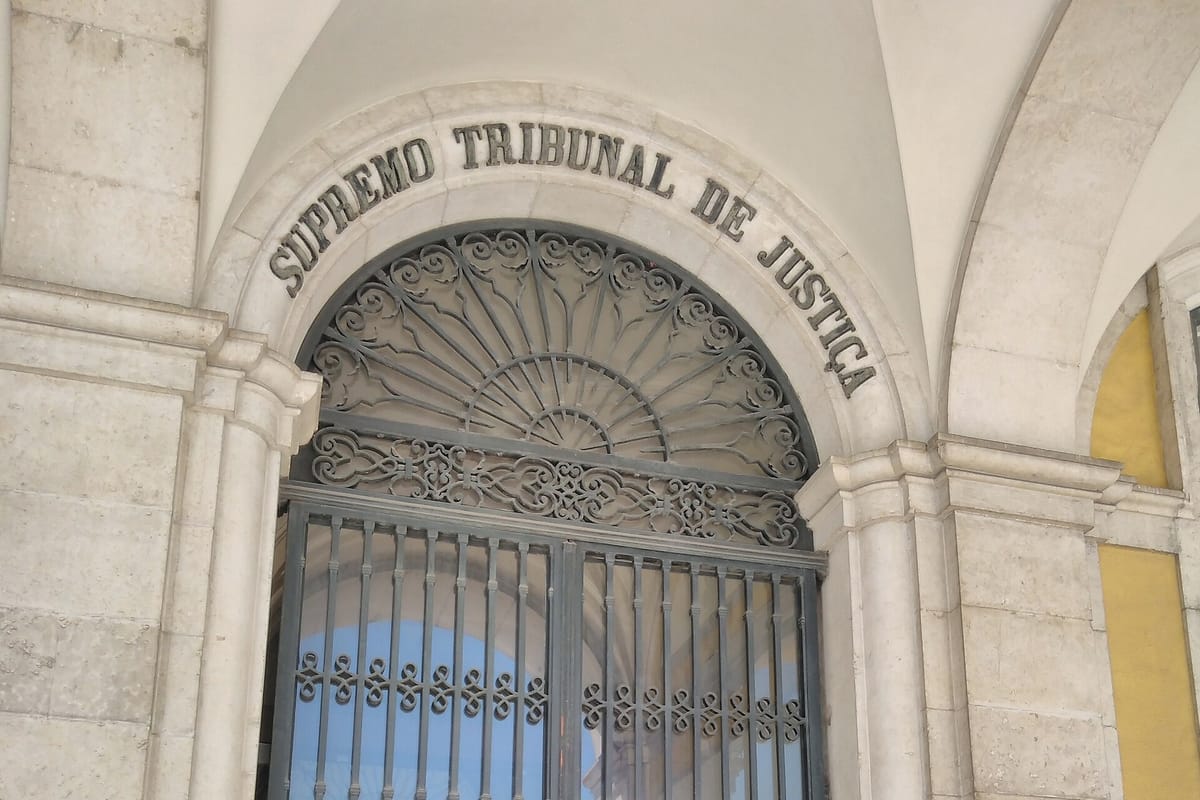
A domestic violence victim who gives evidence to a judge during the investigation, and then refuses to speak at the trial because the accused is their spouse, parent or child, no longer cancels out what they said. Friday's Diário da República carries Acórdão do Supremo Tribunal de Justiça n.º 6/2026, a ruling of the full criminal sections of Portugal's Supreme Court that settles a question the appeal courts had been answering in opposite ways, and settles it in favour of the earlier statement.
The fixed wording is narrow and worth reading closely. A court may weigh declarações para memória futura ("statements for future memory") given during the inquérito or the instrução, provided Article 134(2) of the Código de Processo Penal (CPP, Code of Criminal Procedure) was complied with, by a witness who is the victim of domestic violence and who stands to the accused in one of the relationships listed in Article 134(a) and (b), and who, called to trial, refuses to give evidence after being warned under Article 134(2).
The two machines that had to be made to fit
Portuguese criminal procedure runs on the principle that evidence is produced at the trial, in front of the judges who decide. Declarações para memória futura are the recognised exception: Article 271 CPP allows an investigating judge to hear a witness during the inquiry so that the account can be taken into account at trial. Article 33 of Lei n.º 112/2009, the domestic violence regime, provides its own version for victims of that crime, and Article 24 of Lei n.º 130/2015, the Estatuto da Vítima (Victim Statute), provides another for especially vulnerable victims. A domestic violence victim is legally an especially vulnerable victim, because the offence counts as violent crime under Article 1(j) CPP.
The point of the mechanism is not only to bank the evidence. It is to spare the victim from telling the story repeatedly and to catch the account while it is still genuine, before the pressure of a shared household does its work.
Against that sits Article 134 CPP, which lets descendants, ascendants, siblings, relatives by affinity to the second degree, adoptive parents, adopted children and the spouse of the accused refuse to give evidence, and lets a former spouse or a former or current cohabiting partner refuse as to facts from the period of the marriage or cohabitation. The authority taking the evidence must warn them of that right, on pain of nullity. And Article 356(6) CPP says that it is prohibited, in any case, to read out a statement given in the inquiry or the instruction by a witness who at trial has validly refused to testify.
Put those together and the question writes itself. If the earlier statement was taken by a judge precisely so it could be used, does a refusal at trial erase it?
Lisbon said no, Coimbra said yes
The Tribunal da Relação de Lisboa, on 15 September 2021, held that it did. In that case a victim had given declarações para memória futura and then refused to testify at trial; the Lisbon court read Article 356(6) as a bar, and refused the prosecution's attempt to have an acquittal annulled for having disregarded the earlier statement.
The Tribunal da Relação de Coimbra went the other way on 5 February 2025, in a case where the witness was the accused's daughter. It allowed her earlier statement to be weighed, and rejected the defendant's argument that the conviction was a nullity.
On 26 March 2025 the Ministério Público (Public Prosecution Service) at the Coimbra appeal court lodged an extraordinary appeal under Articles 437 and 438 CPP to have the conflict resolved. The Supreme Court's third criminal section confirmed on 17 September 2025 that the two rulings genuinely opposed each other on the same point of law, and sent the matter to the full criminal sections.
Why the prohibition does not apply
The court's reasoning turns on a distinction between two different moments. Admitting and producing evidence during the inquiry is one thing, governed by Article 271. Examining and weighing it at trial is another, governed by Articles 355 and 356. The consequence the court draws is not the obvious one: producing a memória futura statement validly does not automatically entitle the trial court to use it, and the investigating judge should not be deciding whether to order one on a guess about whether the victim will refuse to testify later. The victim has that right at any moment they are called to speak.
But Article 356(6), the court held, addresses the reading out of an ordinary investigative statement. It does not reach evidence that was pre-constituted before a judge, with the defence present and able to cross-examine. Article 356(2)(a) points the other way, allowing precisely statements taken under Article 271 to be read. And the cross-reference in Article 271(6) to Article 356 was read as carrying over only the provisions about how evidence is produced, not as importing the prohibition wholesale.
There is a second, independent leg. Article 24(6) of the Estatuto da Vítima says that in the cases it covers, evidence should only be given at the trial hearing if it is indispensable to the discovery of the truth and does not endanger the physical or psychological health of the person who would give it. That is a later and a special rule, and the court held that even if there were a conflict with Article 356(6), the special rule would prevail.
The court also refused an analogy that had some surface appeal: that a refusal to testify is a kind of withdrawal of the earlier account, the way withdrawing a complaint undoes a prosecution. Withdrawing a complaint is a positive act that revokes an earlier expression of will. Refusing to testify is the exercise of a negative right and says nothing, in itself, about the facts. In the court's phrase, the victim has not been given a legal power to block the use of their own earlier statement by falling silent in the courtroom.
Two judges dissented
The acórdão was decided in Lisbon on 8 July 2026, with António Augusto Manso as rapporteur. Fourteen judges signed. José Alberto Vaz Carreto voted against and filed a written declaration; Antero Luís adhered to it.
The dissent takes the special-law argument and turns it around. For a domestic violence victim, it argues, the applicable regime is Article 33 of Lei n.º 112/2009, not the Victim Statute, because the domestic violence law is the more specific of the two and the Statute itself says it does not prejudice special regimes for victims of particular crimes. Article 33(5) of that law applies Articles 352, 356, 363 and 364 CPP to the taking of the statement. If Article 356 applies, so does Article 356(6), and a valid refusal at trial bars the reading and therefore bars the use.
The dissent also presses an uncomfortable practical point. Either the witness must be warned again at trial, in which case the refusal is real and Article 356(6) bites, or the earlier warning covers the whole proceeding and the witness cannot refuse at all, in which case refusing is itself the offence of refusing to give evidence. What the majority does, on this reading, is leave the right of refusal formally intact while removing everything that follows from exercising it.
What it changes, and what it does not
Domestic violence prosecutions frequently rest on the victim's account and little else, and a withdrawal at the courtroom door is a familiar ending. This ruling means that where a memória futura statement exists, that ending no longer automatically follows. The practical incentive now points towards taking the statement early, before a judge, with the defence present.
Four things it does not do. It does not make declarações para memória futura compulsory: Article 33(1) of Lei n.º 112/2009 leaves the decision to the judge, case by case. It does not remove the right to refuse to testify, which survives untouched. It does not make the earlier statement conclusive; it remains subject to free evaluation alongside the rest of the evidence, and the trial court can still decline to use it for reasons of its own. And it does not reach statements taken by police or prosecutors rather than by a judge, which remain outside the mechanism entirely.
Under Article 446 CPP, a decision taken against case law fixed by the Supreme Court is itself subject to a dedicated appeal, which is what gives a ruling of this kind its weight in the courts below. Fixed jurisprudence is published in the first series of the Diário da República under Article 444(1); this one appeared on 18 September 2026, in issue n.º 182, ten weeks after it was decided.
If this is your situation
If you are a victim of domestic violence in Portugal, the practical takeaway is about timing. Asking the Ministério Público to request declarações para memória futura early now secures an account that will survive whatever you decide about testifying later, and it is a request the victim can make. Nothing in the ruling obliges you to speak in the courtroom.
Support is free and does not require a police report first. The national domestic violence information and support line, run by the Comissão para a Cidadania e a Igualdade de Género (CIG, the Commission for Citizenship and Gender Equality), is 800 202 148. If you cannot afford a lawyer, legal aid is means-tested through Segurança Social and covers representation in criminal proceedings. The caseload this ruling touches is not small: police logged nearly 8,000 domestic violence cases in the second quarter of this year alone.