Using Portugal's Trains, Metros and Buses With Reduced Mobility in 2026: A Practical Guide to the CP SIM Service, the 24-Hour Notice Rule and the 50 Percent Circula.PT Discount
What European law entitles you to on a Portuguese train or coach, how much notice CP and the long-distance carriers may require, what the assistance dog decree says, and how a 60 percent incapacity certificate turns into a 50 percent discount on a monthly pass.
Portuguese public transport gives people with disabilities and reduced mobility a long list of enforceable rights, and then scatters them across two European regulations, several decree-laws and five operators who each do things differently. This guide pulls the practical parts together: what you are entitled to, how far in advance you have to ask, what you have to show, and what the discount is worth.
It applies to anyone whose mobility is reduced when using transport. Under European law that is not limited to people with a recognised disability: it covers reduced mobility from age, from a temporary condition, and from any impairment that requires attention and adaptation of the service. Several of the Portuguese schemes below, however, attach to a specific certificate, and those are flagged where they arise.
The legal backbone
Four instruments do most of the work.
The United Nations Convention on the Rights of Persons with Disabilities, approved for ratification by Resolução da Assembleia da República n.º 56/2009, binds Portugal. Article 9 covers accessibility and Article 20 personal mobility.
Decreto-Lei n.º 163/2006, de 8 de agosto sets the accessibility regime for buildings and establishments open to the public, for the public highway and for residential buildings. It is the instrument behind pavements, kerbs, crossings and the approaches to a stop or a station. Responsibility for maintaining those approaches sits with the municipality, not the transport operator, which matters when you are deciding who to complain to.
Regulation (EU) 2021/782 governs rail passenger rights, including Articles 21 to 26 on people with disabilities and reduced mobility.
Regulation (EU) No 181/2011 governs bus and coach passenger rights. Its scope is the thing most people get wrong, and it is covered in its own section below.
Trains: the CP SIM service
CP (Comboios de Portugal) calls the relevant group Clientes com Necessidades Específicas (clients with specific needs), meaning anyone who wants to use its trains but has limitations requiring personalised support to guarantee equal access. The assistance itself is delivered through the Serviço Integrado de Mobilidade (Integrated Mobility Service), universally abbreviated to SIM.
SIM provides support with boarding and alighting. There is one distinction in it that determines whether your journey is possible at all, and it is worth reading twice:
- If you do not use a wheelchair or a mobility scooter, SIM is available on all trains and at all stations.
- If you do use a wheelchair or a mobility scooter, SIM is available only at the stations on CP's published Lista de Estações com SIM (list of stations with SIM).
Check that list before you buy a ticket, not after. A station being described as accessible is not the same as a station where CP will put staff on the platform to help you board.
How much notice you have to give
This is set by European law, not by CP, and it changed in the middle of this year.
Article 24(a) of Regulation (EU) 2021/782 says assistance must be provided on condition that the railway undertaking, station manager, ticket vendor or tour operator with which the ticket was bought is notified at least 24 hours before the assistance is needed. Member States were allowed to stretch that to 36 hours, but the regulation is explicit that the extension could not run beyond 30 June 2026. As of today, 24 hours is the maximum notice any operator in the European Union may require.
Four further details of that article are worth knowing, because operators do not always volunteer them:
- One notification per journey is enough. It has to be forwarded to every railway undertaking and station manager involved, including on a journey with changes and more than one operator.
- Notifications must be accepted without additional cost, whatever the channel used. You cannot be charged for booking assistance, and you cannot be pushed onto a premium line to do it.
- A season ticket needs one notification, not one per trip, provided you give adequate information on the timing of the later journeys, and in any case at least 24 hours before the first time assistance is needed.
- If you cancel one of those later journeys, make all reasonable efforts to say so at least 12 hours in advance.
CP takes bookings for SIM through an online form on its website or by telephone. It does not take them at ticket offices. For its urban and suburban services, CP has used the exemption European law allows and dropped the maximum advance notice requirement altogether.
Turning up
Article 24(e) caps how early you can be made to arrive. The station manager or railway undertaking may stipulate a time at the designated assistance point, but it may not be more than 60 minutes before the published departure time.
Article 24(d) obliges the station manager to designate the points where you can make your arrival known and request help, and to publish where they are.
If you did not book at all, Article 24(c) still applies: the railway undertaking and the station manager must make all reasonable efforts to provide assistance so that you can travel. It is a weaker duty than the booked one, but it is a duty.
What else rail law gives you
You cannot be refused, and you cannot be charged extra. Article 21(2) says reservations and tickets must be offered at no additional cost, and that an undertaking, ticket vendor or tour operator may not refuse a reservation or a ticket, or require that you be accompanied, unless that is strictly necessary to comply with its published access rules. Where it does invoke that exception, Article 22(2) obliges it to tell you its reasons in writing on request.
Your companion. Under Article 23(1), a personal assistant recognised as such under national practice may travel on a special tariff and, where applicable, free of charge, seated next to you where practicable. If the operator is the one requiring you to be accompanied, the accompanying person travels free.
Unstaffed stations and trains. Article 23(1)(d) and (f) put the duty on whoever has trained staff on the spot. At an unstaffed station, if the train has trained staff on board, the railway undertaking must provide assistance free of charge on board and during boarding and alighting. Where there are no trained staff at either end, Article 23(1)(g) falls back on all reasonable efforts.
If your wheelchair is damaged. Article 25 is one of the most useful provisions in the regulation and one of the least known. Where a railway undertaking or station manager causes the loss of or damage to mobility equipment or assistive devices, or the loss of or injury to an assistance dog, it is liable and must compensate without undue delay. That covers the cost of replacement or repair, the cost of replacing or treating the dog, and the reasonable cost of a temporary replacement. On top of that, the operator must make all reasonable efforts to provide an immediately needed temporary replacement, and you are entitled to keep that temporary equipment until the compensation has actually been paid.
Information. Article 22(1) obliges station managers, railway undertakings, ticket vendors and tour operators to give you, on request, information in accessible formats on the accessibility of the station and its facilities, of the services, and of the rolling stock.
Long-distance coaches, and the scope trap
Regulation (EU) No 181/2011 is the bus and coach equivalent, but it does not apply in full to every bus you board. Under Article 2(1), the full regulation applies to regular services for non-specified categories of passengers where the scheduled distance is 250 km or more. For regular services shorter than that, Article 2(2) applies only a subset of provisions.
The practical consequence: the assistance regime in Articles 11 to 14 belongs to long-distance coach travel. It is not the rule that governs your city bus.
Where it does apply:
- Notice is 36 hours, not 24. Article 14(1)(a) requires the need for assistance to be notified to the carrier, terminal managing body, travel agent or tour operator at the latest 36 hours before it is needed.
- Arrival times. Article 14(1)(b) says you present yourself at the designated point at the time stipulated in advance by the carrier, which may be no more than 60 minutes before the published departure time, or, if no time is stipulated, no later than 30 minutes before.
- Seating needs must be notified at the time of reservation or advance purchase, if known then.
- Assistance is free, at terminals designated by the Member State (Article 13(1)) and on board (Article 13(2)).
- If no notification was made, Article 14(4) still requires every reasonable effort.
Article 10 sets out the only grounds for refusing you a reservation, a ticket or boarding: applicable safety requirements, or a vehicle or infrastructure design that makes carrying you safely and operationally impossible. If you hold a reservation, complied with the 36-hour notice and are refused anyway, Article 10(3) gives you a choice between reimbursement (with a free return to the first point of departure where relevant) and re-routing.
Article 17(1) and (2) make carriers and terminal managing bodies liable for loss of or damage to wheelchairs, other mobility equipment or assistive devices they cause, with compensation equal to the cost of replacement or repair. That provision applies to short regular services too, under Article 2(2).
City buses and trams
Here the operators' own published rules are what you actually deal with.
Porto: STCP
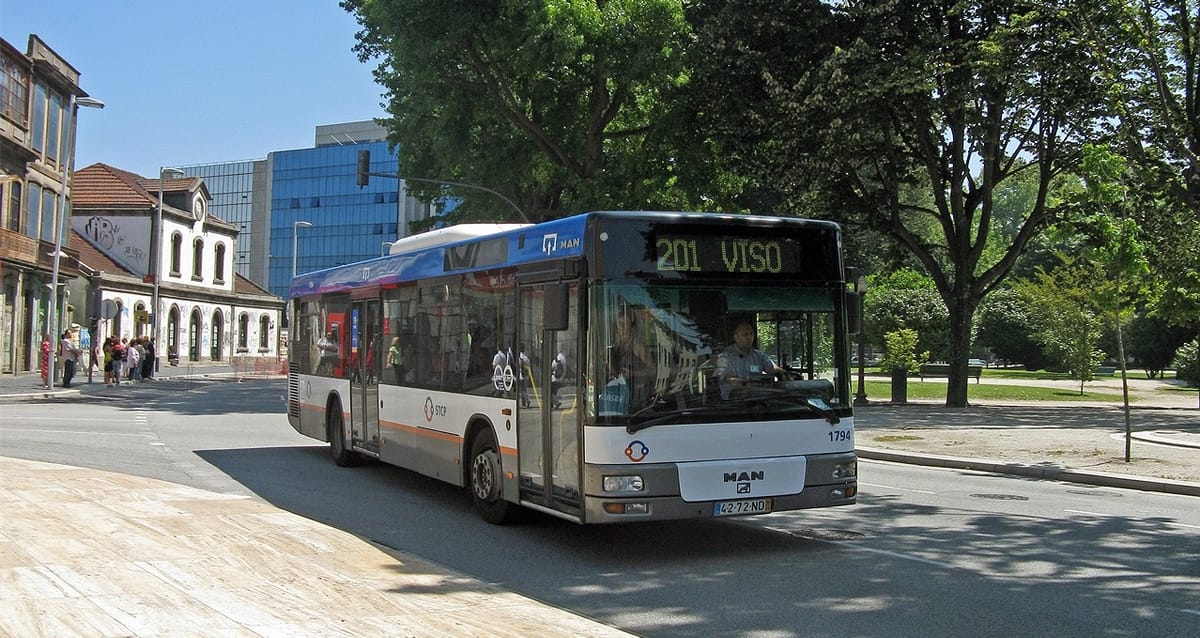
STCP states that it runs the largest accessible urban bus fleet in Portugal, with ramps and a reserved wheelchair or pushchair space. Its published rules are specific:
- Wheelchairs may travel only on buses carrying the universal accessibility symbol, because only those have the safety belt and the reserved space.
- For safety, only one wheelchair per bus, or one open pushchair.
- Wheelchair and pushchair users board and alight by the front door, where the ramp is manual and can be opened by a passenger, a companion or the driver.
- The wheelchair has priority over pushchairs. If the reserved space is taken by a pushchair and a wheelchair user boards, the space must be given up and the pushchair folded and put in the luggage area.
- On buses with an automatic rear ramp, marked by an accessibility sticker beside the rear door, you board at the rear. Make sure the driver has seen you, using the STOP or ramp request button; press the blue button by the rear door to deploy the ramp on entry, and the blue button by the reserved wheelchair space to get off.
- If the ramp is broken, STCP asks you to wait for the next bus.
- The first four seats are reserved for disabled, ill or elderly passengers, pregnant women and people carrying children. Anyone may sit there when free, but must give the seat up.
Lisbon: Carris and the Porta a Porta service
Lisbon's regular network is not fully accessible, so alongside it Carris runs a door-to-door Serviço Especial de Mobilidade Reduzida (special reduced-mobility service), known as Porta a Porta. Its regulation sets out the terms:
- Who it is for: clients with 60 percent or more declared incapacity who are not in a position to use the regular public service. The regulation warns that the driver's help is necessarily limited and advises travelling with a companion if you need assistance.
- Hours: weekdays 06:30 to 21:00; weekends and public holidays 08:00 to 12:00 and 14:00 to 18:00. Plan around those hours, because the service does not run outside them.
- Area: journeys within the city of Lisbon.
- Joining: apply at the Carris shop at Santo Amaro or through the Carris website, with your Cartão de Cidadão or identity card, a signed Atestado Médico de Incapacidade Multiusos (multi-purpose medical incapacity certificate, or AMIM) proving 60 percent or more, and a current photograph. Wheelchair users applying in person are exempt from producing the certificate. Carris may ask for fresh proof of the certificate at any time.
- Cost: every person carried pays, client and companion, per trip, at the on-board fare in force. No other transport title is accepted on this service. Children up to three years old travel free on the lap.
- Booking: by telephone only, on 213 613 141, a number used exclusively for this service. Give your card number, the day and time you want, origin, destination and whether you use a wheelchair (electric or manual) or other support equipment.
- Deadlines, which are the part people trip over. Requests must be made by the day before yesterday relative to your travel date (até à antevéspera). A shorter request can be accepted only if there is a free slot and your route fits into one already scheduled. You must then confirm by 13:00 the day before, or the service is cancelled. Cancellations also go in by 13:00 the day before, on the same number.
Metro
Metro do Porto was designed from the outset around removing the physical barriers common in public transport, and treats reduced mobility as covering not only disability but older passengers, people with pushchairs and people carrying shopping. Its accessibility page sets out that approach.
Metro de Lisboa publishes the state of its lines and its lifts on a dedicated page of its website. Check it before you set out rather than on arrival, and if a lift you need is down, plan an alternative station into the journey.
Assistance dogs
The governing instrument is Decreto-Lei n.º 74/2007, de 27 de março, which replaced the older guide dog rules and widened them.
Article 1 gives people with disabilities the right to be accompanied by an assistance dog when accessing places, transport and establishments open to the public, and defines three categories: the cão-guia (guide dog, for visual impairment), the cão para surdo (dog for a deaf person), and the cão de serviço (service dog, for mental, organic or motor disability).
Article 2 lists where the right runs, and names transport first: aircraft of national air carriers, boats, trains, buses, trams, the metro and taxis. Schools, sports grounds, public buildings, health establishments, banks, shops, restaurants, hotels and workplaces follow.
Article 3 is the operative one. The right of access carries no additional cost for the person with a disability and prevails over any prohibition or limitation to the contrary, even where signposted. It cannot be exercised while the animal shows clear signs of illness, aggression or poor hygiene, or any other abnormal characteristic giving well-founded fears for people's or animals' safety, or behaves so as to disturb the normal running of the place. Assistance dogs are exempt from wearing a functional muzzle in public.
Article 4 extends the same regime to dogs in training, when accompanied by their trainer or accredited host family.
Articles 5 and 6 cover proof. Assistance dog status is recognised only for dogs trained at a licensed establishment using specifically qualified trainers, and certification is a distinctive card issued by a national or international assistance dog training establishment. The dog must carry that badge visibly, and the user must be able to show, whenever necessary, identification of the animal as an assistance dog, compliance with the legal sanitary requirements, and compliance with the insurance obligation.
That insurance obligation is in Article 7(2), and it is easy to miss: exercising these rights depends on having taken out third-party liability insurance for damage caused by the assistance dog.
Article 8 backs it with penalties. Acting against Article 2 is an administrative offence punishable by a fine of 250 to 3,740.98 euros for an individual and 500 to 44,891.81 euros for a legal person. The security forces are competent to enforce and draw up the report.
The fare: Circula.PT
Since 1 January 2025, Circula.PT has replaced the old Passe Social+ across mainland Portugal. It was created by Resolução do Conselho de Ministros n.º 134-C/2024 and regulated by ordinance.
Article 3 of that ordinance sets two discount bands. Escalão A is a 50 percent reduction on the public sale tariff; Escalão B is 25 percent. Article 4(1)(c) puts people with a degree of incapacity equal to or greater than 60 percent, certified by an AMIM, in Escalão A. That is the change that matters: incapacity now qualifies you in its own right, without reference to income or age.
The scope, from Article 2: the discount applies to intermodal or monomodal transport titles for monthly use or 30 consecutive days, valid for an unlimited number of journeys, in the metropolitan areas or the intermunicipal communities. Where intermodal titles exist, Circula.PT applies to those and not to monomodal ones. Where the tariff already offers a reduced senior title and you qualify for it, that becomes the reference price the discount is calculated from. It does not apply to the Passe Ferroviário Verde.
Applying is deliberately light for this group. Under Article 7, you apply to the entity that issues the transport title, and Article 7(2) says applicants with a degree of incapacity of 60 percent or more need produce only two things: the citizen card (or equivalent valid document) and a copy of the AMIM. No income declaration, no household documents. The entitlement then runs for 12 months from the date it is granted, so put a reminder in your calendar.
Implementation sits with the metropolitan areas and intermunicipal communities, with the IMT (Instituto da Mobilidade e dos Transportes) responsible for aggregating the information nationally and supporting the other bodies.
When it goes wrong
Complain to the operator first, and keep the reference number. Beyond that:
- The AMT (Autoridade da Mobilidade e dos Transportes) is the regulator responsible for supervising compliance with passenger rights, including the rights in both European regulations, and for applying sanctions where legal obligations are not met.
- The municipality is the right target for pavements, kerbs, crossings and the approaches to a stop or station, under Decreto-Lei n.º 163/2006.
- The Provedoria de Justiça (Ombudsman's Office) takes complaints about public bodies, and has an open file on exactly this subject.
What is coming
Directive (EU) 2024/2841 of 23 October 2024 establishes the European Disability Card and a new European Parking Card for people with disabilities, intended to serve as proof of disability across the Union and to gradually replace national cards. Portugal's transposition is under way; the directive sets its own deadlines for Member States to adapt their legislation and then to implement.
One wrinkle is already visible. The European card does not show the holder's degree of disability, while Portuguese fare rules such as Circula.PT are indexed to precisely that percentage. Until the transposition settles the point, keep your AMIM.
For the parking side of the picture, see our guide to the Cartão de Estacionamento for people with disabilities, and for the certificate that unlocks most of the schemes above, our guide to the Atestado Médico de Incapacidade Multiusos.
Sources
This guide is written from official Portuguese and EU sources.
- EUR-Lex, Regulation (EU) 2021/782 on rail passengers' rights and obligations
- EUR-Lex, Regulation (EU) No 181/2011 concerning the rights of passengers in bus and coach transport
- EUR-Lex, Directive (EU) 2024/2841 establishing the European Disability Card and the European Parking Card
- Diário da República, Decreto-Lei n.º 74/2007, de 27 de março, right of access for assistance dogs (Portuguese only)
- Diário da República, Decreto-Lei n.º 163/2006, de 8 de agosto, accessibility regime for buildings and the public highway (Portuguese only)
- Diário da República, Regulamentação do Circula PT, consolidated text (Portuguese only)
- Procuradoria-Geral Distrital de Lisboa, Resolução da Assembleia da República n.º 56/2009, UN Convention on the Rights of Persons with Disabilities (Portuguese only)
- CP, Comboios de Portugal, Specific mobility needs and the Serviço Integrado de Mobilidade (operator page, for CP's own assistance procedure)
- Carris, Regulamento do Serviço Especial de Mobilidade Reduzida (operator regulation, Portuguese only)
- STCP, Acessibilidade, rules for using the accessible fleet (operator page, Portuguese only)
- Metro do Porto, Acessibilidade (operator page, Portuguese only)
- Metropolitano de Lisboa, Estado das linhas e elevadores (operator page, Portuguese only)