Two Weeks Remain to Object to Lisbon's 16E Fast Tram, and Carris Quotes 160 Million Euros for It on One Page and 183 Million on Another
The environmental consultation on the eleven-kilometre line from the Praça do Comércio to the Parque Tejo closes on 30 September. APA calls the project environmentally viable if its effects are mitigated; residents at Monday's session said it would assassinate the Parque das Nações.
The public consultation on Lisbon's planned 16E fast tram, an eleven-kilometre surface light-rail line from the Praça do Comércio to the Parque Tejo, closes on 30 September. At a public information session held on Monday by the Agência Portuguesa do Ambiente (APA, the Portuguese Environment Agency), residents of the Parque das Nações used their time at the microphone to object to the loss of parking, the noise and the vibration; one told the room the project would "assassinate" the neighbourhood. The agency's position, set out at the same session, is that the line is environmentally viable provided its negative effects are minimised, compensated and monitored.
Anyone can file a comment until the deadline, through the government's Participa portal, where the Environmental Impact Study and its Non-Technical Summary are published. That is the window in which the route is still formally open to argument: after it closes, the project moves to an execution design and a conformity report, and the questions on the table narrow considerably.
What is actually being proposed
The 16E is not an extension of Lisbon's historic tram network in the ordinary sense. Carris, the municipal operator, describes it as a metro ligeiro de superfície, a surface light metro, running in a corridor that is one hundred per cent dedicated to it, with traffic-light priority and catenary along the whole route. The reference alignment is about eleven kilometres with seventeen stops, and the operating assumption is a reference average speed of 25 kilometres an hour.
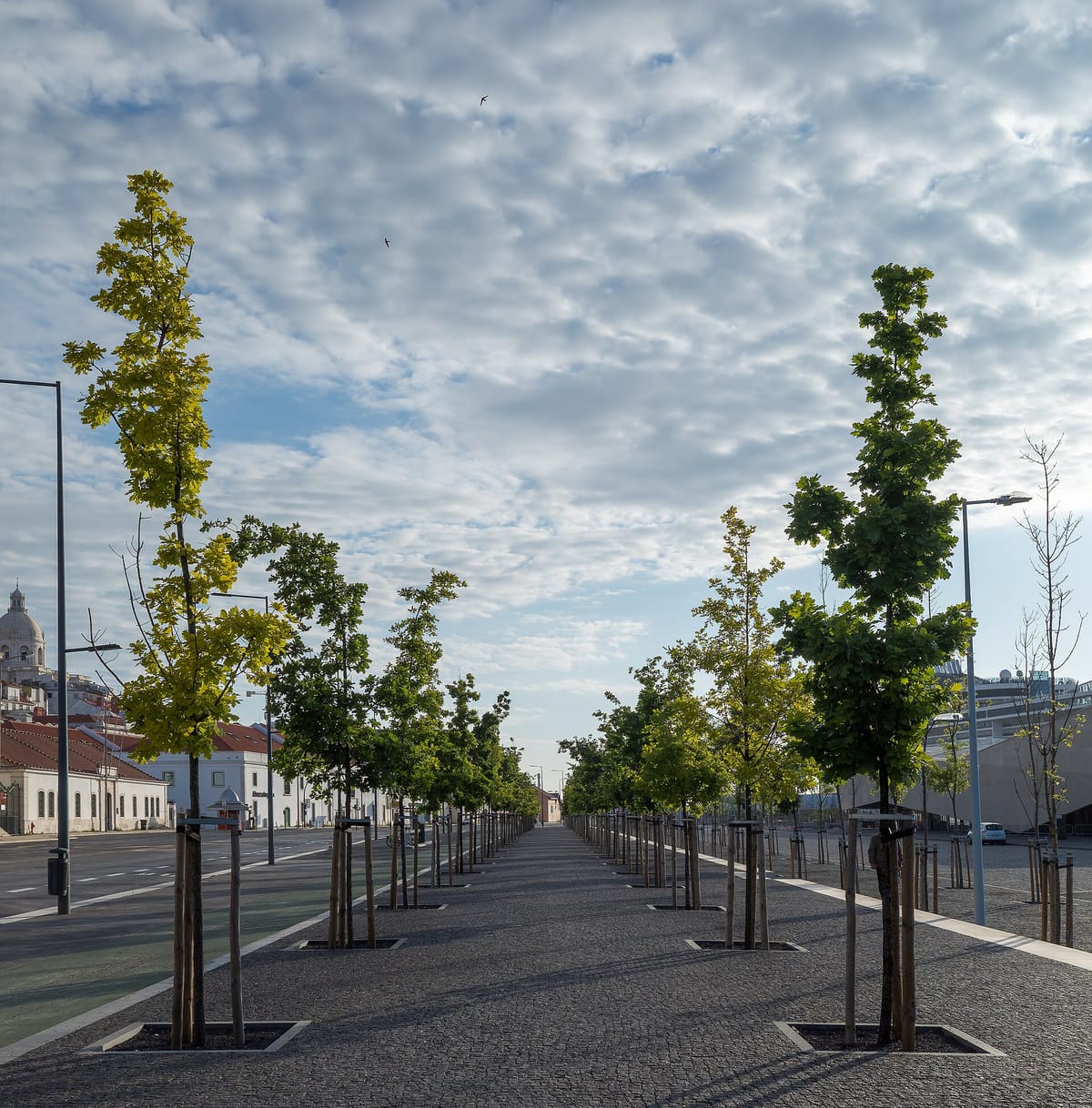
The scheme is really three projects stitched together. The existing 15E is extended from the Campo das Cebolas to Santa Apolónia. The Praça de Santa Apolónia is rebuilt and redesigned, a consequence of the works for the Plano Geral de Drenagem de Lisboa (the Lisbon General Drainage Plan). And the 16E proper runs north from Santa Apolónia along the Avenida Infante Dom Henrique to the Parque Tejo.
Rolling stock is 28 trams, each with a maximum capacity of 220 people: articulated five-module vehicles 28.5 metres long, of the same type Carris recently bought from the Spanish manufacturer CAF. A depot and workshop, the Parque de Material e Oficinas, is planned underneath the Vasco da Gama bridge, with fifteen stabling places.
Carris says the line would serve six freguesias: Santa Maria Maior, São Vicente, Penha de França, Beato, Marvila and Parque das Nações.
Five route options, and the one the study prefers
The Environmental Impact Study assesses a reference alignment plus four alternatives, and concludes that all five are viable from a technical and environmental point of view. The reference route was drawn from the alignment of the earlier LIOS Oriental (Linha Intermodal Sustentável, the Sustainable Intermodal Line) project, with a study area widened at the points where inserting a surface light metro into the urban landscape looked likely to create conflict.
The reference route begins at the Praça de Santa Apolónia, runs along the Alameda dos Oceanos, where each tram track would take over one of the existing traffic lanes, and ends at the Sacavém transport interchange in the neighbouring council of Loures. It alternates between single and double track along the way.
The four alternatives follow much the same line. One of them requires the prior demolition of the Avenida Marechal Gomes da Costa viaduct, together with changes to the new Jardim Ribeirinho where the old Linha da Matinha rail channel used to run. Another routes the line along the Avenida Dom João II, single track along the sides as far as the junction with the Avenida da Peregrinação, north of Moscavide, where it becomes double track.
The study names the reference alignment as the most advantageous option, on the basis that it strikes the best overall balance between maximising the benefits and reducing the scale of the negative effects.
The impacts the study concedes
The list APA presented on Monday is not short. Trees will have to be transplanted, and this applies to every one of the route options: the study identifies the Avenida Infante Dom Henrique, the Avenida Dom João II and the Alameda dos Oceanos, and classifies the effect as potentially significant but capable of being compensated or minimised at the later design stages. Parking places are lost in the Parque das Nações area. There is more noise and more vibration, dust during the works, and temporary changes to how people get around.
The promoters also acknowledged effects on the urban landscape from the lines, the stops and the catenary, and possible effects on mobility, on residents' wellbeing and on safety during construction.
Against that, the case put at the session was a projected reduction of roughly 4,800 vehicles a day and 124,000 tonnes of carbon dioxide, with the wider benefits of the line valued at 298 million euros in a report by the consultancy TIS, counting mobility improvements and positive environmental effects. Carris's own demand study forecasts 7.6 to 8.1 million passengers a year, of whom between 16 and 18 per cent would be new to public transport.
Two prices on the same website
The cost of the 16E is quoted differently depending on which page you read, and Carris has not reconciled the two figures.
The Environmental Impact Study puts the investment at 160 million euros, with European co-financing, and the front page of the operator's dedicated project site at 16e.carris.pt agrees: a forecast investment of 160 million euros, a figure it says includes the rolling stock. Click through to the project page on the same site, however, and the line is described as requiring 183 million euros of initial investment. Both pages give the same benefits estimate of 298 million euros.
The gap is 23 million euros, or about one seventh of the lower number. Neither page explains what accounts for it, and the difference is not trivial in a scheme that leans on European money.
The journey-time claims also depend on where you look, although these are less obviously in tension. The study promises fifteen minutes from the Praça do Comércio to the southern end of the Parque das Nações, and twenty-two minutes to its central area. The Carris project page frames it differently: 35 minutes from the city centre to the Parque Tejo, against 60 minutes today.
What this means for residents
- The deadline is real. Comments close on 30 September. The consultation is where the choice between the reference route and the four alternatives is formally contested; the later stages test compliance with whatever decision comes out of this one.
- You do not have to be Portuguese to file. The environmental impact regime gives the right of participation to the affected public, defined by reference to who holds rights or protected interests and who is affected or liable to be affected. Nationality is not a criterion.
- Parking is the live local issue. If you rent or own in the Parque das Nações, the loss of on-street places along the Alameda dos Oceanos is a concrete, measurable effect, and the kind of point a consultation response can put on the record.
- Construction, not operation, is the disruptive phase. Dust, noise, vibration and temporary access changes are all flagged in the study as construction impacts along a corridor that runs through dense residential streets.
- The line is not funded until it is funded. A 23 million euro discrepancy on the operator's own website is a reminder that the budget has not settled, and that European co-financing is part of the plan rather than a signed cheque.
Whatever the consultation produces, the project still has to clear an execution design and a Relatório de Conformidade Ambiental do Projeto de Execução, the report that checks the detailed design against the environmental decision. The 16E was announced in April 2025. Nothing about the schedule so far suggests trams before the end of the decade.