The Portuguese-Speaking Bloc Turns 30 Still Short of Its Potential, Portugal's Foreign Minister Says, as He Courts Guinea-Bissau's Return
As the Community of Portuguese Language Countries turns 30 on 17 July, Foreign Minister Paulo Rangel says its full potential is nowhere near exploited, presses for suspended founder Guinea-Bissau's return, and reports progress on the CPLP Mobility Agreement that shapes Lusophone migration to Portuga
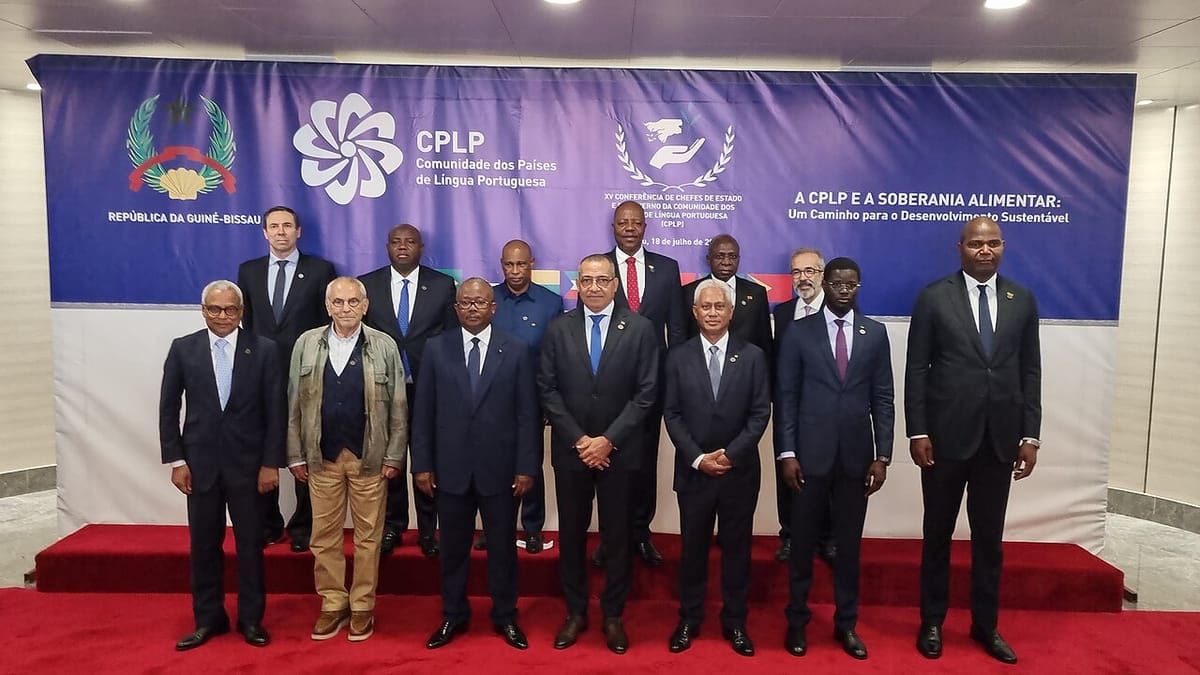
Thirty years after nine governments signed it into being in Lisbon on 17 July 1996, the Comunidade dos Países de Língua Portuguesa (Community of Portuguese Language Countries, or CPLP) reaches its anniversary this week with its own foreign ministers admitting the bloc is still punching far below its weight. In interviews to the Portuguese news agency Lusa marking the milestone, Portugal's Minister of Foreign Affairs, Paulo Rangel, said the community "has been an important instrument of foreign policy for all member states" but that "the full potential is nowhere near exploited. Together, we can do more."
The CPLP groups Angola, Brazil, Cape Verde, Guinea-Bissau, Equatorial Guinea, Mozambique, Portugal, São Tomé and Príncipe and Timor-Leste — a spread of four continents and, on current projections, some 600 million Portuguese speakers by the end of the century, a figure Rangel noted could make Portuguese the most widely spoken language in the Southern Hemisphere. The minister pointed to a steady rise in the number of observer states as "the principal proof of the community's growing importance when viewed from outside."
Two open questions: a suspended founder and a vacant presidency
The anniversary is shadowed by Guinea-Bissau, a founding member suspended after the military coup of 26 November 2025. Rangel was emphatic that the country belongs inside the bloc: Guinea-Bissau, he said, "is one of the elements of the DNA of the CPLP," part of its "genetic code," and there is not one of the remaining eight members that thinks otherwise. Bissau — also suspended by the African Union and the West African bloc ECOWAS (Economic Community of West African States) — has said any return will depend on the outcome of elections now scheduled for 6 December 2026.
The bloc's rotating presidency is also unresolved. Timor-Leste currently holds it on a caretaker (pro tempore) basis, and Rangel acknowledged that the succession "is something that, frankly, cannot be said to be defined," with talks continuing in search of the consensus the CPLP requires for any decision. There is, he stressed, "no immediate urgency," with the next heads-of-state summit not due until 2027.
Where the community has moved: mobility
The one area where Rangel reported clear progress is the CPLP Mobility Agreement (Acordo de Mobilidade), signed at the 2021 Luanda summit, which lets member states grant residence and travel rights to each other's nationals on lighter terms than the general regime. The minister said "much progress has been made, particularly with mobility within the organisation and the promotion of the language," alongside an emerging joint public-health degree first floated at the 2025 Bissau summit.
What this means for expats
- Lusophone residents are a large share of the community here. Brazilians are by far Portugal's biggest foreign community, and nationals of Angola, Cape Verde, Guinea-Bissau, Mozambique and São Tomé make up much of the rest. Anything that deepens the Mobility Agreement feeds directly into how those residents enter, stay and move.
- Mobility is a treaty, not a fast lane through the queue. The agreement smooths the legal basis for residence, but applications still run through the immigration agency AIMA, whose backlog remains the real bottleneck — as the recent reopening of online permit renewals underlined.
- Watch the December vote in Bissau. A return of Guinea-Bissau would restore full mobility ties for its citizens; continued suspension leaves them on the general track.
- Demographics are the backdrop. Portugal's foreign-born numbers have driven its rise past 11.4 million residents, and CPLP arrivals are a big part of that story.
The formal 30th-anniversary events fall on 17 July. For the roughly one in seven Portuguese residents who now hold a foreign passport, the more consequential milestones may be quieter ones: the next tranche of the Mobility Agreement, and whether Bissau is welcomed back to the table. This coverage sits alongside Portugal's parallel push to delay the EU's new biometric border checks.