The Government Opens a 110 Million Euro Credit Line for Grape Buyers, and Bars Anyone Who Imported Wine in the Last Three Harvests
Portaria n.º 433/2026/1 subsidises 75 percent of the interest on money borrowed to pay growers for the 2025 and 2026 crops. Applicants must not have bought wine from outside Portugal in three consecutive campaigns, and must promise not to.
The government has opened a 110 million euro subsidised credit line for the companies and cooperatives that turn grapes into wine, and has attached to it a condition that has nothing to do with creditworthiness: applicants must not have bought or released for consumption any wine from another EU member state or a third country across the last three harvests, and must undertake not to do so for as long as the credit line runs. Portaria n.º 433/2026/1, signed on 17 September by the finance and agriculture ministers and published in Monday's Diário da República (Official Gazette), took effect on Tuesday.
The instrument is called the Linha de Tesouraria Setor Vinícola II (Treasury Line, Wine Sector II), and it is the second of its kind. The first, created by Portaria n.º 221-A/2024/1 in September 2024, was meant to carry transformers through the bills left by the 2023 and 2024 harvests. Two years on, the diagnosis in the preamble has not improved: wine consumption is still slowing in both domestic and international markets, stocks held in storage are high, and the imbalance between what Portugal produces and what the market actually absorbs has persisted. The ministries single out cooperatives and other processors as the pressure point, because they are the bodies that take in the growers' crop and so decide whether the grower gets paid.
What the money is for
The line covers two things. The first is cash to pay members and suppliers for grapes bought in the 2025 and 2026 campaigns. The second is restructuring the debt still outstanding on loans taken under the 2024 line, limited to outstanding capital and expressly excluding accrued interest, default interest, commissions and any other charges. That restructuring portion may not exceed half of what an applicant borrows under the new line.
Individual amounts are capped by a formula rather than a flat figure. For the grape-payment portion, a borrower may not exceed the unpaid value of the 2025 campaign at the date of application, plus the annual value of its grape purchases taken from the best of the three most recent closed financial years, that second figure standing in for the estimated cost of buying the 2026 crop. The restructuring amount is added on top. If total demand across all applicants exceeds 110 million euros, every application is cut back proportionally.
A harder ceiling sits above all of that. The aid falls under the EU de minimis regulation, Regulation (EU) 2023/2831, which caps support at 300,000 euros per single undertaking over three years measured in gross grant equivalent. Where the arithmetic on an individual loan would produce more aid than that, the loan itself is reduced until it fits.
Three years, and the state paying three quarters of the interest
Loans run for a maximum of three years from signature and are repaid in equal annual capital instalments, with the first falling due no later than two years after the contract date. That leaves a borrower two harvests of breathing space before the first repayment. The money must be drawn within nine months of signature, in up to three drawdowns, the first coinciding with contracting. Interest accrues daily on outstanding capital and is paid annually in arrears.
The subsidy is where the two purposes diverge. The state pays 75 percent of the interest on the portion borrowed to pay growers and members for their grapes, and 50 percent on the portion used to settle or restructure the 2024-line debt. The percentage applies to the lender's nominal rate, unless the reference rate for calculating subsidies, created by Decreto-Lei n.º 359/89 and currently fixed by Portaria n.º 502/2003, is lower at the start of the interest period, in which case the lower rate governs. Loans are made by credit institutions that have signed a protocol with the Instituto de Financiamento da Agricultura e Pescas (Institute for the Financing of Agriculture and Fisheries, IFAP), which sets a maximum nominal rate in that protocol. There is no public guarantee to fall back on: the portaria expressly excludes activation of public guarantee mechanisms if the borrower defaults.
The import condition
Access is restricted to legal persons transforming grapes into wine on national territory, properly constituted and licensed for the activity, with tax and social security contributions up to date, and not in insolvency or meeting the criteria for creditors to place them there. Agricultural cooperatives need a current CASES certificate; producer organisations and groupings need a valid recognition title.
Then come the two conditions that make this portaria more than a financing instrument. Applicants must not have acquired or released for consumption wine originating in another member state or a third country during the 2023/2024, 2024/2025 and 2025/2026 wine campaigns. And beneficiaries commit not to acquire foreign wine while the credit line is in force. The state is offering cheap money on condition that the borrower stays inside the Portuguese supply chain, and it is reaching back three campaigns to check.
The paperwork reflects that. Applicants must submit corporate income tax returns and the Informação Empresarial Simplificada filings for the three most recent closed financial years, together with a certified accountant's declaration setting out the value of grapes bought and not paid for in the 2025 campaign, the value of grapes bought in each of those years, and the outstanding capital on any 2024-line loans. Beneficiaries must also tell IFAP about any other de minimis aid they have received. The application window, the analysis and decision timetable and the technical and financial rules are left to IFAP to set and publish on its portal, which means the deadline that matters is not in the portaria at all.
What this means for you
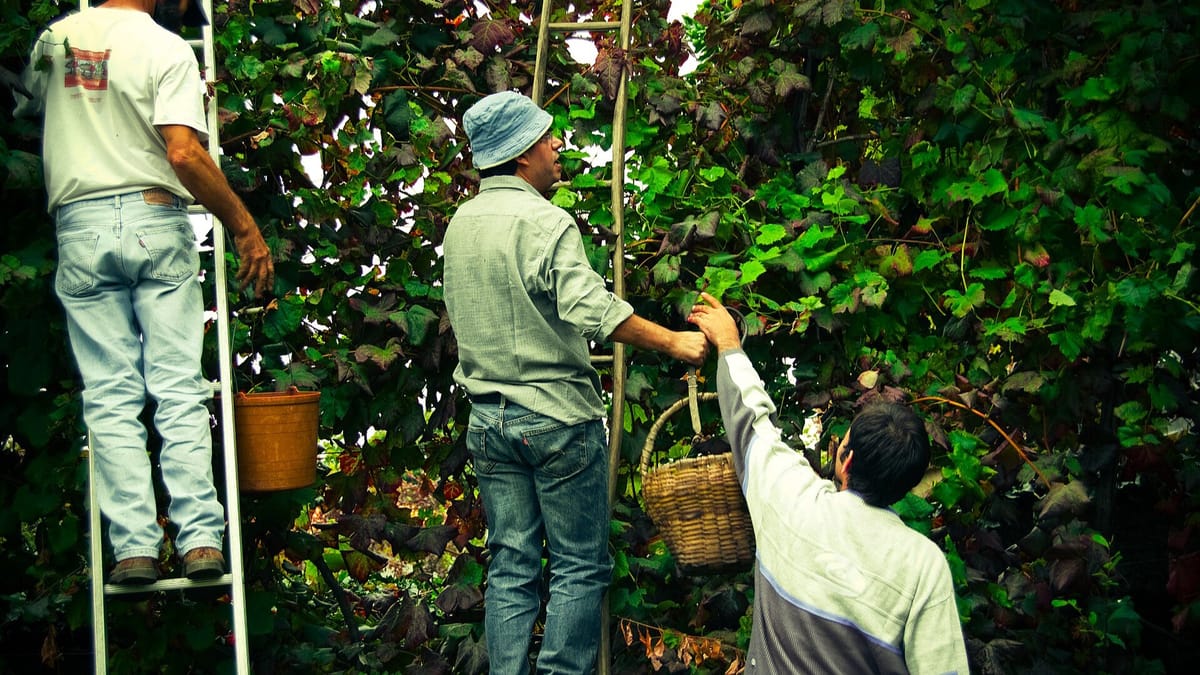
- Growers are the intended beneficiaries at one remove: the line lends to the transformer so the transformer can pay the grower. If you sold grapes into a cooperative in 2025 and are still waiting, this is the mechanism the government is pointing at.
- Watch IFAP, not the gazette: the portaria creates the line but sets no application dates. Those appear on the IFAP portal, along with the protocol banks and the maximum rate.
- The 300,000 euro cap binds before the formula does: for a larger cooperative, the de minimis ceiling, and any de minimis aid already taken in the last three years, will decide the loan size more often than the grape-purchase arithmetic will.
- No public guarantee means the bank carries the default risk: that will show in the credit assessment. The state is subsidising the rate, not underwriting the loan.
- The import restriction is a disqualifier, not a penalty: a single purchase of foreign wine in any of the three named campaigns puts an applicant outside the scheme entirely.
- Context on costs: the same squeeze is visible elsewhere in the sector, with fertiliser and fuel prices rising again as the next harvest is brought in.
Portugal's answer to a wine surplus has now twice been to lend the sector the money to keep buying grapes it may struggle to sell. What is new this time is the string attached. The 2024 line simply moved cash into cooperatives; the 2026 version buys something with it, and what it buys is a commitment that the wine competing with Portuguese growers will not be bought by the companies the state is financing.