Rights of Way over Land in Portugal
Researched and written with AI tools from official sources. How we make our guides
When a track across a neighbour's land is a legal right of way in Portugal, how a landlocked plot can force one, who pays, and how a right of way ends.
Last verified: October 2026.
Who this is for
- You are buying land or a house whose access crosses someone else's land.
- Your neighbour uses a track across your land, or has blocked one you use.
- Your plot has no proper access to a public road.
Not for you if: a public body wants to run a road, pipe, or power line across your land. Read Expropriation in Portugal instead.
A right of way (servidão de passagem) is a legal right for one plot to cross a neighbouring plot. It belongs to the land, not to a person, so it survives when either plot is sold. In Portugal it can be created by contract, by will, by long use of a visible track, or automatically when one owner's land is split.
If your plot has no adequate access to a public road, you can demand one over neighbouring rural land, for compensation. A right of way ends after 20 years without use, among other ways. The rules are in the Civil Code.
What a right of way is
The law calls it a land servitude (servidão predial): a burden on one plot for the benefit of another plot with a different owner. The burdened plot is the serving plot. The plot that benefits is the dominant plot.
Three things follow:
- It belongs to the land. If the serving plot is sold, the new owner takes it with the burden. If the dominant plot is sold, the buyer takes the benefit.
- The two plots must have different owners. You cannot hold a right of way over your own land.
- It can cover more than passage. The same rules cover water, drainage, and other uses of the neighbouring land.
You cannot sell a right of way separately from the land it serves. If the serving plot is later split between owners, each part stays subject to its share of the right of way. If the dominant plot is split, each new owner may use it as before.
A village shortcut is not a right of way
A path across private land that "everyone has always used" is not, for that reason, a right of way. It may be an old public shortcut (atravessadouro). The Civil Code abolished these, however old they are.
What survives is a path set up to serve specific plots. That is a right of way and follows the rules in this guide.
There is one narrow exception. A path used since time immemorial that leads to a bridge or a fountain of clear public use is still recognised, but only while no public road reaches it. If someone says a path is protected because it is old, they must show it fits this exception.
How a right of way is created
There are four voluntary ways, and two more for legal rights of way:
- Contract. A written agreement between the owners.
- Will. An owner leaves the right in their will.
- Long use (usucapião). Years of use of a visible track.
- Splitting one owner's land (destinação do pai de família). See below.
- Court decision or administrative decision, for legal rights of way such as a landlocked plot, where the owners do not agree.
Only contracts and wills leave a clean paper trail. Disputes usually involve long use or split land.
Long use: only visible tracks count
Long use can turn a track into a legal right. But the law excludes rights of way that are not visible, meaning not shown by visible and permanent signs on the ground.
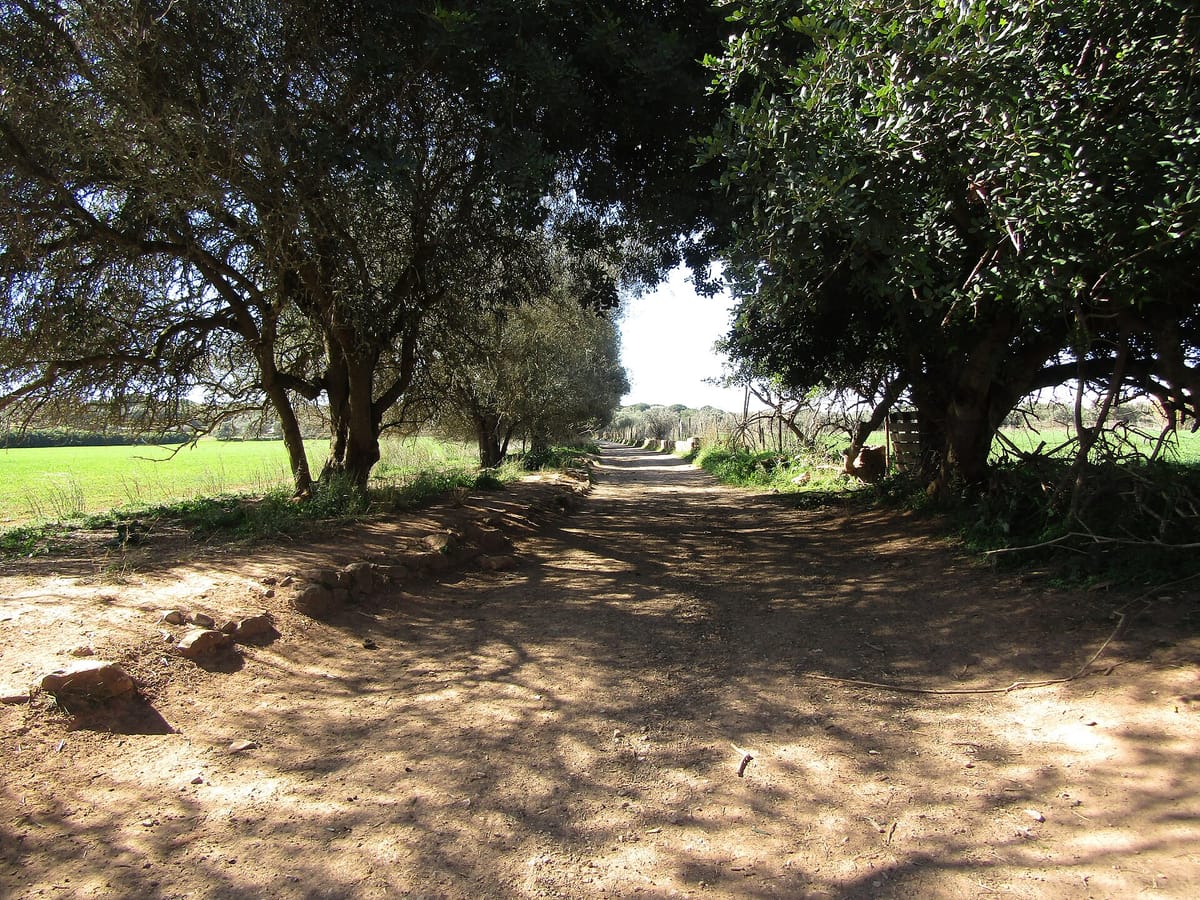
If nothing visible and permanent marks the route, no amount of use creates the right. Driving across a field for 40 years, leaving only tyre marks that ploughing erases, creates nothing. A made track, a gate, a culvert, a small bridge, a walled lane, or a permanent gap in a wall are the kind of signs that count.
If there are visible signs, the length of use needed depends on the paperwork:
| Situation | Good faith | Bad faith |
|---|---|---|
| Title of acquisition registered | 10 years from registration | 15 years from registration |
| Only possession registered, after a court justification | 5 years from registration | 10 years from registration |
| Nothing registered (the usual case for a rural track) | 15 years | 20 years |
If use began by force or in secret, the clock starts only when the force ends or the use becomes public.
Splitting one owner's land
This catches many buyers. Suppose one person owns two plots, or one plot later divided, and a visible, permanent track runs from one part to the other. While one person owns both, there is no right of way. But when the two parts pass to different owners, the track becomes a right of way automatically, with nothing in the deed.
This is how family land split between heirs, or a large plot sold in parcels, creates rights of way that appear in no contract. There is one way out: the right does not arise if the document that separated the plots said otherwise. If you are selling off part of your land and do not want a permanent right of way over what you keep, say so in that document.
A landlocked plot can force a right of way
If your plot has no access to a public road, and you cannot create one without excessive trouble or cost, you can demand a right of way over neighbouring rural plots. The same applies if your access exists but is not enough, whether it runs over your land or someone else's.
- The test is not impossibility. A route that exists in theory but would cost a fortune to build does not defeat your claim.
- It burdens rural land. Owners of walled estates, yards, gardens, or terraces next to urban buildings can avoid the burden. They do so by buying your landlocked plot at its fair value. If you cannot agree a price, a court sets it. If several such owners want to buy, they bid, and the extra goes to you.
- The route is not your choice. The passage must cross the plot or plots that suffer least harm, in the place and manner that cause the least trouble. It is not necessarily the shortest line.
What it costs
You pay compensation equal to the harm the neighbour suffers. It is not a share of the value to you.
If you caused your own plot to become landlocked without good reason, for example by selling off the strip with the access, you pay more. A court sets an increased amount, up to double the normal compensation, based on your fault.
The neighbour gets first refusal on your plot
The owner of land burdened by a legal right of way has first refusal if your landlocked plot is later sold. In plain terms, if you sell, your neighbour can buy at the price your buyer agreed. Anyone buying a landlocked plot served by a legal right of way needs to know this. See Right of First Refusal on Property in Portugal.
Passage to reach water
If you have no access to public fountains, wells, tanks, or watercourses for household needs, you can ask for a right of way to reach them on the same terms. But only if you cannot get enough water elsewhere without excessive trouble or cost.
How far the right goes, and who pays for the track
The deed or document that created the right of way decides its extent and use. The default rules below apply only where it is silent. A well-written deed is the best protection for both sides.
If the document is silent, the right includes everything needed to use and maintain it. In case of doubt, it covers the normal and foreseeable needs of the dominant plot, with the least harm to the serving plot.
On works and upkeep:
- The dominant owner may do works on the serving land, such as surfacing the track, if they do not make the burden heavier. They must do them at the time and in the way most convenient for the serving owner.
- The dominant owner pays, unless the owners agreed otherwise.
- If several plots benefit, their owners share the cost in proportion to their benefit. An owner can escape the cost only by giving up the right of way.
- If the serving owner also uses the track, they contribute on the same basis.
Your neighbour can move the route
The serving owner may not block the right of way. But they may, at any time, ask to move it to another place on their land, or onto other land, if it suits them and does not harm the dominant owner. They pay for the move. With a third party's consent, it can move onto that third party's land.
The dominant owner can ask for a move too, at their own cost, if it helps them and does not harm the serving owner. Either side can also ask to change how and when the right is used, on the same conditions.
These rights cannot be waived or limited by contract. A clause fixing the route forever has no effect. A right of way guarantees you access, not a particular strip of ground.
How a right of way ends
A right of way ends:
- When both plots come into the same ownership.
- After 20 years without use, whatever the reason.
- When the serving owner acquires freedom from it by long possession (see below).
- When the dominant owner gives it up. The serving owner does not need to accept.
- When its term ends, if it was created for a fixed time.
A court can also end two kinds of right of way, at the serving owner's request, once they are no longer needed by the dominant plot:
- Rights of way created by long use.
- Legal rights of way, such as one forced for a landlocked plot. Any compensation paid may have to be returned, in whole or in part.
So a forced right of way is not permanent. If the landlocked plot later gains its own access, for example a new council road, the neighbour can ask a court to end it.
What counts as non-use
- The 20 years run from when the right of way stopped being used.
- If the dominant plot has several owners, use by one keeps the right alive for all.
- If the right of way cannot be used, for example because a bridge collapsed, it still lasts until the 20 years have passed.
- Using only part of the right of way counts as using all of it.
- Using it at a different season from the one in the deed does not stop the 20-year clock, although long use may create a new right.
The serving owner can gain freedom from a right of way by long possession only if they actively opposed its use, for example by putting up a gate and refusing access. The clock starts only from that opposition.
What to check before you buy
- Get the land registry certificate for your plot and for the land your access crosses. Registered rights of way appear on the register, and only the burdened plot's record shows rights over it. See Getting a Certidão Permanente (Land Registry Certificate) in Portugal.
- Assume the register is incomplete. Registration of a right of way is compulsory, but rights created by long use or by splitting land exist even if nobody registered them.
- Walk the access and photograph the visible signs. A made track, gate, culvert, or walled lane matters more than any spoken assurance.
- Check the history. If your plot and the neighbouring one were once a single holding, a right of way may have arisen when they were split. Look at what the separation document said.
- Check the boundaries. Many rural boundaries are not mapped, which makes it hard to say whose land a track is on. See Registering Rural Land on BUPi in Portugal.
- Make access a condition of the promissory contract. After the deed, your leverage is gone. See Signing a Promissory Contract (CPCV) in Portugal.
- If the plot is landlocked, remember your neighbour's first refusal on any future sale.
If you are already in a dispute
Work through these questions in order. They settle most arguments quickly.
- Is there anything visible and permanent on the ground? If not, a claim based on long use cannot succeed.
- Were the two plots ever one holding? If so, a right of way may have arisen when they were split. What did the separation document say?
- Is the plot really landlocked? The test is whether access can be created without excessive trouble or cost. Insufficient access also counts.
- How long has it really gone unused? It takes 20 years. A blocked route still counts toward them, and partial use counts as full use.
- Is the right of way still needed? A serving owner can ask a court to end one created by long use, or a legal one, once it is unnecessary.
- Would moving it solve the problem? The serving owner can move the route at their own cost if it does not harm the other side. In a dispute about a track past someone's front door, this is often the answer both sides can live with.
Access disputes turn on the facts on the ground and the documents behind two specific plots. An early hour with a lawyer or solicitador is worth more than the same hour after a gate goes up.
This guide is general information, not legal advice. Rules change; check the official source before you act.
Sources
This guide is written from official sources and, where relevant, organisations' own websites.
- Procuradoria-Geral Regional de Lisboa, Código Civil (Decreto-Lei n.º 47344/66), consolidated: https://www.pgdlisboa.pt/leis/lei_mostra_articulado.php?nid=775&tabela=leis (articles 1293 to 1297 long possession periods and exclusion of non-visible servitudes; 1383 and 1384 abolition of public shortcuts and the bridge or fountain exception; 1543 to 1547 definition, content, inseparability, indivisibility, ways of creation; 1548 visible and permanent signs; 1549 splitting one owner's land; 1550 to 1556 landlocked plots, rural land, buy-out by walled estate owners, aggravated compensation up to double, least harm, compensation for harm, neighbour's first refusal, passage to water; 1564 to 1567 extent, works, and costs; 1568 moving the route, not waivable; 1569 to 1574 extinction, 20 years, court extinction of unnecessary servitudes, non-use rules, freedom by long possession after opposition), checked 2 October 2026
- BUPi, frequently asked questions: https://bupi.gov.pt/pt/perguntas-frequentes (registration at the land registry is compulsory when a servitude is created over land), checked 2 October 2026
Last verified October 2026. Rules and fees change; check the official source before acting.