Getting a criminal record certificate in Portugal
How to get a Portuguese criminal record certificate online or at a counter, what it costs, how long it lasts, and how to use it abroad.

Last verified: September 2026.
Who this is for
- Anyone living in Portugal, of any nationality, who has been asked for a Portuguese criminal record certificate.
- Portuguese citizens and former residents abroad who need a certificate from Portugal.
- Foreign residents who need a certificate from their home country for a Portuguese file.
Not for you if: you need a certificate for a company or other legal entity. Companies request theirs through the same portal via a legal representative; this guide covers individuals only. "Starting a company in Portugal" explains the company-side paperwork.
Updated September 2026. AIMA and the civil registry now check your Portuguese record directly, so residence permit, nationality, and name change applications no longer need the certificate. The EU multilingual model can now be downloaded from the online portal.
A criminal record certificate (certificado do registo criminal) is the official statement of what, if anything, is on your Portuguese criminal record. Employers, professional bodies, schools, landlords, and foreign immigration authorities ask for it. It costs €5, online or at a counter. Online, it is usually issued within minutes of payment. At a counter, you normally leave with it the same day. It is valid for 90 days. The Directorate-General for the Administration of Justice (DGAJ) issues it, not the registry office (IRN).
Do you actually need one?
Check before you pay. Two of the most common reasons for requesting the certificate no longer apply.
- Foreign residents applying for or renewing a residence permit do not need to request it. You authorise AIMA to read your Portuguese record when you make the application.
- Nationality and name change applicants do not need to hand it to the civil registry (Conservatória). The registry reads the record itself.
You still need a certificate when a private body or a foreign authority asks for it. Typical cases:
- A job offer, especially in teaching, healthcare, security, finance, transport, or any regulated profession.
- Any paid or voluntary role with regular contact with children.
- Admission to a professional body (Ordem).
- Firearms and hunting licences, adoption files, and some tenders.
- A visa, residency, or citizenship file in another country.
- A landlord who asks for it. This is not a legal requirement, but some do.
The record covers people aged 16 and over. A certificate cannot be issued for anyone under 16.
Which version to ask for
When you request the certificate you state a purpose (finalidade). The purpose is printed on the certificate, and it determines what the certificate shows. There is no universal version, so ask the body that wants it which purpose to choose.
- General purposes: the standard certificate for most jobs, tenancies, and administrative files. It shows only convictions that the law still allows to be shown.
- Work with regular contact with minors: a stricter version required by law for teachers, coaches, childcare staff, and volunteers with children. It reveals certain sexual offence convictions that a general certificate leaves out. Schools and clubs must ask for this version, and a general certificate will not do.
- Other specific purposes: adoption, firearms, public office, and similar cases each have their own option in the list.
Choosing the wrong purpose means requesting again and paying again.
How to request it online
The portal is registocriminal.justica.gov.pt. It works from anywhere in the world, and it is the cheapest and fastest route. You need a way to prove your identity electronically:
- Portuguese citizens: a Citizen Card (Cartão de Cidadão) with a card reader and PIN, or the Digital Mobile Key (Chave Móvel Digital).
- EU and Liechtenstein citizens: your national electronic ID through eIDAS, if your country has joined the scheme.
- Everyone else: a Digital Mobile Key linked to your passport or residence permit.
The name on your Digital Mobile Key must match your identity document exactly, or the portal will not release the certificate. If your Citizen Card has expired or is being renewed, the online request is refused. Go to a counter instead with proof of renewal.
Then follow these steps:
- Log in to the reserved area (Área Reservada) and choose "Pedir um novo certificado".
- Confirm your identity details and pick the purpose.
- Pay €5 by Multibanco reference, MB WAY, credit card, or PayPal. Bank transfer is not accepted.
- Wait for the payment to clear. The certificate then appears under "Os Meus Pedidos". It is not emailed.
- Download the PDF. It is bilingual, Portuguese and English, electronically signed, and carries an access code (código de acesso).
Give the access code to whoever needs the certificate. They enter it at "Consultar Certificado" on the same portal and get a live, updated version. A printout or forwarded PDF is normally accepted for the same reason. You can also cancel the code from your account if you no longer want it used.
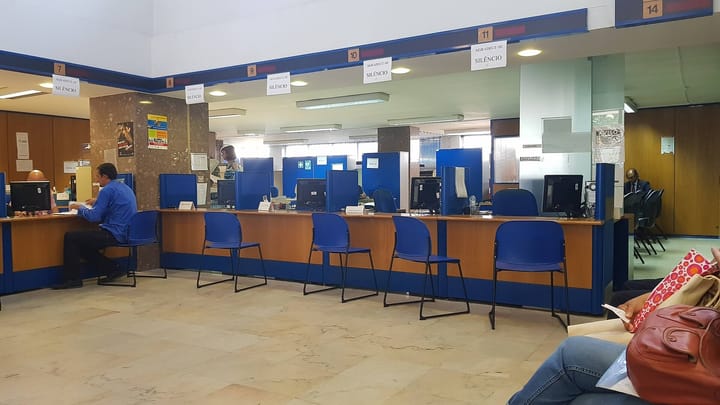
How to request it at a counter
Anyone of any nationality can request in person. Booking is strongly advised at all locations. Bring a valid identity document: Citizen Card, passport, or residence permit. The request is verbal, with no form to fill in. You confirm your name, place and date of birth, parents' names, and nationality, sign a receipt, and pay €5.
Where to go:
- Criminal identification desks (Balcões dos Serviços de Identificação Criminal), in three places. Book at agendamento.dgaj.justica.gov.pt or by telephone.
- Lisbon, Campus de Justiça, Parque das Nações, Av. D. João II 1.08.01. Weekdays 9:00 to 17:00. Tel. 217 906 569.
- Lisbon, Loja do Cidadão das Laranjeiras, Rua Abranches Ferrão 10. Weekdays 8:30 to 19:30, Saturdays 9:30 to 15:00. Tel. 217 231 448.
- Porto, Loja do Cidadão, Av. Fernão de Magalhães 1862. Same hours as Laranjeiras. Tel. 225 571 838.
- Courts. The central unit or proximity unit of any district court registry (Tribunal de Comarca). Weekdays 9:00 to 12:30 and 13:30 to 16:00. Book on the same platform.
- Espaços Cidadão. Only some offer this service, so check first by calling 300 003 990. Individuals only.
- Azores. RIAC citizen shops (Rede Integrada de Apoio ao Cidadão).
How to request it by telephone
Call 300 003 990 or +351 210 489 010 on weekdays between 9:00 and 18:00. You need an active Digital Mobile Key and the autenticação.gov app on a phone with fingerprint or face recognition. The operator confirms your identity through the app, and the certificate is sent to the email address you give.
Who can request it for someone else
- Another adult can request yours, in person only. They bring a signed authorisation from you, their own identity document, and your identity document or a certified copy. On the copy you write and sign: "autorizo esta cópia exclusivamente para a emissão do meu certificado de registo criminal". The DGAJ publishes an authorisation form on its site.
- Young people aged 16 to 18. A parent requests in person, with proof of parenthood and both identity documents. Online and telephone requests are not available for minors.
- People under guardianship. The guardian requests in person with proof of the appointment.
- Children under 16. No certificate exists. Foreign visa rules recognise this and exempt under-16s from the criminal record requirement.
What it costs
The fee is €5 per certificate, paid when you make the request, at every channel. There is no higher counter fee. The EU multilingual model is generated from the same request, and the portal lists no separate fee for it.
The certificate is free only for four purposes: candidacy for President of the Republic, the award of military or commemorative medals, equal rights status, and effective service in the Armed Forces.
The portal's request detail plus your payment proof serves as the receipt. No invoice is issued, because the fee is not subject to VAT.
How long it takes
- Online: issued as soon as the payment is recorded, which usually means minutes, but can take longer if your bank is slow to confirm. If the system cannot match your identity automatically, it takes up to three working days.
- Criminal identification desks and courts: on the spot with a valid Citizen Card, passport, or residence permit. Up to three working days if there is a technical problem or if a court has to check a foreign document.
- Espaços Cidadão and RIAC: on the spot with a Citizen Card. With a passport or residence permit, up to three working days, and the certificate is emailed or posted to you.
- Residents abroad using the paper form: ten working days after the DGAJ receives all documents and confirms payment, plus postage.
How long it is valid
The access code is valid for 90 days from the date of issue, and the expiry date is printed on the certificate. Government pages describe this as three months. After that the code stops working and the receiving body will ask for a new one.
Two practical consequences:
- Request the certificate late in a slow application, not early. A certificate ordered when you start gathering documents may have expired by the time you submit.
- During the 90 days you can pull an updated version at any time by entering the access code at "Consultar Certificado". You do not need to pay again.
If you live outside Portugal
You have four options.
- Online, with any of the identity methods listed above. The portal works from any country, and you can pay by card or PayPal.
- By telephone, on +351 210 489 010, if you have a Digital Mobile Key and the app. Portuguese citizens abroad can activate a Digital Mobile Key at a consulate.
- Through someone in Portugal, using the authorisation route described above.
- The DGAJ form for residents abroad (requerimento para residentes no estrangeiro). You fill it in online, download it, sign it to match your identity document or with a qualified electronic signature, and send it with the documents and payment it asks for. Filling instructions are published in Portuguese and English. Bank transfer is not accepted. Do not use this form if you live in Portugal: the request is refused and the fee is not refunded.
Using the certificate abroad
The standard certificate is already bilingual in Portuguese and English, which satisfies many employers abroad. What else you need depends on where the certificate is going.
Inside the EU. Portuguese citizens with a clean record can download the EU multilingual model (Certificado Modelo Europeu). Open the certificate under "Os Meus Pedidos", scroll to the National and European formats, pick the destination language, and download. It shares the 90-day validity of the Portuguese certificate and must always be presented with it. EU authorities must accept it without translation or apostille. If the portal does not offer it, email [email protected] and state the language you need.
Outside the EU, in a Hague Convention country (the UK, the USA, Canada, Australia, Brazil, and most others). You need an apostille from the Attorney General's Office (Procuradoria-Geral da República, PGR). Because the certificate is electronic, request an electronic apostille at apostila.ministeriopublico.pt. The fee is €10.20 per apostille. In-person service in Lisbon is by appointment only, through the e-APP application.
The apostille certifies the Portuguese signature; it does not translate the document. Ask the receiving authority whether the English text on the certificate is enough or whether they want a certified translation.
Outside the Hague Convention. The certificate must be legalised instead: first by the Portuguese Ministry of Foreign Affairs, then by the destination country's consulate in Portugal. Budget several weeks.
If you need a certificate from your home country
A Portuguese certificate only shows what Portugal holds, plus convictions other countries have notified to Portugal. Foreign residents are therefore often asked for a certificate from their country of origin as well.
Who asks for it. Portuguese consulates require it for every residence visa application: a certificate from your country of origin, or from any country where you have lived for more than a year, apostilled or legalised. AIMA may ask for it in first residence permit applications that do not start with a visa, and it is a standard document in citizenship files. Under-16s are exempt.
How it must be authenticated. The rule is set by where the certificate was issued:
- Issued in an EU member state: no apostille and no legalisation. EU public documents are exempt under the EU regulation on public documents, and AIMA applies this. Ask the issuing authority for the multilingual standard form, which also removes the need for translation.
- Issued in a Hague Convention country outside the EU: an apostille from that country's competent authority.
- Issued anywhere else: legalisation by a Portuguese consulate in that country.
- AIMA lists a few exceptions, for example Cabo Verde's electronic certificate and certificates issued by the Ukrainian Embassy, which need no authentication.
Translation. Documents in English, French, or Spanish are accepted by AIMA without translation. Anything else needs a certified Portuguese translation. In Portugal a translation can be certified by a notary, a registry official, a lawyer or solicitor, a chamber of commerce, or a translator recognised by one of these. Portuguese consulates can also certify translations.
Timing. Authorities expect a recent certificate. Ask the consulate or AIMA how recent before you order it. The foreign certificate is often the slowest part of the file, so start it first and order the Portuguese one last.
Why an old conviction may not appear
Portugal does not treat a record as permanent. Convictions stop appearing on the certificate after set periods that depend on the sentence, once it has been served. That is why a minor conviction from years ago may not appear on a general certificate. The version for work with minors follows stricter rules and may show sexual offences against children for longer. If you are unsure what yours will show, order one for your own information first.
Common mistakes
- Requesting a certificate for AIMA or a nationality file that no longer needs one.
- Ordering too early, so the 90 days run out before the file is submitted.
- Choosing the general purpose when the employer needs the version for work with minors.
- A Digital Mobile Key registered under a slightly different name from the identity document.
- Trying to request a minor's certificate online. It must be done in person by a parent.
- Sending the residents-abroad form from an address in Portugal. The fee is lost.
- Skipping the apostille for a non-EU country, or assuming the apostille replaces a translation.
- Paying for an apostille on an EU-issued certificate that does not need one.
Sources
- DGAJ, Pedir e consultar registo criminal de pessoas singulares: https://dgaj.justica.gov.pt/Registo-criminal/Pedir-e-consultar-registo-criminal-de-pessoas-singulares (who can request, channels, counters, fee, free cases, turnaround, residents abroad, authorisation of a third person, AIMA and Conservatória no longer need the certificate)
- DGAJ, Criminal record certificate (English): https://dgaj.justica.gov.pt/Registo-criminal/Criminal-record-certificate (turnaround by channel and identity document, minors, third-party requests)
- Registo Criminal Online, portal and FAQ: https://registocriminal.justica.gov.pt/ and https://registocriminal.justica.gov.pt/Home/FAQ (login methods including eIDAS and Digital Mobile Key for foreign documents, payment methods, bilingual certificate, access code, 90-day validity, EU multilingual model, counter addresses and hours, telephone route, PGR apostille referral; updated 10 September 2026)
- gov.pt, Pedir o Registo Criminal de pessoas: https://www.gov.pt/servicos/pedir-o-certificado-de-registo-criminal-de-pessoas-singulares (three-month validity, age 16 rule, legislation list, AIMA and nationality note)
- Procuradoria-Geral da República, Serviço de Apostilas FAQ: https://www.ministeriopublico.pt/perguntas-frequentes/servico-apostilas (electronic apostille at apostila.ministeriopublico.pt, fee of €10.20 under Decreto-Lei n.º 86/2009, appointment via e-APP)
- AIMA, Reconhecimento de documentos: https://aima.gov.pt/pt/temas-transversais/reconhecimento-de-documentos (apostille, consular legalisation, EU exemption, translation rules, exceptions)
- Ministério dos Negócios Estrangeiros, Vistos Nacionais, documentação instrutória, Residência: https://vistos.mne.gov.pt/pt/vistos-nacionais/documentacao-instrutoria/residencia (home-country certificate with apostille or legalisation, under-16 exemption)
- Lei n.º 37/2015, de 5 de maio (Lei da Identificação Criminal) and Decreto-Lei n.º 171/2015, de 25 de agosto (content of certificates, purposes, removal of convictions)
- Lei n.º 113/2009, de 17 de setembro (certificate for functions involving regular contact with minors)
- Regulation (EU) 2016/1191 of 6 July 2016 (exemption of EU public documents from apostille, multilingual standard forms, Annex XI absence of criminal record)
Last verified September 2026. Rules and fees change; check the official source before acting.