Owning a Firearm in Portugal
Researched and written with AI tools from official sources. How we make our guides
How firearm licensing works in Portugal: the PSP licence classes, the medical, course, and exam, the safe rule, limits, renewals, and inherited guns.
Last verified: October 2026.
Who this is for
- You live in Portugal and want to know how the law licenses firearms for hunting, sport, or defence.
- You have inherited a gun, or found one among a relative's belongings, and need to know what to do.
- You already hold a licence and want to check the rules on storage, transport, and renewal.
Not for you if: you want to know what force you may use to defend yourself, or whether you may carry pepper spray. Read Self-Defence Law in Portugal instead.
In Portugal you need a licence from the PSP (Polícia de Segurança Pública, the public security police) before you may own or carry a firearm. To get one you must be over 18, have full civil rights, show a real need, be of good character, and pass a medical. For most firearm licences you must also pass a training course and a PSP exam. You need an approved safe at home before the PSP will let you buy a gun. Licences last five years and are never for life. If you inherit a gun, you must tell the PSP within 90 days.
Who grants licences
The national director of the PSP grants every firearm licence and every purchase authorisation. You apply to the PSP, online or in person. The PSP's online service portal (SEROnline) lists the licences and authorisations you can request.
Weapon classes and licence types
The law sorts weapons into classes by how dangerous they are and what they are for. It then sets licence types that match those classes. The two lists are related but not the same.
Weapon classes, in plain terms:
- Class A: prohibited weapons, such as automatic firearms and military weapons.
- Classes B and B1: handguns. B1 is a short list of small-calibre pistols and revolvers.
- Classes C and D: long guns, broadly rifles (C) and smoothbore shotguns (D), mainly used for hunting.
- Class E: approved defence sprays, electric stun devices up to 200,000 volts with a safety catch, and certain non-lethal guns.
- Class F: martial arts weapons and replicas for collecting, film, or historical re-enactment.
- Class G: veterinary and signal guns, starter pistols, line throwers, and freely sold air guns.
Licence types:
| Licence | Lets you use and carry |
|---|---|
| B | Classes B, B1, C, D, E, and F |
| B1 | Classes B1 and E |
| C | Classes C, D, and E |
| D | Classes D and E |
| E | Class E |
| F | Class F |
| Special licence | Classes B, B1, C, D, E, and F |
A higher licence covers the lower classes listed with it. Holders of a C or D licence may use firearm replicas when hunting. Holders of a B, B1, or D licence who also hold a sports federation licence do not need a separate sport licence for that class.
Licence B is not open to ordinary applicants
Licence B is not a "top" licence you work up to. It is granted only to someone who proves they held the right to carry a class B weapon for at least four years through their work. In practice, it is for people such as police officers and judges who carried a handgun on duty and want to keep doing so after leaving.
Licence B is refused if that right ended through disciplinary dismissal, compulsory retirement, or retirement because of an incapacity that rules out carrying a weapon. It is also refused after a conviction for any crime against persons in the Penal Code. The PSP must issue licence B within 90 days at most.
For an ordinary resident who wants a handgun, the licence to look at is B1.
Who can get a licence
For licences B1, C, D, E, and F, you must meet all of these conditions:
- Be over 18.
- Have full civil rights.
- Show that you need the licence. The test depends on the licence: - B1: you need it for work, or for personal defence or defence of property. - C or D: you need it to hunt and hold a hunting licence (carta de caçador), or you show a justified work need. - E: you justify why you need it. - F: you are a registered martial arts athlete, you practise on private property, you collect replicas, or you take part in historical re-enactment.
- Be of good character (idóneo). A security measure, or a conviction for an intentional violent crime with a prison sentence of more than one year, can count against you. The PSP can also weigh other well-founded reasons.
- Hold a medical certificate.
- Pass the training course and exam. This applies to B1, C, and D only. Licences E and F need no course.
If a past conviction counts against you, you can ask the court that last convicted you to recognise that you are of good character. You can do this while the conviction is still on your criminal record. The judge must hear you and the public prosecutor. Asking the court does not pause the PSP's handling of your application.
The medical certificate
A doctor examines your physical and mental fitness. The certificate says whether you are fit, or fit with restrictions, to hold and carry a weapon. It also confirms you have no clinical history suggesting you could harm yourself or others. Any restriction must be written on the certificate.
You submit the certificate with your licence application. From age 70, you must present a new medical certificate every two years. The law says the certificate is issued electronically.
The training course and exam
Training courses for classes B1, C, and D are run by bodies recognised by the interior and agriculture ministries. Where no recognised body can run a course in a district, the PSP runs it.
You need the PSP's authorisation before you can join a course. The PSP first checks that you meet the conditions for the licence. Once you are admitted, your licence application is open, subject to passing the exam.
What gov.pt says to bring when you apply for the course:
- the PSP application form for the course;
- proof that you have full civil rights;
- a medical certificate of physical and psychological fitness;
- a criminal record certificate;
- proof of address, such as a residence certificate from your parish council (junta de freguesia), a utility bill, or a tax document;
- two passport-type photos.
gov.pt says a course application takes about 90 days.
After the course, you sit an aptitude exam at a date and place the PSP sets. It has a theory test and a practical test. Your course certificate names the weapon class and is valid for five years. You can sit the exam at any time in that period.
Hunters can use a single procedure that gives both the hunting licence and the firearm licence for hunting. Recognised hunting organisations run the training. The exam is set only by the PSP and the ICNF (Instituto da Conservação da Natureza e das Florestas, the nature and forests institute). For where and when you may hunt, see Hunting Season in Portugal.
Refresher courses. B1 holders must take a refresher course every five years. C and D holders must take one every 10 years. Federated sport shooters, and hunters who show they hunt regularly, are exempt.
You need a safe before you can buy a gun
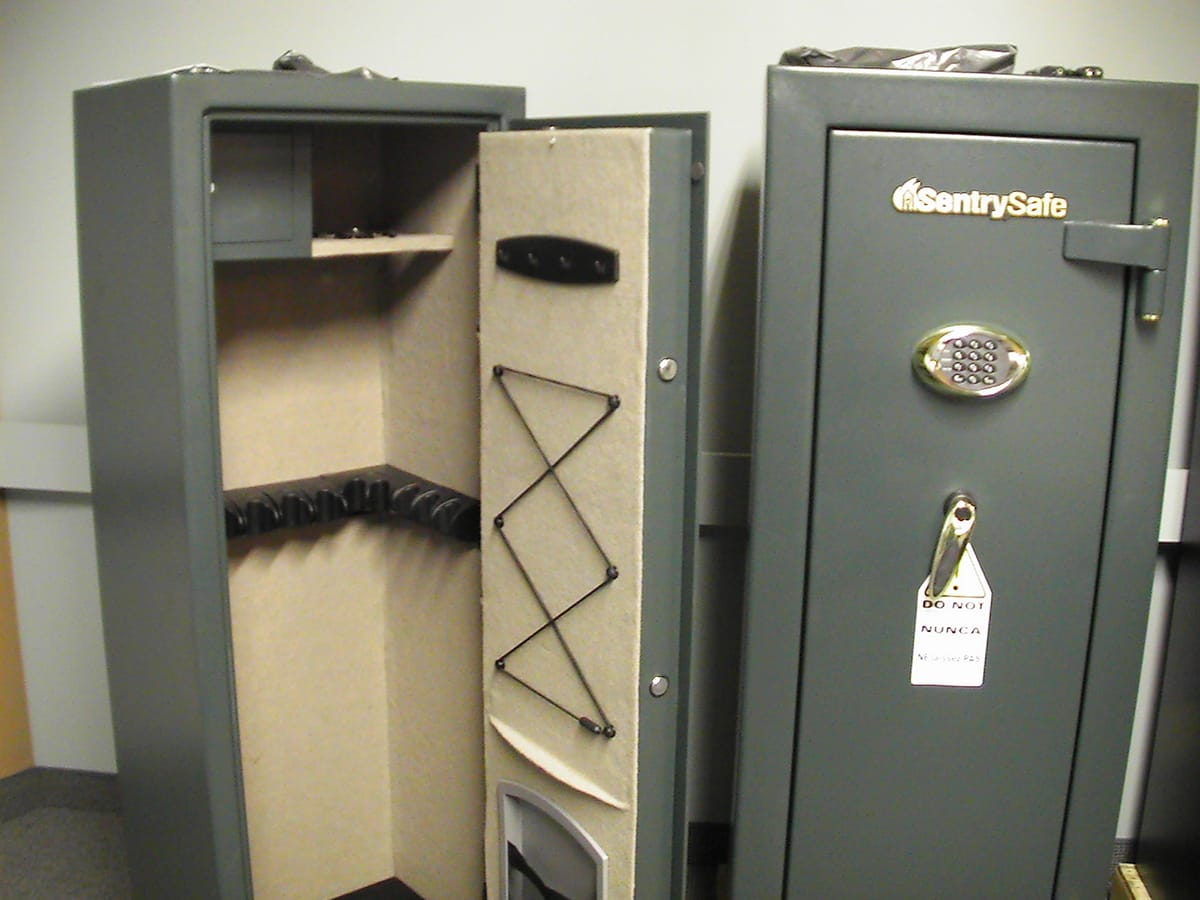
Every firearm owner must keep their guns in a fixed (non-portable) safe or security cabinet, at minimum to European standard EN 14450 S1 or equivalent. You prove this with the invoice. If you have no invoice, you sign a sworn statement with photos of the safe and how it is installed. A strongroom can replace the safe.
Getting a purchase authorisation
To buy a class B, B1, or C weapon, you need a purchase authorisation (autorização de aquisição) from the PSP. A class D weapon is acquired by a declaration of sale, gift, or inheritance, without that prior authorisation. You still need the right licence.
The purchase application must include:
- your full identification;
- your licence number and type;
- the make, model, type, and calibre of the weapon;
- a sworn statement that you have a fixed safe, security cabinet, or strongroom at home, and whether any children live with you;
- your consent for the PSP to inspect your storage, after notice.
The PSP always takes into account whether children live in the home. It can make the authorisation depend on changes to your storage. The authorisation is valid for 60 days.
Storage at home
When you are not physically with your firearm, it must be in the safe. Where no safe is required, you must do one of three things. Remove a part needed to fire it and keep that part separately, fit a lock that stops it being used, or fix it to a wall.
How many guns you may hold
| Licence | Maximum firearms |
|---|---|
| B | 4 in total, class B, B1, or both |
| B1 | 2 of that class |
| C or D | 25 in total, class C, D, or both |
Insurance
Firearm owners are liable for harm their weapons cause to others, even without fault. You must hold civil liability insurance. If your hunting or sport insurance already covers this risk, you do not need a separate policy. One policy can cover all your guns. You must be able to show proof of valid insurance whenever the police check.
Carrying and transporting
The law treats carrying and transporting differently.
Carrying a handgun. It must be in a holster or case made for it, with the safety on and no round in the chamber (revolvers excepted). It may be within your reach.
Transporting any firearm. It must be in a suitable bag or case, separate from the ammunition. It must also have a trigger lock, be taken apart so it cannot easily be used, or be missing a part needed to fire it, carried separately.
Batons, electric weapons, and sprays must also be carried in a suitable case. You need authorisation from the competent authority to carry weapons in airport security zones or on a plane.
Alcohol and drugs. You may not hold, use, or carry a weapon under the influence of alcohol or drugs. The limit is a blood alcohol level of 0.50 g/l or more. A police officer can order you to take a test. Refusing is a crime.
Five years, and never for life
The law says no licence is granted for life.
- Licences B, B1, C, D, E, F, and the special licence last five years.
- A licence to keep a weapon at home only lasts 10 years.
Renewal. Apply before your licence expires. You must still meet the conditions for the original licence. Where a refresher course is required, it replaces the original course. The PSP must warn you in the 90 days before your licence expires. Missing the renewal deadline is an offence.
If you hold more than one licence, you can renew them all at once. You line up the expiry dates, hand in the documents once, and pay only the highest renewal fee.
When you get a new licence document, you must hand the old one to the PSP within 30 days.
If you inherit a firearm
You must declare the weapon to the PSP within 90 days of the owner's death, or of finding the weapon.
What happens next:
- The PSP national director can register the gun in the name of the person managing the estate (cabeça de casal) until it is divided. In that case, the gun must be deposited with the PSP.
- If the estate manager or another heir meets the legal conditions, they can ask for the gun to be registered in their name and keep it.
- The estate manager can ask for the gun to be transferred to someone who meets the conditions.
- When the estate is divided, the gun goes to the heir who receives it, if that heir qualifies.
- If no one claims it within 10 years, it passes to the State.
Depositing with a dealer. Any owner, licensed or not, can deposit firearms with a licensed type 2 dealer (armeiro tipo 2). The gun can later be collected by the owner or heir once licensed. It can also be released once the PSP authorises a transfer, export, deactivation, donation to a museum, or surrender to the State. For a family that has inherited a gun nobody wants to license, this is often the simplest lawful option. For the rest of the estate, see Making a Will and Handling an Inheritance in Portugal.
What it costs
The PSP charges fees for the course authorisation, the course certificate, the licence, each purchase authorisation, and renewals. The fees are updated each year, and the PSP publishes the current table. Check it before you apply.
On top of PSP fees, you pay private providers for the medical certificate, the training course, the safe, and the insurance.
Penalties
Holding or carrying a weapon without authorisation, or outside the legal conditions, is a crime. A weapon that is not registered when it must be counts as held outside the legal conditions.
| What you hold without authorisation | Maximum penalty |
|---|---|
| Automatic or military weapons, explosives | 2 to 8 years in prison |
| Class B, B1, C, or D firearms, sawn-off or disguised guns, modified guns | 1 to 5 years in prison or a fine of up to 600 days |
| Flick knives, knuckledusters, batons, non-approved sprays and stun guns, and similar | Up to 4 years in prison or a fine of up to 480 days |
| Silencers, non-approved sound moderators, essential firearm parts, large magazines | Up to 2 years in prison or a fine of up to 240 days |
If someone commits a crime while carrying one of these weapons, the sentence range rises by one third, even if the weapon is licensed. For what you may carry for self-defence, see Self-Defence Law in Portugal.
The short version
- To hunt: licence C or D, through the combined hunting licence route, with a course and a PSP and ICNF exam.
- For personal or property defence: licence B1, two guns at most, and you must show the circumstances that justify it.
- For martial arts, collecting replicas, or re-enactment: licence F.
- Licence B is only for people who carried a handgun at work for four years.
- In every case: a medical certificate, a fixed safe before you buy, insurance, and renewal every five years.
- Inherited a gun? Tell the PSP within 90 days, or deposit it with a licensed dealer.
Other outdoor activities in Portugal also need specific permission. See Metal Detecting in Portugal and Fishing in Portugal's Rivers and Reservoirs.
This guide is general information about Portuguese law, not legal advice. It does not cover buying, modifying, or using any particular weapon. For your own case, contact the PSP or a lawyer.
Sources
This guide is written from official sources and, where relevant, organisations' own websites.
- Procuradoria-Geral Regional de Lisboa, Weapons and Ammunition Law (Lei n.º 5/2006, of 23 February), consolidated to Lei n.º 50/2019: https://www.pgdlisboa.pt/leis/lei_mostra_articulado.php?nid=692&tabela=leis (article 3 weapon classes; articles 5 to 8 acquisition by class, prior PSP authorisation for B, B1, C, declaration for D; article 12 licence types, replicas for hunting, federation licence; article 13 licence B, four years, refusals, 90 days; articles 14 to 17 conditions for B1, C, D, E, F, good character, court recognition; article 20-A medical certificate issued electronically; article 21 courses, five-year certificate, combined hunting procedure, PSP and ICNF exam; article 22 refresher courses every five or 10 years and exemptions; article 23 medical, every two years from 70; article 25 exams; article 27 validity, no lifetime licences, 30-day hand-in; article 28 renewal, 90-day warning, combined renewal; article 30 purchase authorisation contents, children in the home, 60 days; article 32 holding limits and EN 14450 S1 safe; article 37 inheritance, 90 days, 10 years; article 40-A deposit with a type 2 dealer; article 41 carrying and transport; article 43 storage at home; article 45 alcohol, 0.50 g/l; article 77 strict liability and compulsory insurance; article 86 offences and penalties, one-third aggravation), checked 2 October 2026
- gov.pt, Pedir o licenciamento de armas (updated 2 September 2026): https://www.gov.pt/servicos/pedir-o-licenciamento-de-armas (licences for individuals requested from the PSP, online or in person, SEROnline portal, list of licences and authorisations), checked 2 October 2026
- gov.pt, Curso de formação técnica e cívica de uso e porte de armas, candidatura (updated 27 March 2026): https://www.gov.pt/servicos/curso-de-formacao-tecnica-e-civica-de-uso-e-porte-de-armas-candidatura (prior PSP authorisation to join a course, documents to bring, about 90 days, course opens the licence procedure), checked 2 October 2026
Last verified October 2026. Rules and fees change; check the official source before acting.