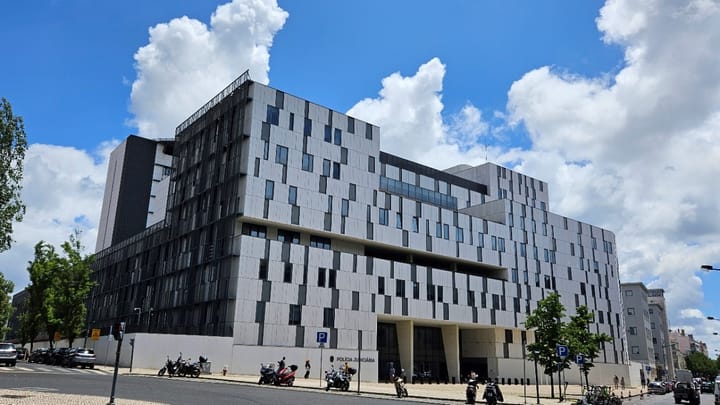
Lisbon Court Orders Preventive Detention for Suspect Charged With Terrorism in Molotov Attack on Marcha pela Vida
A 39-year-old man arrested on Wednesday for throwing a Molotov cocktail at anti-abortion demonstrators outside the Assembleia da República in Lisbon will remain in preventive detention, a Lisbon court ruled early on 16 April. The decision, first...

A 39-year-old man arrested on Wednesday for throwing a Molotov cocktail at anti-abortion demonstrators outside the Assembleia da República in Lisbon will remain in preventive detention, a Lisbon court ruled early on 16 April. The decision, first reported by SIC Notícias and confirmed by Portugal's Judicial Police, makes the case the most serious domestic-security incident of the year.
Six charges, including attempted terrorism
The suspect is indicted on six counts: attempted commission of terrorist offences, possession of a prohibited weapon, arson, explosion and other particularly dangerous conduct, and serious bodily harm. The court endorsed the arguments put forward by the Judicial Police (PJ) and by the Central Department for Investigation and Prosecution (DCIAP) on flight risk, noting that the suspect lived and worked for a period in the United States and that, crucially, his passport was not seized on the day of the incident.
The attack itself took place on 21 March, when participants in the annual Marcha pela Vida — a pro-life demonstration that typically draws several hundred people, including families with young children — gathered in front of Parliament. The incendiary device was thrown at the crowd. No injuries were reported, but the potential for mass casualties prompted the Interior Minister, Luís Neves, to condemn the incident on the day and to describe it publicly as violent extremism.
The political fallout
The profile of the arrested man has sharpened the political response. According to DN, he works in the design sector, has connections to far-left movements, and is a card-carrying member of the Partido Socialista. The PS itself confirmed the membership on Wednesday evening and announced that it had provisionally suspended him and opened internal disciplinary proceedings.
Opposition parties have seized on the case. Chega MP Rita Matias circulated video of the attack on social media in the days after it happened, while the CDS-PP parliamentary leader Paulo Núncio called it 'an attack on democracy' and drew a contrast with the 'thousands who demonstrated peacefully'. The government, for its part, has been careful to frame the incident as individual criminality rather than organised political violence.
A broader pattern flagged by RASI
The case lands just weeks after the publication of the 2025 Annual Internal Security Report (RASI), which explicitly warned of a resurgence of politically motivated violence at both ends of the spectrum. The document notes that 'anti-fascism' has become a principal recruitment and radicalisation vector for the radical-left, 'often interpenetrated by radical environmental activism', and singles out the autonomous and anarchist movements for 'preparing for physical confrontation with their adversaries and the security forces' and for developing what it calls 'a praxis of insurrectional violence'.
The PJ is continuing to investigate whether the suspect acted alone or had accomplices — a line of inquiry that, given the RASI framing, is likely to extend into the broader ecosystem of militant groups operating on Portuguese streets.
Why it matters
For a country that, in recent years, has been able to claim among the lowest levels of politically motivated violence in Western Europe, the combination of an attempted-terrorism charge, a preventive-detention ruling and a major-party membership is unusual. It also lands at a politically sensitive moment: the DCIAP's involvement signals that prosecutors intend to treat the case as a matter of national security, not a local public-order offence, and any trial will play out against a backdrop of intensifying parliamentary debate over Portugal's abortion regime.