Portugal Recorded More Births in 2025 — And Still Lost 34,244 People Through Natural Causes
Preliminary INE data for 2025 shows 87,732 live births — 2,798 more than 2024 and the first annual rise in nearly a decade. But the natural balance still widened to a record minus 34,244. Without net migration of 143,641, Portugal would be shrinking by the size of Bragança every year.

The preliminary demographic data for 2025 released by the Instituto Nacional de Estatística (INE) carries what at first reads as a rare piece of good news. Portugal registered 87,732 live births last year — 2,798 more than in 2024, a 3.3 per cent increase and the first annual rise in nearly a decade. But the same release contains a number that drowns out the positive headline. The natural balance — births minus deaths — widened to minus 34,244, the deepest gap Portugal has ever recorded in a single year and the fourteenth consecutive year of negative natural growth.
The Arithmetic of Decline
The numbers tell a simple story: more births, but even more deaths. Mortality in 2025 stayed close to the 118,374 recorded in 2024, a figure that itself had been slightly up on 2023. An ageing population drives both sides of this equation — fewer people in their reproductive years, more people in the age brackets where mortality naturally rises. The Total Fertility Rate for 2024 fell to 1.40 children per woman, down from 1.44 a year earlier and well below the 2.1 required for generational replacement. The statistics institute published its latest monthly figures on Friday: the registry count for July and August, with marriages up nine percent and the natural balance still negative.
Against that backdrop, population growth has become entirely a function of migration. Portugal's total resident population ended 2024 at 10,749,635 — an increase of 109,909 people on 2023. The decomposition is stark: minus 33,732 from natural change, plus 143,641 from net migration. Without the migratory inflow, the country would be shrinking by roughly the size of Bragança every year.
The Policy Contradiction
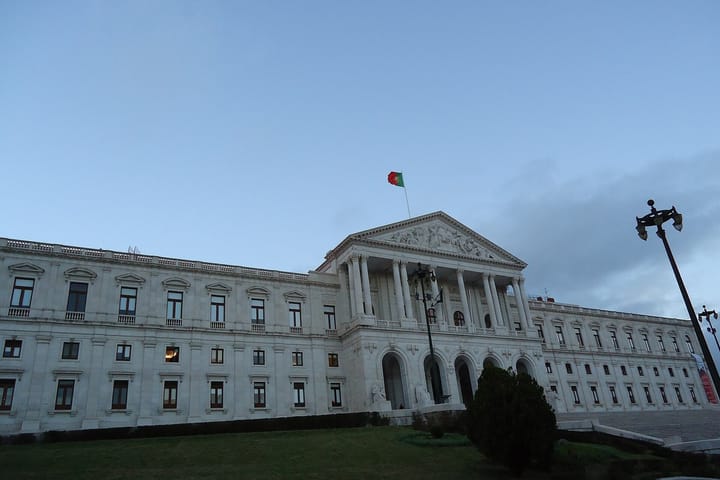
That arithmetic puts this week's political debate about Portuguese citizenship in sharper focus. Parliament's approval on 1 April of a revised Nationality Law doubled the residence requirement for most applicants from five to ten years. Supporters framed the change as tightening standards. Critics have pointed out that it makes Portugal a noticeably less attractive destination for the very migrants whose arrival is currently keeping the population curve from bending downward.
The country now finds itself in a structural contradiction: its economy, pension system and healthcare service depend on a sustained migratory inflow that its political class is increasingly reluctant to encourage. The Conselho das Finanças Públicas warned on Monday that compensation of employees will hit 48.5 per cent of GDP — the highest share since 1995 — precisely because the workforce is ageing and productivity growth is lagging. The Social Security fund's own projections assume continued net immigration of roughly 70,000 people a year through 2040 simply to maintain current pension ratios.
The Ageing Snapshot
The wider demographic picture is unforgiving. Portugal is now one of the oldest societies on earth. Roughly 24.9 per cent of the population is 65 or older, while only 12.7 per cent is under 15. Life expectancy sits at 78 years for men and nearly 84 for women. The municipalities with the highest ageing index — parts of the interior Centro and Alentejo regions — are already recording two or three deaths for every birth.
The small 2025 uptick in births is partly explained by residents born abroad, who tend to have slightly higher fertility rates than the Portuguese-born population. In other words, the policy lever pulling up the birth rate is the same one that parliament has just restricted.
The message in the INE numbers is not new. It is, however, arriving with unusual clarity: the country's demographic maths only works if Portugal stays open — and the political class is drifting in the other direction.