Algarve Reservoirs at 95% Don't Cancel the Fire Risk — DECIR Charlie's 13,335 Operatives and 78 Aircraft Step Onto a 2,780-Fire Run That Already Doubles 2025 in the Same Five-Month Window
Portugal entered the official fire season with the Algarve reservoir system at 95% of usable capacity — and Civil Protection deploying 13,335 operatives, 78 aircraft and two Black Hawks. The two readings are not contradictory: a wet winter is exactly what feeds a hot fire run.
The Algarve entered June 2026 with its main reservoir system at 95% of usable capacity — a posture that, eighteen months ago, regional water authorities would not have penciled at any confidence interval. The Bravura, Funcho, Odelouca and Beliche dams together hold roughly three years of cushion against current consumption profiles, and APA (Agência Portuguesa do Ambiente, Portuguese Environment Agency) shifted its 2026 summer-water guidance from rationing to allocation just last week. And yet on the same Monday, the Autoridade Nacional de Emergência e Proteção Civil (ANEPC, National Emergency and Civil Protection Authority) activated DECIR's Charlie phase — the most intensive of the fire-fighting stack — with 13,335 operatives, 78 aircraft, and two Black Hawks fielded across the continental footprint.
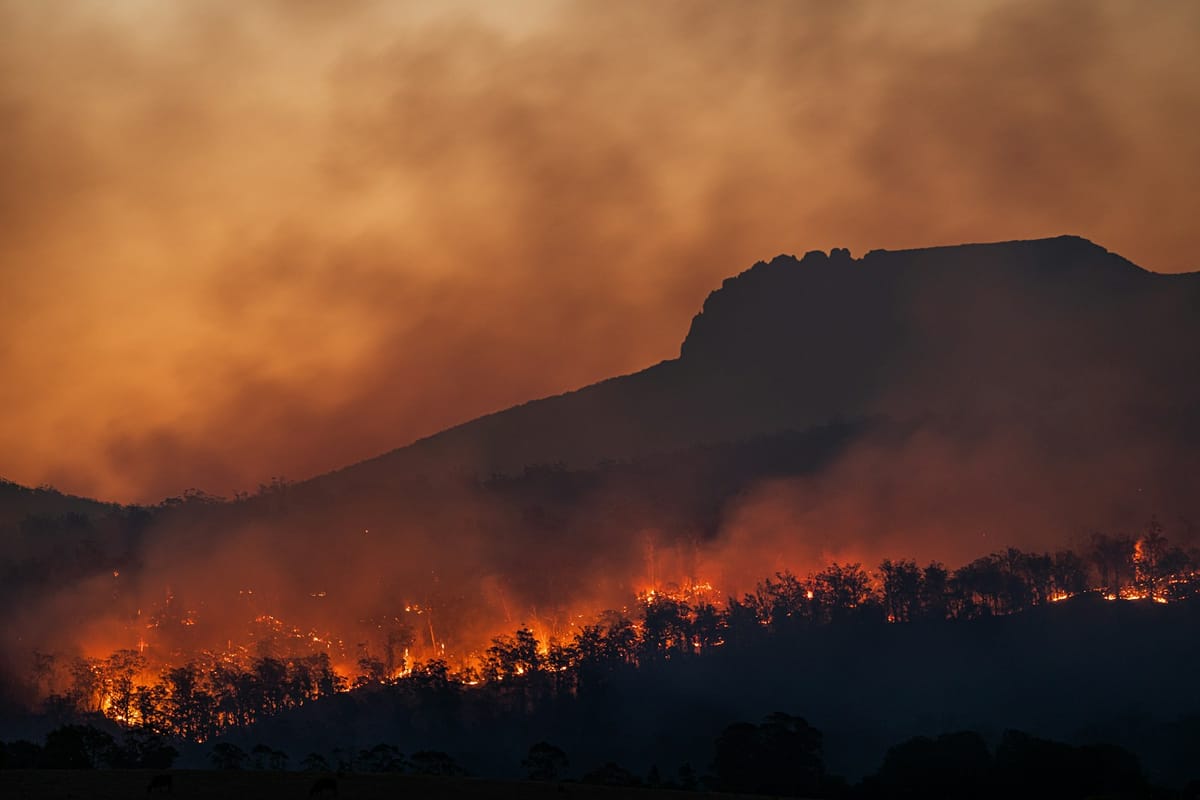
Those two readings are not contradictory. They are causally linked. A wet winter is exactly what produces the rural-fire arithmetic the country is reading off the ICNF (Instituto da Conservação da Natureza e das Florestas, Institute for Nature Conservation and Forests) tape: 2,780 rural fires through 31 May, more than double the 2025 same-period run, with 9,079 hectares burnt across the Norte region alone. Heavy spring rainfall lifts the fuel load — biomass that, once it dries through June and July, becomes the substrate fires propagate through fastest.
The geography splits
Portugal's fire-and-water map is not one map. The Algarve south stayed wet through April, and the southern aquifer system recharged. The Norte and Centro regions ran hotter and drier through May; the 9,079-hectare burned-area print for Norte is already three quarters of the full 2025 Norte annual total in 2026 H1. That regional split is the operational reason DECIR's Charlie phase deployment skews toward the interior north — Trás-os-Montes, Beira Interior, Alto Tâmega — rather than the south where the reservoirs are full.
The two-Black-Hawk addition is the headline procurement story of the 2026 fire-fighting envelope. The pair sit alongside the Air Tractor fleet, Canadair amphibians from the EU rescEU pool, and the standard Kamov rotorcraft fielded under the Fundo Florestal Permanente. The fleet upgrade matters because the operational window for first-attack suppression has compressed: ICNF analytics show that the median time from ignition to 5-hectare propagation has dropped roughly 20% over the last decade, on the back of warmer summer temperatures and lower morning relative humidity. Where the fleet sits at 13:00 hours on a Yellow-or-Red index day determines whether a fire ends at 5 hectares or 500.
The 2,780-fire count for January–May is also flagging a structural shift in the ignition curve. Roughly 95% of Portuguese rural fires are human-caused — agricultural burns out of control, equipment sparks, deliberate ignition. The ICNF and GNR's Serviço de Proteção da Natureza e do Ambiente (SEPNA, Nature and Environment Protection Service) detentions for negligent ignition are running at a 30% lift on the 2025 period, but the deterrence math is uneven: rural fines for non-compliance with the burn-permit regime sit well below the cost-of-prevention threshold for many smallholders.
What This Means for Expats
- Geography matters: If you live in or are buying property in the rural interior of Norte, Centro or the Trás-os-Montes belt, your 2026 fire-season risk is materially higher than the Algarve or the urban coast.
- Property insurance: Standard multi-risco home insurance includes fire cover, but read the franquia (deductible) and the exclusions on outbuildings, fences, and adjacent vegetation. Insurers are repricing rural policies tied to the burned-area trend.
- Tourism timing: The Algarve south is structurally lower-risk for the 2026 season; interior Portugal is where the operational pressure sits. Trail and forest closures are most likely in Norte and Centro between July and mid-September.
- Emergency alerts: Register for the SMS alert system through your câmara municipal and download the ICNF "Pocket Fires" app — both push real-time risk-index and operational-warning notifications.
- Compliance reminder: The faixas de gestão de combustível (fuel-management strips) — the 50-metre clearance band around residential structures and the 100-metre band around population clusters — are mandatory under Decreto-Lei 124/2006 as amended. Non-compliance carries fines that scale with parcel size, and is now actively enforced by GNR-SEPNA during DECIR's Charlie phase.
The Algarve's water cushion is real and it is going to remain real through 2027 absent a multi-year drought reset. The fire risk is a different system entirely, fed by exactly the inputs (winter rainfall, spring biomass growth, summer heat) that are now reading as Portugal's new normal. DECIR Charlie's 13,335 operatives are the operational expression of that new normal — and the 2,780-fire count tells you the season started before the official calendar said it had. On what the GNR finds when it investigates a fire, the GNR's own count of 173 fire-crime detentions this year out of 6,200 fires investigated, in which burning agricultural residues remains the largest identified cause sets the latest reference.