Keeping Bees in Portugal
Researched and written with AI tools from official sources. How we make our guides
How to register as a beekeeper in Portugal, the 1 to 30 September hive declaration, where you may place hives, moving apiaries, varroa treatment, and fines.
Last verified: October 2026.
Who this is for
- You want to keep a few hives as a hobby on your land in mainland Portugal.
- You are planning a commercial beekeeping business.
- You have bought rural land with hives on it.
Not for you if: you keep chickens or other small farm animals. Read our guide to keeping chickens and small livestock instead.
Anyone who keeps bees in Portugal must register with the food and veterinary authority (DGAV) before starting, whatever the number of hives. You then declare your hives every year between 1 and 30 September. Registering and declaring are free. You can do it online through the agriculture funding institute's portal (IFAP), at a regional veterinary office, or through a beekeepers' association. Apiaries must be more than 50 metres from public roads and 100 metres from buildings in use. Missing a declaration can cost €100 to €3,740 for a person.
Registering as a beekeeper
The law says beekeeping needs prior registration. There is no minimum number of hives that exempts you.
You have three ways to register:
- Online, in the Atividade Apícola application in the reserved area of the IFAP portal (ifap.pt). You need IFAP login details.
- In person, at the Regional Food and Veterinary Services (DSAVR), or their divisions and local offices.
- Through a beekeepers' association that has an agreement with IFAP. The association files for you. This can help if your Portuguese is limited.
When you start, you must make your first declaration of hives within 10 working days. This does not replace the September declaration. If you start in May, you declare on starting and again in September.
You must give the approximate geographic coordinates of each apiary, not just the parish. Registration gives you a beekeeper number. You must display that number clearly at every apiary.
The September declaration
Every year, between 1 and 30 September, every beekeeper must file a declaration of holdings (declaração anual de existências). DGAV publishes a notice each August with the year's rules. For 2026 the window was 1 to 30 September 2026.
You file it the same three ways: on the IFAP portal, at a DSAVR office, or through an association. The date that counts is the date you submit. You must also give or confirm the coordinates of each apiary.
When your hive count changes
You must file a declaration of change within 10 working days if your number of hives changes by more than 20%. DGAV says these declarations apply to changes of 20 colonies or more.
So a hobbyist with eight hives who loses two need not file mid-year. A beekeeper who moves 60 colonies does. If you are close to the line, filing costs nothing.
Where you may put hives
The national rules apply everywhere in mainland Portugal:
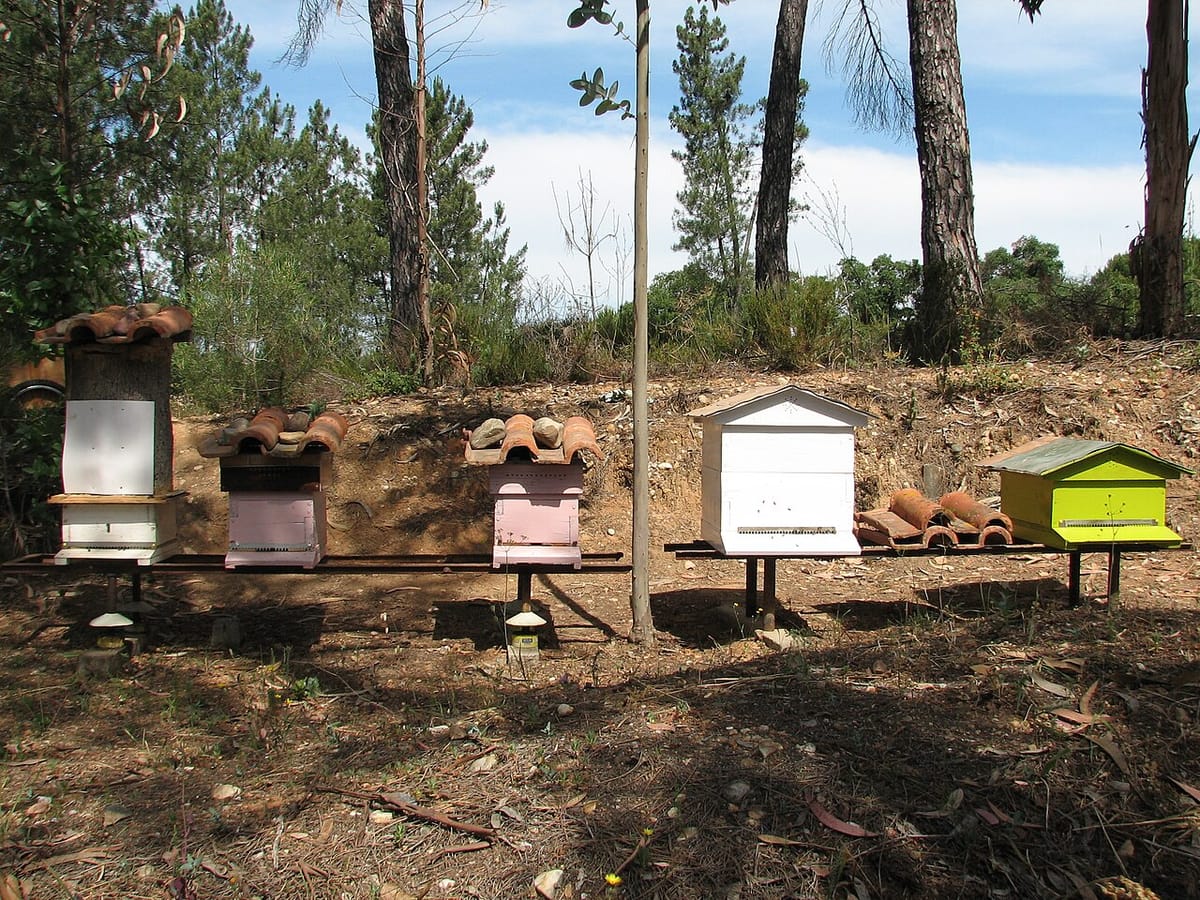
- An apiary must be more than 50 metres from a public road and more than 100 metres from any building in use. Rural and farm tracks, and your own beekeeping buildings, do not count.
- An apiary may hold at most 100 colonies.
- Apiaries must be spaced from the nearest other apiary: 400 metres for an apiary of 11 to 30 hives, and 800 metres for 31 to 100 hives. Where two apiaries are of different sizes, the larger distance applies.
- For counting, a nucleus or traditional cork hive (cortiço) counts as half a hive.
- Hives placed in a crop while it flowers are an exception. The number of colonies must then suit the crop area.
Some regions have their own density rules, set by order:
- the whole Alentejo;
- the councils of Castelo Branco, Covilhã, Fundão, Idanha-a-Nova, Oleiros, and Vila Velha de Ródão.
If your land is in one of these areas, check the regional rules with the DSAVR before you buy hives or agree to host someone else's.
Placing an apiary too close to roads or buildings, or breaking the density rules, is an offence in its own right. Talk to your neighbours and your parish council (junta de freguesia) before the first colony arrives.
Moving hives
Many Portuguese beekeepers move hives to follow the flowering. Two rules apply:
- Tell the destination region first. Before you move an apiary anywhere in Portugal, notify the DSAVR of the region where the hives will go. Use form Mod. 488/DGAV (Comunicação de Deslocação de Apiários). The notice goes to the destination, not the region you are leaving.
- Get authorisation for controlled zones. Moving hives into a controlled zone (zona controlada) needs prior authorisation from the destination DSAVR.
Controlled zones are areas where bee diseases are systematically controlled by a managing body recognised by DGAV. DGAV lists six in the mainland, for example in the Minho and Lima valleys and around Bragança and Montesinho. DGAV publishes a map and a list of the councils covered.
The Azores are different. Six islands (Santa Maria, São Miguel, Terceira, Graciosa, São Jorge, and Corvo) have EU recognition as free of varroa. The Azores also have their own beekeeping law. Assume strict limits on bringing bees in, and ask the regional authorities before anything travels.
Bee health
Notifiable diseases. You must report suspected or confirmed cases of these diseases to the DSAVR where the apiary stands:
- American foulbrood (loque americana) and European foulbrood (loque europeia);
- acarine disease (acarapisose) and varroa (varroose);
- small hive beetle (Aethina tumida) and Tropilaelaps mites;
- chalkbrood and nosema, in controlled zones only.
Varroa treatment. DGAV's varroa control plan says every colony must have at least two treatments a year. A treatment can be made up of two or more applications. Use only veterinary medicines authorised for bees, bought from pharmacies or authorised veterinary medicine outlets. Home-made recipes and products not meant for veterinary use are expressly banned. Not treating is only accepted where you justify it technically to DGAV. Keep a record of the treatments you give. DGAV publishes a model record form.
Asian hornet. The Asian hornet (Vespa velutina) preys on honeybees. ICNF runs a reporting platform, STOP Vespa, for sightings and nests. See our guide to invasive plants and animals for more.
If DGAV orders hives to be destroyed for disease control, the owner is compensated. You lose that right if your apiary breaks the beekeeping rules.
Fines
These are administrative offences, with a fine of €100 to €3,740 for a person and up to €44,890 for a company:
- not registering;
- not filing the annual declaration;
- not declaring changes;
- not displaying your beekeeper number;
- placing an apiary too close to roads or buildings, or breaking density rules;
- not notifying a move to a new site;
- not reporting a notifiable disease;
- bringing bees or beekeeping material into a controlled zone without authorisation.
Negligence and attempt are punishable. Extra penalties can include losing animals or equipment, losing subsidies, and being barred from fairs and markets, for up to two years.
Selling honey
Keeping bees and selling honey follow separate rules. DGAV's honey pages set out what honey producers and operators must do, including traceability and labelling.
If you plan to sell, check DGAV's honey pages before your first sale. If beekeeping becomes a business, the tax and social security side follows the normal route for self-employment. See our guide to opening an independent activity on recibos verdes.
Hives and hunters
Hunting is banned within 100 metres of apiaries, but only if the land is signposted with the official signs. See our guide to the hunting season.
What to do, by situation
- You have bought land with hives on it. Find out whose beekeeper number is on the apiary. The hives may belong to a beekeeper who moves them seasonally; agree the arrangement in writing. If the hives are now yours, register and declare within 10 working days of taking over. Check your plots are mapped too; see our guide to registering rural land on BUPi.
- You are a hobbyist with a few hives. Register, display your number, declare every September, and keep each apiary's coordinates. Check the 50 and 100 metre distances before you place hives. Treat for varroa at least twice a year.
- You are planning a commercial operation. Check the regional density rules and the spacing between apiaries before you commit to a site. Plan for change declarations when you move colonies. Talk to a local beekeepers' association early.
- You want to move hives to the Azores. Assume restrictions and get written approval first.
This guide is general information about mainland Portugal, not legal or veterinary advice. Check DGAV's pages, or ask your DSAVR, before you act.
Sources
This guide is written from official sources and, where relevant, organisations' own websites.
- DGAV, registration of beekeeping: https://www.dgav.pt/animais/conteudo/animais-de-producao/abelhas/identificacao-registo-e-movimentacao-animal/registo/ (prior registration on IFAP, at DSAVR, or via associations; annual declaration 1 to 30 September; first declaration within 10 working days; changes over 20% and 20 colonies or more; coordinates; beekeeper number displayed), checked 2 October 2026
- DGAV, notice on the 2026 declaration of holdings, signed 20 August 2026: https://www.dgav.pt/wp-content/uploads/2026/08/AVISO-Atividade-Apicola-Declaracao-de-Existencias-2026.pdf (1 to 30 September 2026, channels, submission date counts, 10 working days for first declaration and for changes, coordinates, Mod. 488/DGV, controlled zones, fines of €100 to €3,740 or €44,890), checked 2 October 2026
- DGAV, moving apiaries: https://www.dgav.pt/animais/conteudo/animais-de-producao/abelhas/identificacao-registo-e-movimentacao-animal/movimentacao/ (prior notice to the destination DSAVR on Mod. 488/DGAV; authorisation for controlled zones), checked 2 October 2026
- DGAV, bee diseases: https://www.dgav.pt/animais/conteudo/animais-de-producao/abelhas/saude-animal/doencas-das-abelhas/ (controlled zones, six in the country, map and list, model forms, medicines record), checked 2 October 2026
- DGAV, list of controlled zones, February 2026: https://www.dgav.pt/wp-content/uploads/2026/01/Lista-de-Zonas-controladas_Fev2026.pdf (managing bodies and councils covered), checked 2 October 2026
- DGAV, varroa control plan, 13 May 2026: https://www.dgav.pt/wp-content/uploads/2026/06/Plano_Luta_Varroose_v13maio2026.pdf (at least two compulsory treatments a year per colony, authorised medicines only, bought from authorised outlets, home-made products banned, non-treatment only if justified), checked 2 October 2026
- DGAV, beekeeping legislation list: https://www.dgav.pt/wp-content/uploads/2021/03/Apicultura_Legislacao.pdf (Alentejo and Castelo Branco area density orders, Azores regional law, varroa-free status of six Azores islands), checked 2 October 2026
- DGAV, honey: https://www.dgav.pt/alimentos/conteudo/generos-alimenticios/regras-especificas-por-tipo-de-alimentos/mel/ (operator obligations, labelling and traceability, main honey law), checked 2 October 2026
- gov.pt, beekeeping registration and declaration of holdings: https://www.gov.pt/servicos/fazer-o-registo-apicola-e-declarar-existencias-de-abelhas (channels, first declaration within 10 working days), checked 2 October 2026
- Diário da República, Decreto-Lei n.º 203/2005, de 25 de novembro (beekeeping and bee health): https://diariodarepublica.pt/dr/detalhe/decreto-lei/203-2005-481729 (article 3 registration and declarations; 5 apiaries more than 50 m from public roads and 100 m from buildings in use; 6 and annex I maximum 100 colonies and 400 m and 800 m spacing; 9 and annex II notifiable diseases; 11 compensation; 16 offences and fines; 17 accessory penalties), read in the original gazette text, checked 2 October 2026
- Diário da República, Despacho n.º 4809/2016, de 8 de abril: https://diariodarepublica.pt/dr/detalhe/despacho/4809-2016-74081000 (registration model and annual declaration period), as cited by DGAV, checked 2 October 2026
- EUR-Lex, Commission Implementing Decision (EU) 2019/1895: https://eur-lex.europa.eu/eli/dec_impl/2019/1895/oj (varroa-free status of six Azores islands), checked 2 October 2026
- ICNF, STOP Vespa: https://stopvespa.icnf.pt/ (Asian hornet reporting platform), checked 2 October 2026
- IFAP, portal: https://www.ifap.pt/portal/ (reserved area with the Atividade Apícola application), checked 2 October 2026
Last verified October 2026. Rules and fees change; check the official source before acting.