Dealing with Invasive Plants and Animals in Portugal
Researched and written with AI tools from official sources. How we make our guides
Which garden plants and pets are banned as invasive in Portugal, what to do if you already have one, how to report a sighting, and the fines.
Last verified: October 2026.
Who this is for
- You have a garden, land, or a pond in mainland Portugal and want to know which plants are banned.
- You keep, or plan to keep, a turtle, fish, or other exotic pet.
- You are moving to Portugal and want to bring plants, an aquarium, or a reptile.
Not for you if: you are bringing a dog, cat, or ferret. Read Bringing a Pet to Portugal instead.
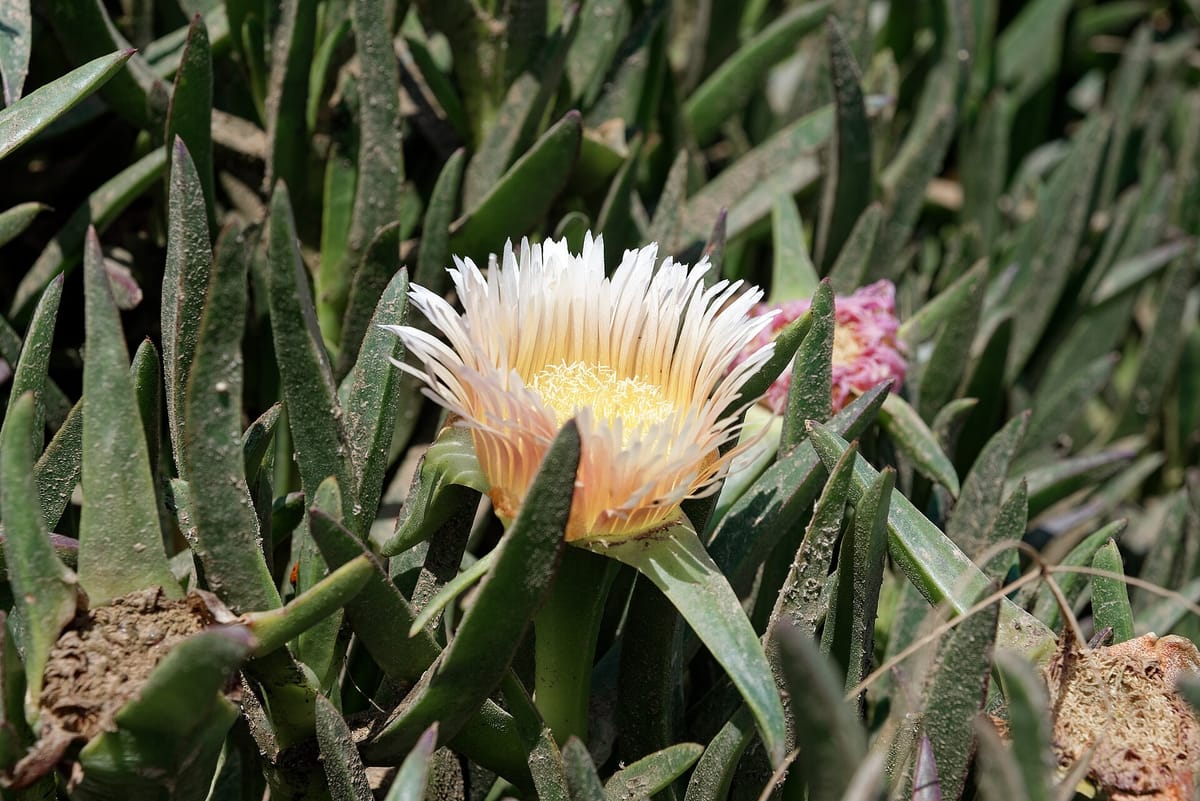
Portugal has a national list of invasive species (Lista Nacional de Espécies Invasoras). It includes common garden plants such as pampas grass, the ice plant (chorão), and every acacia, including mimosa. It also includes pets such as red-eared slider turtles and goldfish. You may not keep, grow, breed, sell, give away, transport, or release anything on the list. If you have a listed plant, you must remove it.
If you already had a listed pet before its species was listed, you may keep it for life, but only in escape-proof conditions with no breeding. Fines for individuals start at €200 and can reach €200,000.
What the rules cover
The law separates two groups:
- Alien species (espécies exóticas): any plant or animal living outside its natural range, including seeds, eggs, and any part that could survive and grow.
- Invasive species (espécies invasoras): alien species that harm, or threaten, native wildlife and habitats.
Alien species are regulated. Invasive species on the national list are, in practice, banned. The list includes every species on the EU's own list of invasive species.
For a listed species, the law bans:
- releasing it into nature or restocking it;
- keeping, giving away, buying, selling, offering for sale, transporting, growing, or breeding it;
- using it as a garden plant or a pet;
- putting it back into the wild if you catch it while hunting or fishing.
Anyone who holds a listed species, even without selling it, must get rid of it. This includes keepers, breeders, and plant nurseries.
The rules do not apply to crop, vegetable, fruit, and vine varieties in the official variety catalogues, or to plant pests and diseases, which have their own rules.
Madeira-only entries. Some species on the list are marked with an asterisk. These are listed as invasive only in Madeira. On the mainland they do not apply. The Azores and Madeira can adapt the rules and set their own lists. This guide is written for the mainland.
Garden plants on the mainland list
Many listed plants were sold for gardens, banks, hedges, or ponds. These are among those listed for the mainland:
- Acacias (Acacia, all species), including mimosa, planted for its yellow winter flowers.
- Ice plant (chorão, Carpobrotus edulis and Carpobrotus acinaciformis), used to cover dunes and dry banks.
- Pampas grass (erva-das-pampas, Cortaderia selloana).
- Tree of heaven (Ailanthus altissima).
- False acacia or black locust (Robinia pseudoacacia).
- Giant reed (cana, Arundo donax).
- Pittosporum (Pittosporum undulatum), a common hedge shrub.
- Lantana (Lantana camara), blue morning glory (Ipomoea indica), and small-leaf spiderwort (Tradescantia fluminensis).
- American agave (Agave americana) and the prickly pear Opuntia maxima.
- Fountain grasses (Pennisetum setaceum and Pennisetum villosum).
- Foxglove tree (Paulownia tomentosa), castor oil plant (Ricinus communis), and tree tobacco (Nicotiana glauca).
- Garden nasturtium (Tropaeolum majus).
- Bermuda buttercup (azedas, Oxalis pes-caprae), the yellow flower that covers olive groves and verges in spring.
- Pond and aquarium plants: water hyacinth (Eichhornia crassipes), water lettuce (Pistia stratiotes), parrot's feather (Myriophyllum aquaticum), Egeria densa, Cabomba caroliniana, giant salvinia (Salvinia molesta), and the water fern Azolla filiculoides.
These carry the asterisk and are listed for Madeira only: hydrangea (Hydrangea macrophylla), agapanthus, arum lily (Zantedeschia aethiopica), jade plant (Crassula ovata), gorse (Ulex), and broom (Cytisus).
Animals on the mainland list
- Turtles: sliders (Trachemys, all species), including the red-eared and yellow-bellied sliders long sold as pets.
- Fish: goldfish (Carassius auratus), Prussian carp, mosquitofish (Gambusia holbrooki), and others.
- Invertebrates: the red swamp crayfish (Procambarus clarkii), the giant African land snail, and all non-European hornets (Vespa), which includes the Asian hornet.
- Mammals: raccoons (Procyon) and others.
- Birds: several species, including the common myna and the sacred ibis.
These carry the asterisk and are listed for Madeira only: the ring-necked parakeet, the monk parakeet, the common waxbill, the collared dove, hedgehogs, rabbits, goats, and the domestic cat.
The full list is long. Check the annex of the law, or the species pages on invasoras.pt, before you buy or plant anything exotic.
If you already have a listed pet
You may keep a pet of a listed species, kept for non-commercial reasons, for the rest of its natural life if:
- you had it before its species was listed; and
- you keep it in contained conditions, with every reasonable step taken so it cannot breed or escape.
If you cannot meet those conditions, you may not keep the animal.
In practice, this means a slider turtle in an escape-proof tank or enclosure, not a garden pond it can climb out of. It also means no breeding. If you got the pet after its species was listed, this protection does not apply.
Never release it. Releasing a listed species into nature is in the most serious band of offences.
If you have a listed plant
There is no lifetime allowance for plants. Anyone holding a listed plant must remove it. When the current rules came in, in July 2019, owners of newly listed garden plants had six months to tell the Nature and Forests Institute (ICNF) and remove them. That window closed long ago. Many of the most common plants, such as acacias, pampas grass, and the ice plant, were already banned under the older rules.
The law does not set a removal method for households. Two points help:
- The rules cover living material that can grow again. An official programme published in September 2026 confirms that dead or non-viable specimens are no longer subject to the restrictions on keeping and moving them.
- So the risky parts are seed heads, cuttings, and roots that can regrow. Contain them. Do not put pampas plumes or ice plant cuttings on a compost heap or leave them by the road.
For what you may do with dry garden waste, see Burning Garden and Farm Waste in Portugal.
Buying, moving, and releasing
In shops. Shops selling garden plants or pets must display an official notice warning buyers that they are responsible for stopping alien species from spreading or escaping. They must also give you this information in writing and keep a record of sales.
At airports and ports. Customs check passenger terminals for live alien plants and animals. If a listed species is found, it is refused entry. You have no more than 48 hours to choose between destruction and return to the country of origin. You pay the costs, including holding, euthanasia, destruction, or shipping back. Leave listed plants, fish, and reptiles behind when you move.
Releasing any alien species. Releasing an alien species into nature needs ICNF authorisation, even if it is not on the invasive list. Emptying an aquarium into a stream is an offence whether or not the fish are listed.
Reporting a sighting
You must report straight away to the ICNF if a listed species escapes or spreads by accident, or if you see one in the wild somewhere it was not known before. The law says to report preferably through the ICNF's online platform. Failing to report an escape is itself an offence.
For invasive plants, the national information site invasoras.pt, run by the University of Coimbra, also lets you record sightings online, through an app, or on a paper form. You need to register an account.
The fines
Breaches are environmental offences. For individuals, the fines are:
| Band | Examples | Negligence | Intent |
|---|---|---|---|
| Very serious | Releasing a listed species; buying, selling, giving away, growing, or breeding one as a garden plant or pet | €10,000 to €100,000 | €20,000 to €200,000 |
| Serious | Keeping, transporting, or using a listed species as a garden plant or pet; putting a caught one back in the wild; releasing an unlisted alien species without authorisation | €2,000 to €20,000 | €4,000 to €40,000 |
| Minor | Failing to report an accidental escape or spread | €200 to €2,000 | €400 to €4,000 |
Companies face higher fines. Convictions for very serious offences, and for serious ones where the fine is more than half the maximum, can be made public.
On top of any fine, you must remove the cause and restore the site. If you do not, the ICNF can do the work and recover the cost from you through the tax collection process.
Many bodies can enforce the rules, including the ICNF, the regional coordination commissions (CCDR), the veterinary authority (DGAV), APA, customs and tax (AT), the GNR, and the PSP.
What to do
- Check your garden against the list. Pampas grass, ice plant, acacias, tree of heaven, pittosporum hedges, and nasturtiums are the most common finds on mainland properties.
- Remove listed plants without spreading seeds or live cuttings.
- Do not buy replacements. Buying or planting a listed species as a garden plant is in the very serious band.
- If you have a listed pet, keep it contained, stop it breeding, and never release it.
- Moving here? Leave listed plants, fish, and reptiles behind.
- See one spreading in the wild? Report it to the ICNF.
This guide is general information, not legal advice. Rules change; check the official source before you act.
Sources
This guide is written from official sources and, where relevant, organisations' own websites.
- Procuradoria-Geral Regional de Lisboa, alien species law (Decreto-Lei n.º 92/2019), consolidated to Lei n.º 25/2023: https://www.pgdlisboa.pt/leis/lei_mostra_articulado.php?nid=3100&tabela=leis (article 1 scope and exclusions; 11 shop notice, written information, and sales register; 13 ICNF authorisation to release alien species; 16 and 19 ban and its effects, duty to eradicate; 23 ICNF surveillance platform; 24 duty to report; 30 border controls, 48 hours, costs; 33 offence bands; 35 enforcement bodies; 37 restoring the site, costs recovered through tax enforcement; 39 six-month window for garden plants; 40 pets; 43 Azores and Madeira; Annex II national list; Annex III species under the exception regime), checked 2 October 2026
- Diário da República, Decreto-Lei n.º 92/2019, of 10 July, original text: https://diariodarepublica.pt/dr/detalhe/decreto-lei/92-2019-123025739 (Annex II with species marked with an asterisk as invasive only in Madeira; the Diário da República page needs JavaScript, so the asterisks were read on a copy of the original 1.ª série, n.º 130, pages 3428 onwards, held by the European Commission's EASIN service: https://easin.jrc.ec.europa.eu/easin/Document/OutermostRegion/Portugal/DL%2092-2019%20especies%20exoticas.pdf), checked 2 October 2026
- Procuradoria-Geral Regional de Lisboa, environmental offences framework law (Lei n.º 50/2006), consolidated: https://www.pgdlisboa.pt/leis/lei_mostra_articulado.php?nid=1356&tabela=leis (article 22 fine bands for individuals and companies), checked 2 October 2026
- EUR-Lex, Regulation (EU) No 1143/2014 on invasive alien species: https://eur-lex.europa.eu/eli/reg/2014/1143/oj (article 31: non-commercial owners may keep companion animals until the end of their natural life if kept before listing and contained so they cannot breed or escape; otherwise not permitted to keep them), checked 2 October 2026
- Diário da República, Despacho n.º 11629/2026, of 22 September, national action programme for the invasive seaweed Rugulopteryx okamurae: https://files.diariodarepublica.pt/2s/2026/09/184000000/0013700183.pdf (dead or non-viable specimens fall outside the alien and invasive species definitions and their restrictions), checked 2 October 2026
- Invasoras.pt (University of Coimbra), sightings map and reporting: https://invasoras.pt/mapa-de-avistamentos/ (online, app, and paper reporting; account required), checked 2 October 2026
Last verified October 2026. Rules and fees change; check the official source before acting.