Jaime Faria Is the Third Portuguese Ever to Win a Main-Draw Match at All Four Grand Slams
He beat Jenson Brooksby 6-3, 7-6(4), 4-6, 1-6, 6-2 for his first main-draw win at the US Open, a year after losing a five-setter here as a lucky loser. Nuno Borges is also through, putting two Portuguese men in the second round.
Jaime Faria came through five sets at Flushing Meadows on Sunday to record his first win in the main draw of the US Open, and in doing so joined a list that until now had two names on it. He is the third Portuguese player ever to win a main-draw match at all four Grand Slam tournaments in singles, after Joao Sousa and Nuno Borges, and he got there younger than either.
The opponent was Jenson Brooksby of the United States, ranked 73rd. Faria, at 23 the national number two and 70th in the world, his best career position, won 6-3, 7-6(4), 4-6, 1-6, 6-2.
A match that got away and came back
For two sets it was close to a controlled performance. The tiebreak in the second, taken 7-4, should have settled it. Instead Faria unravelled at the end of the third, argued with the crowd, collected a warning for verbal abuse, and watched Brooksby recover two sets despite visible physical trouble. The fourth went 6-1 against him.
What he did in the fifth is the part worth noting. A year ago Faria lost a five-setter to Frances Tiafoe at this tournament as a lucky loser, an exit that has followed him around since. This time he steadied and closed it out 6-2.
He arrived in New York with direct entry to the main draw for the first time, rather than through qualifying. That is the quiet measure of where his year has gone. Two weeks earlier in Cincinnati he had won his first main-draw match at a Masters 1000 event and beaten a top-ten player for the first time, taking down world number six Ben Shelton before losing in the last sixteen.
Two Portuguese men in the second round
Borges is through as well. RTP's Antena 1 bulletin reported him into the second round after his opening match against the American Learner Tien, who had beaten him in their two previous meetings, at the Paris Masters last year and at the Australian Open in January.
Having two Portuguese men in the second round of a Grand Slam at the same time remains unusual. Portuguese tennis has spent most of the past two decades resting on one player at a time: Sousa carried it through the 2010s, Borges took over, and Faria is the first to arrive while the previous holder is still competitive.
What this means for expats
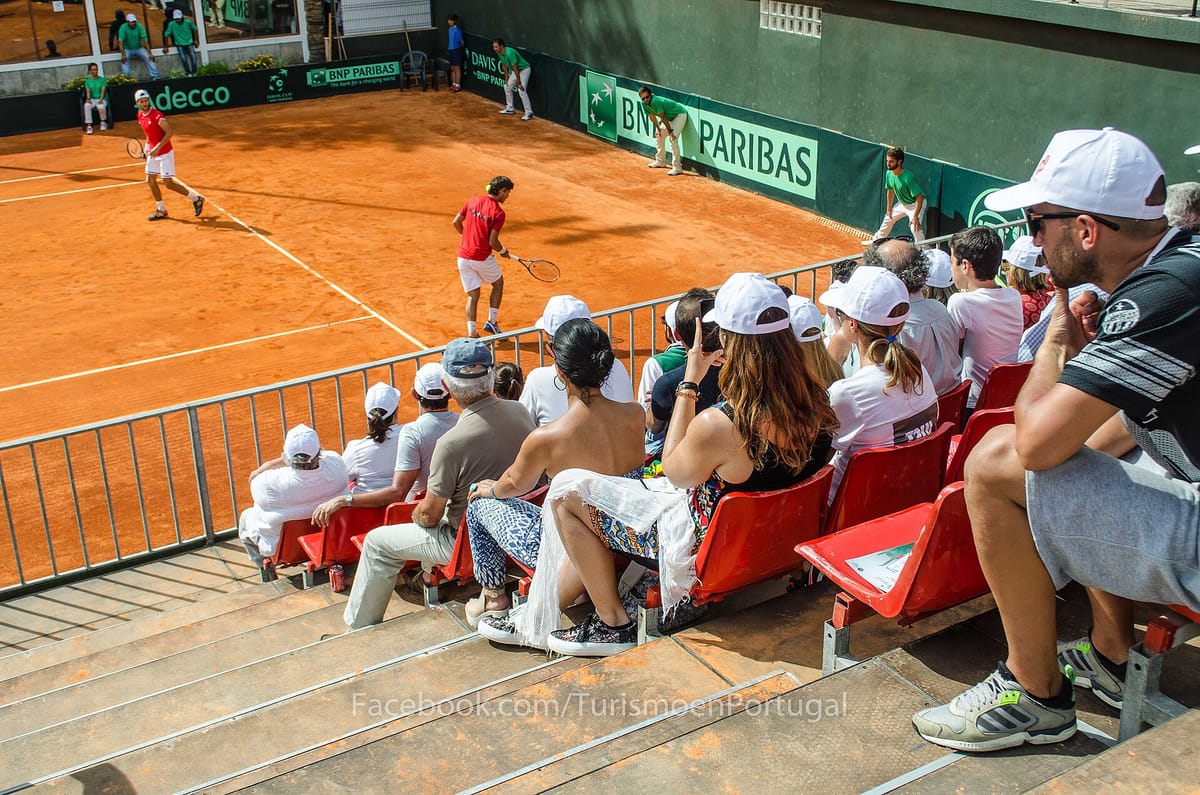
- The domestic circuit is where you can watch them: the Millennium Estoril Open each spring is the one ATP-level event on Portuguese soil, and the Davis Cup ties move around the country.
- It has been a strong fortnight for Portuguese sport: at the canoe world championships in Poznan, Fernando Pimenta took the K1 1000 title at 37 before adding the K1 5000.
- Money follows results: reaching a Grand Slam second round is worth six figures, which in a sport where players fund their own coaching and travel is what determines whether a ranking of 70 is sustainable.
- Where the sport sits commercially: Portuguese sport funding is dominated by football, as the fight over the centralised television rights pot shows.