IPAM Mundial 2026 Impact Study Pencils Portuguese Pickup at €378M to €945M Across Four Scenarios — Domestic Consumption Carries 26%, Food Service 15%, Advertising 14% and Digital 23% as the Seleção Opens vs DR Congo on 17 June
IPAM's 2 June UK-Sport-grounded prediction model pencils the Portuguese Mundial 2026 economic impact between €378M (group-stage exit) and €945M (title), with domestic consumption carrying 26%, food service 15%, advertising 14% and digital 23%.
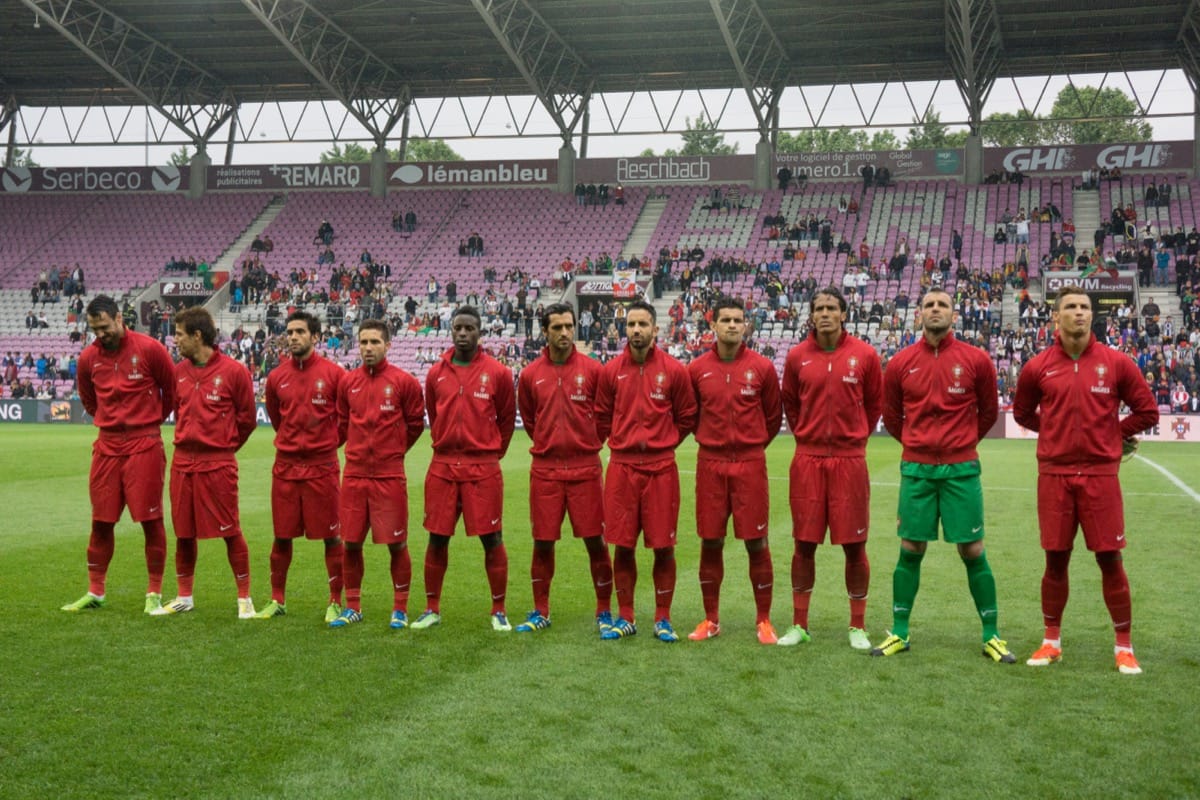
The Instituto Português de Administração de Marketing (Portuguese Marketing Management Institute, IPAM) — the Ensilis-group business school running the country's longest-standing sport-marketing observatory under executive director Daniel Sá — released the 2026 edition of its FIFA-Mundial economic-impact prediction model on 2 June 2026, with national broadcast cycle pickup landing on Tuesday 9 June ahead of the Seleção Nacional's Group K opener against the Democratic Republic of the Congo (DR Congo) in Texas-set 17 June 2026 kickoff. The model pencils the Portuguese economic pickup from the 8 June – 19 July 2026 tournament between €378 million (group-stage exit) and €945 million (title win) across a four-scenario fan.
Methodology grounding: IPAM has run the UK-Sport-developed prediction model since the 2012 European Championship as a calibrated input-output adaptation for the Portuguese household-consumption and small-and-medium-enterprise (SME) commercial mix, with quadrennial Mundial editions and biennial Eurocup editions inside the rotation. The 2026 vintage extends the variable stack from the prior 2022 Qatar-edition model — which delivered a €290 million to €820 million spread across three scenarios — to add a fourth scenario (semifinal exit) and to elevate the digital-channel variables (streaming, social-media engagement, user-generated content, betting platforms) to a 23% block of the predicted value, lifting them above the historic stadium-traditional-revenue stack.
Four-scenario fan and the predicted-impact spread:
- (1) Group-stage exit (minimum): €378 million. Anchored on the Group K group-stage draw against DR Congo (17 June), Uzbekistan (23 June) and Colombia (27 June) — the predicted impact captures the 16-day window from the 12 June tournament opener through the Portugal group-stage closing match on 27 June.
- (2) Round-of-16 exit (intermediate): €561 million. Extends the predicted impact through the 4–5 July round-of-16 window, with the cumulative-engagement multiplier lifting the food-service and digital-engagement blocks.
- (3) Quarter-final-or-semifinal exit (extended): ~€720 million (linearly interpolated). Captures the 11–12 July quarter-final and 14–15 July semi-final windows, with the Seleção-still-in-the-tournament fan-engagement multiplier compounding through the Santos Populares-to-Santa Maria summer-festive calendar window.
- (4) Title-win (maximum): €945 million. Anchors on the 19 July 2026 East-Rutherford MetLife-Stadium final, with the post-title celebration calendar lifting the consumer-goods and hospitality channels through the August summer-vacation window into the September school-year reset.
Six top-impact channels in the predicted-value distribution: domestic consumption carries the largest single block at 26%, with the AC-Nielsen-tracked grocery, beer, and durable-goods consumer-package-goods baskets concentrated through the Pingo Doce, Continente, Auchan, Mercadona and Lidl retail map; food service (restaurants, tascas, esplanadas, sports bars, fan-zone catering) carries 15%, with the SIVA / Sociedade Portuguesa de Bebidas-channel beer and wine sales driving the on-trade tape; advertising and media (television, radio, digital display, social-media campaigns by Mundial-cycle brand sponsors) carries 14%, with the SporTV / RTP / TVI / SIC / Eleven Sports broadcast-rights bundle anchoring the share; digital platforms and streaming (RTP Play, SporTV's streaming arm, Eleven Sports digital, and the FIFA+ catch-up product) carries 10%; social-media engagement (Instagram, TikTok, X / Twitter and emerging short-form video) carries 7%; betting (Santa Casa da Misericórdia Placard and the EU-regulated Betano / Solverde / Estoril Sol / BetClic / Betano-cousin Bwin product) carries the residual ~5%.
Structural shift in the predicted-value composition: the 2026 vintage marks the first Mundial cycle where digital-channel components (digital platforms, social-media engagement, streaming) make up 23% of the predicted value — up from ~12% in the 2018 Russia-edition model and ~17% in the 2022 Qatar-edition model. IPAM's Daniel Sá framed this as the structural transformation of the football economic model beyond stadium-gate-receipt revenue toward audience-engagement-platform monetisation. The traditional stadium-and-merchandise blocks have shrunk in relative weight even as their absolute scale has held — the digital-channel scaling has come over the top.
Portugal's Group K geography for the predicted-impact baseline: the FIFA 16-team Mundial format expansion (from 32 to 48 teams) shifted Portugal into Group K with DR Congo, Uzbekistan and Colombia under the 5 December 2025 Las-Vegas-set draw, with the Seleção opening Wednesday 17 June 2026 against DR Congo at the Arrowhead Stadium in Kansas City (Missouri); the Tuesday 23 June 2026 second match against Uzbekistan at the BMO Field in Toronto (Canada); and the Saturday 27 June 2026 group-stage close against Colombia at Estadio Akron in Zapopan-Guadalajara (Mexico). Roberto Martínez confirmed the 26-player roster captained by Cristiano Ronaldo at Cidade do Futebol on Monday 8 June 2026.
Comparative anchors: the 2018 Russia-edition IPAM model delivered Portugal a predicted impact between €180M and €410M (against the round-of-16 exit reality of Portugal-Uruguay 1-2 on 30 June 2018, the predicted impact landed in the lower-band intermediate scenario at ~€260M); the 2022 Qatar-edition model delivered between €230M and €560M (against the quarter-final exit reality of Portugal-Morocco 0-1 on 10 December 2022, the predicted impact landed at ~€480M). The 2026 vintage's higher predicted-impact floor (€378M minimum) reflects both inflation-adjusted nominal lift on the 2018 / 2022 baseline and the higher-weighted digital-channel scaffolding inside the 2026 model.
Supply-side responses already pencilled into the calendar: Câmara Municipal de Lisboa opened the Parque das Nações fan-zone reservation channel through the 8 June – 19 July tournament; Câmara Municipal do Porto activated the Avenida dos Aliados broadcast-screen schedule; the Porto Outlets/Mar Shopping arc and Algarve Forum-Algarve / Almancil / Quarteira commercial-precinct schedule reserves through the Group K kickoff windows. Câmara Municipal de Lisboa's commercial-licensing arm extended the on-trade alcohol-service window for the 17, 23 and 27 June Group K matches; Câmara do Porto extended its on-trade window for the same matches plus the round-of-16, quarter-final and semi-final calendar in the event of Seleção qualification.
What this means for expat-resident readers in Portugal — five practical implications:
- (a) Spending-side rationality. The €378M-to-€945M predicted impact effectively reads as a multi-channel households-and-SMEs marginal-spend lift — domestic consumption carries 26%, food service 15%, advertising-and-media 14%. Expat households should expect promotional pricing on consumer-package-goods baskets through the Group K window (Continente / Pingo Doce / Auchan / Lidl rotating the Sagres, Super Bock and Castelo beer SKUs, plus Brasileira-and-Galp-fuel-card cross-promotions), with on-trade prices at tascas and sports bars in Lisbon Bairro Alto, Mouraria, Cais do Sodré and Porto Ribeira / Cedofeita corridors holding rather than lifting through the group-stage despite the higher footfall.
- (b) Hospitality-and-employment ramp. Food-service SMEs across the AHRESP (Associação da Hotelaria, Restauração e Similares de Portugal) and FHORESP perimeter — about 100,000 establishments across the tasca / restaurante / esplanada / café / pastelaria / discoteca / sports-bar segment — will pull short-term staffing through the Group K window. Expat job-seekers on D-series visas with Portuguese-language workable English plus a fundamental Português-de-bar interaction range find the IEFP / Centro de Emprego short-term-match window opens through 8 June – 19 July; the Trabalho residence-permit conversion pathway under Lei n.º 23/2007 needs a longer-term contract anchor than a short Mundial-window placement.
- (c) Mobility implications. Lisbon Metro, Carris, CP and Metro do Porto schedules carry the standard summer-frequency lift through the Mundial window. Expat residents in central Lisbon Príncipe Real / Estrela / Lapa / Alcântara should expect commute lifts of 8–15 minutes through 17, 23, 27 June match windows plus the round-of-16, quarter-final, semifinal and final match windows if the Seleção qualifies. Porto Ribeira / Cedofeita / Foz corridors are similarly affected during home-broadcast-screen events.
- (d) Broadcast-rights-and-streaming map. RTP holds the free-to-air bundle for the 17, 23, 27 June Portugal group-stage matches plus the title-window 19 July final (alongside SporTV's pay-TV stream). The FIFA+ free-tier streaming catch-up product carries the long-tail 24–48-hour post-match window; the Eleven Sports / DAZN combination carries the parallel knockout-stage commentary product. Expat residents on the Vodafone, NOS, MEO and Nowo IPTV packages keep the standard Mundial inclusion; D7 / D8 / NHR-era retirees-resident on hybrid Sky-VPN / DAZN setups may find the FIFA+ free-tier the cleanest legal-resolution channel for the Portugal-group-stage matches.
- (e) Macro-fiscal frame. The €378M-to-€945M scenario fan effectively spans 0.13% to 0.32% of nominal GDP — a non-load-bearing macroeconomic input but a meaningful single-month services-PMI lift through the Q3 2026 INE Mensal de Comércio retail tape and the Q3 2026 INE Conta Trimestral by Sector services activity index. The fiscal-side feedthrough — IVA on consumer-package-goods and on-trade hospitality plus IRS withholding on short-term Mundial-window employment — runs around €60M to €150M across the four scenarios, with the Tribunal de Contas-side reporting in the H2 2026 Conta Geral do Estado pipeline.
Bottom line: IPAM's UK-Sport-grounded prediction model pencils the Portuguese Mundial 2026 economic impact in a €378M-to-€945M fan, with the four-scenario distribution centred around domestic consumption (26%), food service (15%) and advertising-and-media (14%), and digital-channel components lifted to a structural 23% block. The 17 June DR Congo opener carries the Group K baseline; Roberto Martínez's 26-man roster is set. The model anchors what a Seleção-still-in-the-tournament summer feeds back to the Portuguese consumer-spending tape — and the AHRESP / FHORESP hospitality perimeter is the load-bearing transmission channel from the broadcast stack down to the on-trade and retail mix.