Using Public Transport with Reduced Mobility in Portugal
Researched and written with AI tools from official sources. How we make our guides
How to book free help on CP trains and coaches, the notice you must give, fare discounts for 60% incapacity, city buses, metros, and assistance dogs.
Last verified: October 2026.
Who this is for
- You use a wheelchair, a mobility scooter, or a cane, or you have a sight, hearing, or other impairment.
- You want help boarding trains, coaches, buses, or the metro, or a cheaper pass or ticket.
- You travel with someone who needs this support, or with an assistance dog.
Not for you if: you drive and want a disabled parking card. Read Getting a Disabled Parking Card in Portugal instead.
If your mobility is reduced, you have the right to free help on Portuguese trains and long-distance coaches. On CP trains, book the free assistance service (SIM) at least 24 hours ahead by phone or online. Long-distance coaches need 36 hours' notice. If you hold a multi-purpose disability certificate showing at least 60% incapacity, you get 50% off monthly transport passes through Circula PT and 20% off CP tickets, rising to 75% at 80% incapacity. City buses and metros have their own rules, set out below.
What you are entitled to
EU passenger rules give you these rights on trains everywhere in Portugal:
- Free assistance at stations and on board, including getting on and off and changing trains.
- No extra charge for tickets or reservations because of your disability.
- No refusal, unless it is strictly needed to follow the operator's published, non-discriminatory safety or access rules. If the operator insists you travel with a companion for that reason, the companion travels free and sits next to you where possible.
- Accessible information about stations, trains, and services, on request.
- Compensation if staff lose or damage your wheelchair or other mobility equipment, covering repair or replacement and the reasonable cost of a temporary replacement. The same applies to injury to an assistance dog.
These rights do not depend on a formal disability certificate. Reduced mobility from age, an injury, or a temporary condition also counts. Some Portuguese discounts do need a certificate, and those are flagged below.
Trains: booking CP's assistance service (SIM)
CP, the national train operator, gives boarding and alighting help through its Integrated Mobility Service (Serviço Integrado de Mobilidade, SIM).
Check this first if you use a wheelchair or scooter. SIM covers all trains and stations for passengers who do not use a wheelchair or mobility scooter. If you do use one, SIM works only at the stations on CP's List of Stations with SIM (Lista de Estações com SIM). Check the list before you buy a ticket. A station called "accessible" is not always one where staff will help you board.
How to book
- Give at least 24 hours' notice. EU rules allow an operator to ask for notice of up to 24 hours before you need help. The option some countries had to ask for 36 hours ended on 30 June 2026.
- Book by phone or online. Call CP's SIM line on 808 100 746 (808 100 SIM), or +351 210 900 032 from a mobile or abroad. You can also use the SIM request form on cp.pt. CP's page lists these as the booking channels.
- Book once per journey. One request covers the whole trip, including changes, and must be passed on to every operator involved. You cannot be charged for booking.
- Arrive on time. CP may ask you to be at the meeting point up to 60 minutes before departure. If no time was given, be there at least 30 minutes before.
If you did not book, staff must still make all reasonable efforts to help you travel.
What else to know
- Station access. The pavements, kerbs, and crossings leading to a station are the town council's job, not CP's. Complain to the council (Câmara Municipal) about those.
- If something goes wrong, tell the station manager or CP at the time, and complain in writing afterwards (see the last section).
CP fare discounts
CP gives discounts to holders of a multi-purpose medical disability certificate (Atestado Médico de Incapacidade Multiuso, AMIM), in second class:
| Your incapacity | Your discount | Companion's discount |
|---|---|---|
| 80% or more | 75% off the full fare | 25% off the full fare, same train, class, and route |
| 60% to 79% | 20% off the full fare | None |
The discounts apply on Alfa Pendular, Intercidades, Regional, InterRegional, and urban trains. Buy at a ticket office, online, in the CP app, or through CP's phone line. They cannot be combined with other offers.
What to show:
- a valid official ID;
- your AMIM, or a Forces or Judicial Police disability card;
- or the same documents in the id.gov.pt app, on a phone with internet access.
CP does not accept plain scans, photos, or photocopies unless they are certified by a parish council, CTT, a chamber of commerce, a lawyer, or a solicitador. An expired AMIM is accepted together with your request for a new medical board. To get the certificate, see Getting the Multi-Purpose Disability Certificate (Atestado Multiuso).
Monthly passes: the Circula PT discount
Circula PT replaced the old Passe Social+ on 1 January 2025 and covers all of mainland Portugal. If your AMIM shows 60% or more incapacity, you get 50% off monthly or 30-day passes. Your income does not matter.
- It applies to monthly and 30-day passes for unlimited travel in the metropolitan areas and intermunicipal communities.
- It does not apply to the Passe Ferroviário Verde, the national rail pass.
- You apply to the company that issues your pass (for example the Navegante card in Lisbon, the Andante card in Porto, or CP).
What to bring if you qualify through incapacity:
- your Citizen Card, passport, or residence permit;
- your AMIM.
You do not need an income declaration. If you already have a CP card, CP says you must ask for a new one to get the discount. For pass types and prices, see Choosing a Public Transport Pass in Portugal.
Long-distance coaches
EU coach rules apply in full only to regular services whose scheduled route is 250 km or more. On these services:
- Tell the coach company, ticket seller, or tour operator at least 36 hours before you need help.
- Mention seating needs when you book, if you know them.
- Be at the meeting point at the time set, no more than 60 minutes before departure. If no time was set, be there no later than 30 minutes before.
Assistance at designated terminals and on board is free. You can be refused only for safety rules or because the vehicle or terminal makes safe boarding impossible. You can ask to bring a companion, who then travels free.
On shorter routes, including most city and regional buses, the full assistance rules do not apply. Compensation for a wheelchair or mobility aid that the company damages or loses does apply on every regular service, whatever the distance.
City buses in Porto: STCP
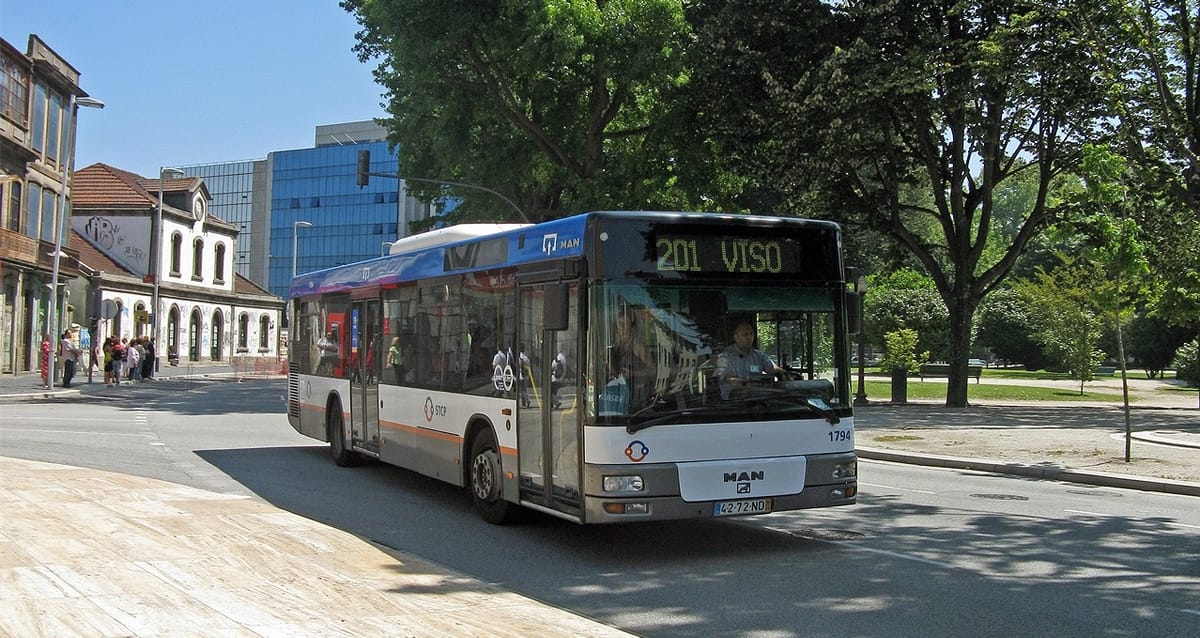
STCP says it runs the largest accessible urban bus fleet in Portugal, and all its vehicles now have a low floor and a ramp. Its rules:
- Wheelchairs travel only on buses with the universal accessibility symbol. Only those have the seat belt and reserved space.
- One wheelchair per bus, or one open pushchair.
- Board and get off by the front door. The ramp is manual and can be opened by a passenger, a companion, or the driver.
- Wheelchairs come before pushchairs. If a pushchair is in the space, it must be folded and stowed.
- On buses with an automatic rear ramp (sticker by the rear door), board at the rear. Press the STOP or ramp request button so the driver sees you. Press the blue button by the rear door to get on, and the blue button by the wheelchair space to get off.
- If the ramp is broken, STCP asks you to wait for the next bus.
- The first four seats are reserved for disabled, ill, or older passengers, pregnant women, and people carrying a child.
Lisbon: the Carris door-to-door service
Carris runs a door-to-door minibus service for people who cannot use regular buses, called the Special Reduced Mobility Service (Serviço Especial de Mobilidade Reduzida). Its current regulation, dated November 2022, sets these terms:
- Who can use it: people with 60% or more declared incapacity who cannot use the regular service. The driver's help is limited, so bring a companion if you need assistance.
- Hours: weekdays 06:30 to 21:00; weekends and public holidays 08:00 to 12:00 and 14:00 to 18:00.
- Area: trips within the city of Lisbon only.
- Joining: apply at the Carris shop in Santo Amaro or on the Carris website. Bring your Citizen Card or ID card, a signed AMIM showing 60% or more, and a recent photo. Wheelchair users who join in person do not need the AMIM.
- Cost: every passenger, including a companion, pays the on-board fare per trip. Passes are not accepted. Children up to 3 travel free on a lap.
- Equipment: wheelchairs up to 1,250 mm long, 700 mm wide, and 1,350 mm high, and 300 kg with the user. Mobility scooters cannot be carried.
How to book:
- Call 213 613 141, a line only for this service.
- Give your card number, day and time, pickup point, destination, and whether you use a manual or electric wheelchair.
- Book no later than two days before the trip. Shorter notice is accepted only if a slot is free.
- Confirm by 13:00 the day before, or the trip is cancelled.
- To cancel, call by 13:00 the day before. If you do not, you pay for that trip on your next one.
Be ready at the agreed place and time. The driver waits up to 5 minutes.
Metro
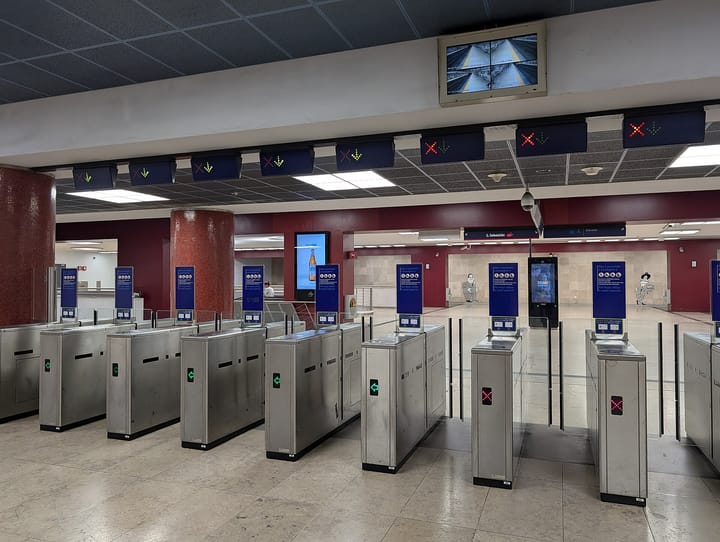
Metro do Porto was built without the usual barriers. At every station the train floor is level with the platform. Underground platforms have lifts from the street, and surface stations have ramps. Ticket machines are set at a height wheelchair users can reach.
Metro de Lisboa publishes the live status of its lines and lifts on its website. Check it before you leave. If a lift you need is out of service, plan a different station.
Assistance dogs
If you have a disability, the law gives you the right to travel on public transport with a guide dog, a hearing dog, or a service dog.
- There is no extra charge.
- Assistance dogs do not have to wear a muzzle or travel in a carrier.
- Staff can refuse the dog only if it is clearly ill, aggressive, or dirty, or is disturbing the service.
- The dog can be identified by the card or badge issued by its training school. Carry it.
- The dog must have third-party liability insurance for damage it might cause to others.
If something goes wrong
- Complain to the operator first. Use the electronic complaints book (Livro de Reclamações) online, or the paper book at the station or shop. Keep the reference number. The operator has 15 working days to reply.
- If there is no reply, or you were discriminated against, complain to the Mobility and Transport Authority (AMT), the national regulator for passenger rights. It can investigate and fine operators. It does not settle individual disputes.
- For money claims, such as a damaged wheelchair the operator will not pay for, use a consumer arbitration centre or a justice of the peace court (julgado de paz). Both are cheaper and faster than the courts.
- For pavements, kerbs, and crossings, complain to your town council.
This guide is general information, not legal advice. Operators change their procedures; check with them before you travel.
Sources
This guide is written from official sources and, where relevant, organisations' own websites.
- EUR-Lex, Regulation (EU) 2021/782 on rail passengers' rights: https://eur-lex.europa.eu/legal-content/EN/TXT/PDF/?uri=CELEX:32021R0782 (article 24: 24 hours' notice, 36-hour option not beyond 30 June 2026, 60-minute arrival; article 23: free accompanying person; article 2: limits on exemptions), checked 2 October 2026
- EUR-Lex, Regulation (EU) No 181/2011 on bus and coach passengers' rights: https://eur-lex.europa.eu/legal-content/EN/TXT/PDF/?uri=CELEX:32011R0181 (250 km scope, provisions for shorter services, 36 hours' notice, 60 and 30 minutes, refusal grounds, free companion, wheelchair compensation), checked 2 October 2026
- Your Europe (European Commission), rights for travellers with disabilities or reduced mobility: https://europa.eu/youreurope/citizens/travel/transport-disability/reduced-mobility/index_en.htm (free assistance, refusal grounds, 30-minute arrival when no time is set), checked 2 October 2026
- Your Europe (European Commission), rail passenger rights: https://europa.eu/youreurope/citizens/travel/passenger-rights/rail/index_en.htm (compensation for lost or damaged mobility equipment and temporary replacement), checked 2 October 2026
- CP, specific mobility needs and SIM: https://www.cp.pt/info/w/necessidades-especificas-mobilidade (who SIM serves, wheelchair users limited to listed stations), checked 2 October 2026
- CP, contacts for customers with specific needs: https://www.cp.pt/info/clientes-com-necessidades-especificas (808 100 746, +351 210 900 032, SIM request form), checked 2 October 2026
- CP, discount for customers with specific needs: https://www.cp.pt/info/pt/w/desconto-cne (75% and 25% at 80%, 20% at 60% to 79%, documents accepted), checked 2 October 2026
- CP, Circula PT pass: https://www.cp.pt/info/en/w/circula-pt-pass (50% and 25% bands, documents for 60% incapacity, new CP card needed), checked 2 October 2026
- Government of Portugal, Circula PT announcement: https://portugal.gov.pt/gc24/comunicacao/comunicados/circula-pt-entra-em-vigor-amanha-e-alarga-descontos-a-desempregados-de-longa-duracao-e-cidadaos-com-incapacidade (in force 1 January 2025, 50% for 60% incapacity, mainland coverage, Passe Ferroviário Verde excluded, Citizen Card and AMIM only), checked 2 October 2026
- Instituto da Mobilidade e dos Transportes, what is Circula PT: https://www.imt-ip.pt/faq/o-que-e-o-circula-pt/ (monthly and 30-day passes in metropolitan areas and intermunicipal communities), checked 2 October 2026
- Diário da República, Portaria n.º 322-A/2024/1, Circula PT regulation, consolidated: https://diariodarepublica.pt/dr/legislacao-consolidada/portaria/2024-900673775 (legal basis of Circula PT)
- STCP, accessibility: https://www.stcp.pt/pt/acessibilidade (wheelchair and ramp rules, reserved seats, assistance dogs), checked 2 October 2026
- Carris, Regulamento do Serviço Especial de Mobilidade Reduzida (November 2022): https://www.carris.pt/media/jsajbmxq/regulamento-servi%C3%A7o-especial-mobilidade-reduzida_v3.pdf (eligibility, hours, joining, fares, booking, confirmation, cancellation, equipment limits), checked 2 October 2026
- Metro do Porto, accessibility: https://www.metrodoporto.pt/pages/316 (level boarding, lifts, ramps, ticket machines), checked 2 October 2026
- Metropolitano de Lisboa, status of lines and lifts: https://www.metrolisboa.pt/estado-das-linhas-e-elevadores/ (live lift status page), checked 2 October 2026
- Diário da República, Decreto-Lei n.º 74/2007, of 27 March (assistance dogs): https://diariodarepublica.pt/dr/detalhe/decreto-lei/74-2007-520261 (legal basis of the right of access with assistance dogs; the points in the guide are as STCP states them)
- Diário da República, Decreto-Lei n.º 163/2006, of 8 August (accessibility of public spaces): https://diariodarepublica.pt/dr/detalhe/decreto-lei/163-2006-538624 (accessibility of the public highway, the council's responsibility for station approaches)
- Autoridade da Mobilidade e dos Transportes, complaints and information requests: https://www.amt-autoridade.pt/consumidor/reclama%C3%A7%C3%B5es-e-pedidos-de-informa%C3%A7%C3%B5es/ (electronic complaints book, 15 working days, AMT form for discrimination, arbitration and justice of the peace courts), checked 2 October 2026
Last verified October 2026. Rules and fees change; check the official source before acting.