June Saints' Festivals in Portugal (Santos Populares)
Researched and written with AI tools from official sources. How we make our guides
The June saints' nights in Lisbon, Porto, and Braga: the dates, which towns get a local holiday, what happens each night, and how to get home.
Last verified: October 2026.
Who this is for
- You live in or near Lisbon, Porto, Braga, or another festival town and want to join in.
- You are planning June work, appointments, or a visit around the local holidays.
- You are new to Portugal and want to know what happens each night and how to get home.
Not for you if: you want every holiday and festival of the year. Read Portuguese Festivals and Public Holidays through the Year instead.
The Santos Populares are Portugal's June street festivals for three saints. Santo António is on 13 June, São João on 24 June, and São Pedro on 29 June. The big night is always the eve: 12 June in Lisbon, and 23 June in Porto and Braga. Neighbourhoods grill sardines, play music, and dance until late. The street parties are free to enter. Each saint's day is also a local holiday in certain towns, so council offices and many public counters close there.
The dates, every year
The saints' days never move. Only the weekday changes.
| Festival | Main night | Local holiday | Towns with that holiday (examples) |
|---|---|---|---|
| Santo António | 12 to 13 June | 13 June | Lisbon, Cascais, Vila Real |
| São João | 23 to 24 June | 24 June | Porto, Braga, Vila Nova de Gaia |
| São Pedro | 28 to 29 June | 29 June | Sintra, Évora, Póvoa de Varzim, Montijo |
Other towns also take one of these days. Check your council's website for its municipal holiday.
Weekdays for the next two years:
| Day | 2027 | 2028 |
|---|---|---|
| Portugal Day, 10 June (national holiday) | Thursday | Saturday |
| Santo António eve, 12 June | Saturday | Monday |
| Santo António, 13 June | Sunday | Tuesday |
| São João eve, 23 June | Wednesday | Friday |
| São João, 24 June | Thursday | Saturday |
| São Pedro eve, 28 June | Monday | Wednesday |
| São Pedro, 29 June | Tuesday | Thursday |
The festivities last longer than the holiday. In 2026, Lisbon's festival programme (Festas de Lisboa) ran from 29 May to 28 June. Braga's São João runs for about a week before 24 June.
What the local holiday means for you
A municipal holiday applies only inside that council's borders. On 13 June, Lisbon's council services close, but neighbouring councils work normally.
- If you work for a private employer, the law makes the municipal holiday optional. You get it only if your contract or collective agreement includes it. Many employers give it anyway, so ask in advance.
- If you have an appointment, check first. Council services close, and some public counters do too. For example, the Citizen Shops (Lojas do Cidadão) in Braga and Vila Nova de Gaia close on 24 June, and Cascais and Vila Real close on 13 June.
- If the holiday falls on a weekend, as Lisbon's does in 2027, the law gives no replacement day.
Portugal Day on 10 June is a national holiday for everyone. Some employers give a bridge day (ponte) between it and a nearby saint's day. That is not a legal right.
Lisbon: Santo António
Lisbon's festival is the Festas de Lisboa, run by EGEAC, the city council's culture company. It publishes the full programme each May.
The Marchas Populares. Neighbourhood groups compete with costumes, their own song, and choreography. In 2026, 20 marchas competed. Two more, a children's march and a markets march, took part outside the competition. The 2026 theme was "Somos Lisboa, Somos Europa", and Alfama won.
- Late May: the arena shows. Each marcha performs indoors over three nights. In 2026 these were 29 to 31 May at the MEO Arena, from 21:00.
- 12 June: the parade on Avenida da Liberdade. It starts at 21:00 and lasts several hours. Arrive early for a front spot on the pavement.
- Later in June: the school children's marches. In 2026 they took place on 20 June at Alameda Dom Afonso Henriques.
Santo António weddings (Casamentos de Santo António). On 12 June, a group of couples marry in a ceremony organised as part of the festival. The tradition began in 1958. In 2026, 16 couples took part, with a civil ceremony at City Hall at 11:30 and a religious one at Lisbon Cathedral at 14:00.
The arraiais. These are the street parties: trestle tables, paper garlands, a sardine grill, a bar, and a small stage. They run on many evenings through June and are fullest on 12 June. The traditional ones are in Alfama, Mouraria, Graça, Castelo, Bica, Madragoa, and Bairro Alto. Arrive early in Alfama, which is the busiest.
Other events. The Corrida de Santo António, a 10 km run or 4 km walk in Belém, is held in early June. In 2026 it was on 7 June.
Getting around on 12 June. In 2026 the Lisbon metro ran on all four lines until 03:00 on the night of 12 to 13 June. Avenida station on the blue line closed at 19:30 on police advice. Expect similar arrangements each year, and check Metro de Lisboa's announcement a few days before. Trams through Alfama and Graça are packed, so walking is often quicker.
Porto: São João
Porto's São João is the city's biggest night. From the evening of 23 June to dawn on 24 June, the centre turns into one street party. The city council publishes the programme in early June.
What happens.
- Plastic hammers (martelinhos). People tap strangers on the head with a squeaky plastic hammer. It is friendly and expected. Some people carry a leek (alho-porro) instead, the older tradition.
- Concerts. Free stages across the city. In 2026 the three main stages were at Avenida dos Aliados, Cordoaria (Largo do Amor de Perdição), and Casa da Música, with another by the river.
- Fireworks at midnight. In 2026 the show lasted 12 minutes, over the Douro between the Luís I and Arrábida bridges. The riverside fills up early. For a calmer view, go higher up on either side of the river.
- Sky lanterns (balões). Launches are allowed only in a set window, when the airport's airspace closes for safety. In recent years it has been 21:45 on 23 June to 01:00 on 24 June. Check the announcement each year.
Getting around. Porto and Gaia close many roads in the centre from the evening of 23 June to the morning of 24 June. In past years, the Luís I bridge's upper deck has closed to walkers for the night, and some metro and bus links across the river have stopped for a few hours. The councils advise you to leave the car at home and use the metro and STCP buses, which run extra services. Check their timetables a few days before.
Braga: São João
Braga's São João is the oldest São João festival in Portugal and one of the largest. The festival association and the city council organise it. It runs for about a week up to 24 June.
- 23 June: bands, folk groups, giants, and big-heads fill the historic centre all day. At night, the Cortejo das Rusgas, a parade of folk groups, crosses the city from Campo das Hortas to Parque da Ponte. Fireworks and a night in the streets follow.
- 24 June: in the morning, the Cortejo Sanjoanino brings the cart of herbs, King David (Rei David), and the shepherds through the streets. Masses follow. In the evening, the São João procession winds through the historic centre.
- During the week: concerts, folk shows, a fairground, and the contest of São João cascades (small decorated altars).
Leeks (alhos-porros) are part of the night in Braga too.
São Pedro: the last saint
São Pedro closes the cycle on the night of 28 to 29 June. In Póvoa de Varzim, it is the town festival. The neighbourhoods compete with marches, build decorated thrones, and gather round bonfires with grilled sardines on the night of 28 June. A procession of the three popular saints follows on the afternoon of 29 June. Montijo, Sintra, Évora, and other towns also celebrate and take 29 June as a local holiday. Check each council's website for its programme.
Food, drink, and the manjerico
The menu is much the same at every arraial:
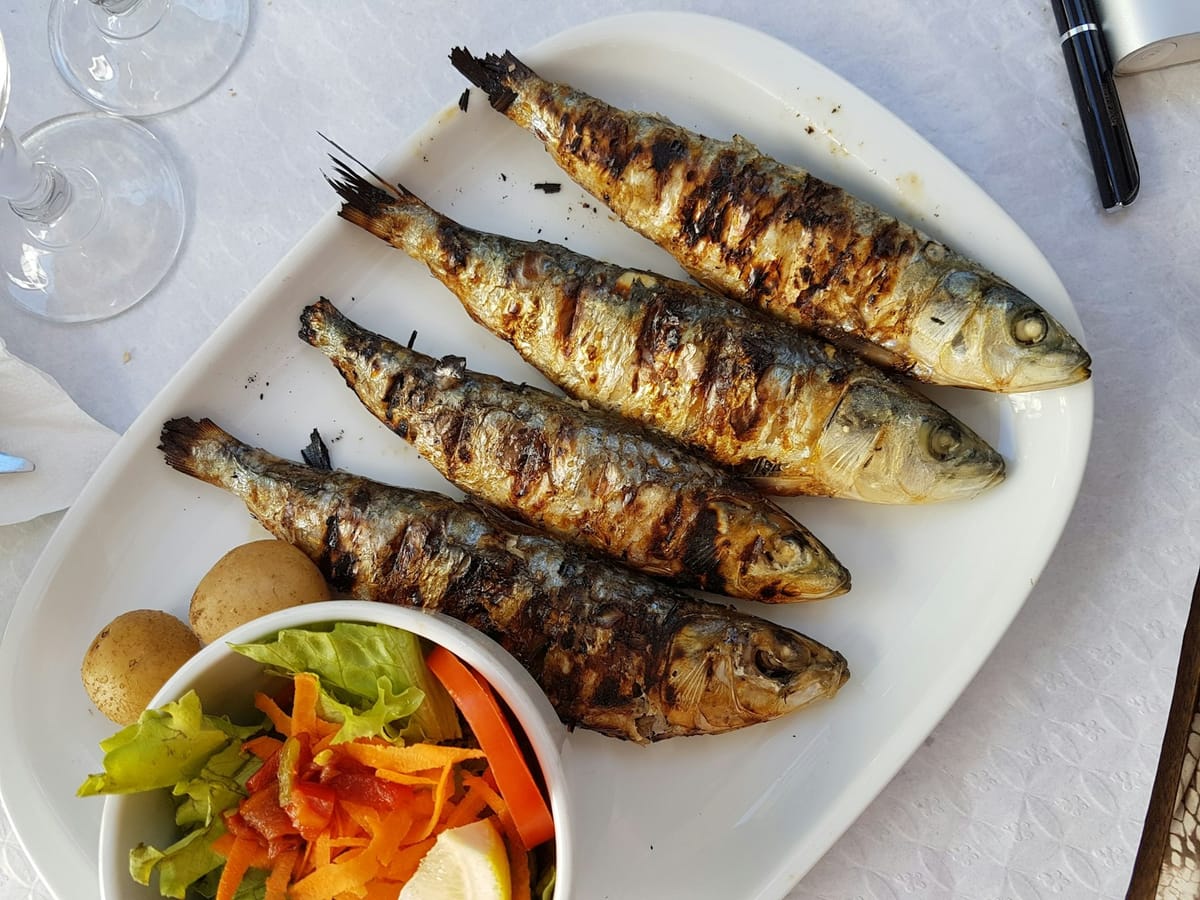
- Grilled sardines (sardinhas assadas), often eaten on a slice of bread.
- Caldo verde, a soup of shredded greens and potato with a slice of chouriço.
- Bifana, a marinated pork sandwich.
- Grilled pork at the larger stalls.
- Beer, house wine, sangria, and soft drinks.
Stalls set their own prices. Bring small notes.
The manjerico. This is a small pot of bush basil with a paper flower and a flag carrying a short rhyming verse (quadra). People give them as gifts, above all around 12 June in Lisbon. To smell it, brush the leaves with your hand and smell your hand.
Practical tips
- Carry cash. Many stalls prefer cash, and queues at cash machines are long on peak nights.
- Wear closed shoes. Cobbles get slippery, and there are open grills.
- Plan your way home before you go out. Know the last metro or train, or where the night buses stop.
- Bring a light layer. Nights can be cool by the river in the early hours.
- Expect little sleep if you live in the centre. Music and fireworks go on late. For your rights on noise the rest of the year, read Dealing with Noise and Neighbours in Portugal.
- Mind your belongings. Crowds are dense. Keep your phone and wallet in a front pocket.
- Join in. The arraiais are the neighbourhood's own party, and people who take part are welcome.
This guide is general information, not legal advice. Programmes, transport, and closures change each year, so check the council and operator announcements before you go.
Sources
This guide is written from official sources and, where relevant, organisations' own websites.
- EGEAC, Festas de Lisboa 2026 programme (PDF): https://egeac.pt/wp-content/uploads/2026/05/festas-de-lisboa-2026-web.pdf (29 May to 28 June, MEO Arena nights and time, parade date and time, 2026 theme, weddings since 1958 and 2026 times, children's marches on 20 June at Alameda, Corrida de Santo António on 7 June, arraiais), checked 1 October 2026
- EGEAC, Marchas Populares 2026 draw: https://egeac.pt/apresentacao-e-desfile-das-marchas-populares-de-lisboa-2026/ (20 marchas in competition, two outside it), checked 1 October 2026
- EGEAC, Alfama vence Marchas Populares 2026: https://egeac.pt/alfama-vence-marchas-populares-2026/ (2026 winner), checked 1 October 2026
- Metro de Lisboa, "O Metro leva-te aos Santos e traz-te de volta" (11 June 2026): https://www.metrolisboa.pt/institucional/2026/06/11/o-metro-leva-te-aos-santos-e-traz-te-de-volta/ (all lines until 03:00, Avenida station closed at 19:30), checked 1 October 2026
- Câmara Municipal do Porto, São João Porto 2026 programme news: https://www.porto.pt/pt/noticia/sao-joao-porto-2026-tony-carreira-dama-e-nunca-mates-o-mandarim-animam-festas-da-cidade (stages, midnight fireworks of 12 minutes between the Luís I and Arrábida bridges), checked 1 October 2026
- Câmara Municipal do Porto, Noite de São João 2026 traffic information (PDF): https://cms.porto.pt/documents/INFOMAIL-NOITE-SAO-JOAO-2026.pdf (three main stages, road closures on 23 and 24 June), checked 1 October 2026
- Câmara Municipal do Porto, "Porto e Gaia preparam noite de São João com plano de mobilidade e segurança": https://www.porto.pt/pt/noticia/porto-e-gaia-preparam-noite-de-sao-joao-com-plano-de-mobilidade-e-seguranca (bridge, metro, and bus arrangements; ANAC sky lantern window 21:45 to 01:00; earlier edition), checked 1 October 2026
- Câmara Municipal do Porto, Celebrating Porto patron saint, São João: https://www.porto.pt/en/news/celebrating_porto_patron_saint_sao_joao (24 June public holiday in Porto, basil and sardines), checked 1 October 2026
- Associação de Festas de São João de Braga, "Milhares viveram a maior noite do ano" (24 June 2026): https://saojoaobraga.pt/2026/06/24/milhares-viveram-a-maior-noite-do-ano-sao-joao-de-braga-fez-se-entre-tradicao-musica-e-alhos-porros/ (23 June programme, Cortejo das Rusgas route, leeks), checked 1 October 2026
- Associação de Festas de São João de Braga, "São João de Braga despediu-se até ao próximo ano" (25 June 2026): https://saojoaobraga.pt/2026/06/25/sao-joao-de-braga-despediu-se-ate-ao-proximo-ano-numa-celebracao-de-fe-tradicao-e-identidade/ (oldest São João festival, Cortejo Sanjoanino with the cart of herbs, King David and shepherds, procession), checked 1 October 2026
- Câmara Municipal da Póvoa de Varzim, História da festa de S. Pedro: https://www.cm-pvarzim.pt/comunicacao/programacao-eventos/s-pedro/arquivo-2008/historia-da-festa-de-s-pedro/ (29 June municipal holiday since 1974, neighbourhood thrones, bonfires, procession of the popular saints), checked 1 October 2026
- Câmara Municipal de Évora, Feriado Municipal: https://www.cm-evora.pt/municipe/evora/concelho/feriado-municipal/ (29 June), checked 1 October 2026
- Câmara Municipal do Montijo, horários dos equipamentos municipais nas Festas de S. Pedro: https://www.mun-montijo.pt/viver/noticia/horarios-equipamentos-municipais-festas-s-pedro (29 June municipal holiday), checked 1 October 2026
- Junta de Freguesia de Queluz, Dia de São Pedro, Feriado Municipal: https://jfqueluz.pt/noticias-dia-de-sao-pedro---feriado-municipal-2026 (29 June municipal holiday in Sintra), checked 1 October 2026
- Câmara Municipal de Lisboa, Feriados 2025 notice (PDF): https://informacoeseservicos.lisboa.pt/fileadmin/espacos/ficheiros/CDMAL_Feriados_2025_aviso.pdf (13 June municipal holiday in Lisbon), checked 1 October 2026
- gov.pt, Loja de Cidadão de Braga: https://www2.gov.pt/locais-de-atendimento-de-servicos-publicos/loja-de-cidadao-de-braga (closes on the municipal holiday, 24 June), checked 1 October 2026
- gov.pt, Loja de Cidadão de Vila Nova de Gaia: https://www2.gov.pt/locais-de-atendimento-de-servicos-publicos/loja-de-cidadao-de-vila-nova-de-gaia (closes on the municipal holiday, 24 June), checked 1 October 2026
- gov.pt, Loja de Cidadão de Cascais: https://www2.gov.pt/locais-de-atendimento-de-servicos-publicos/loja-de-cidadao-de-cascais (closes on the municipal holiday, 13 June), checked 1 October 2026
- gov.pt, Loja de Cidadão de Vila Real: https://www2.gov.pt/locais-de-atendimento-de-servicos-publicos/loja-de-cidadao-de-vila-real (closes on the municipal holiday, 13 June), checked 1 October 2026
- Diário da República, Código do Trabalho (Lei n.º 7/2009 of 12 February), consolidated: https://diariodarepublica.pt/dr/legislacao-consolidada/lei/2009-34546475 (article 234, compulsory holidays including 10 June; article 235, municipal holiday optional by collective agreement or contract), checked 1 October 2026
Last verified October 2026. Rules and fees change; check the official source before acting.