Escalators at Cais do Sodré Have Been Broken for 2,500 Days Because Two State Companies Cannot Agree Who Owns Them
Metro figures cover 234 escalators, 133 lifts and 10 travelators across 46 stations. February 2026 was the worst month yet, with 38 lifts and 40 escalators stopped at once. One set at Cais do Sodré has not moved since 2019, stranded by a dispute with Infraestruturas de Portugal.
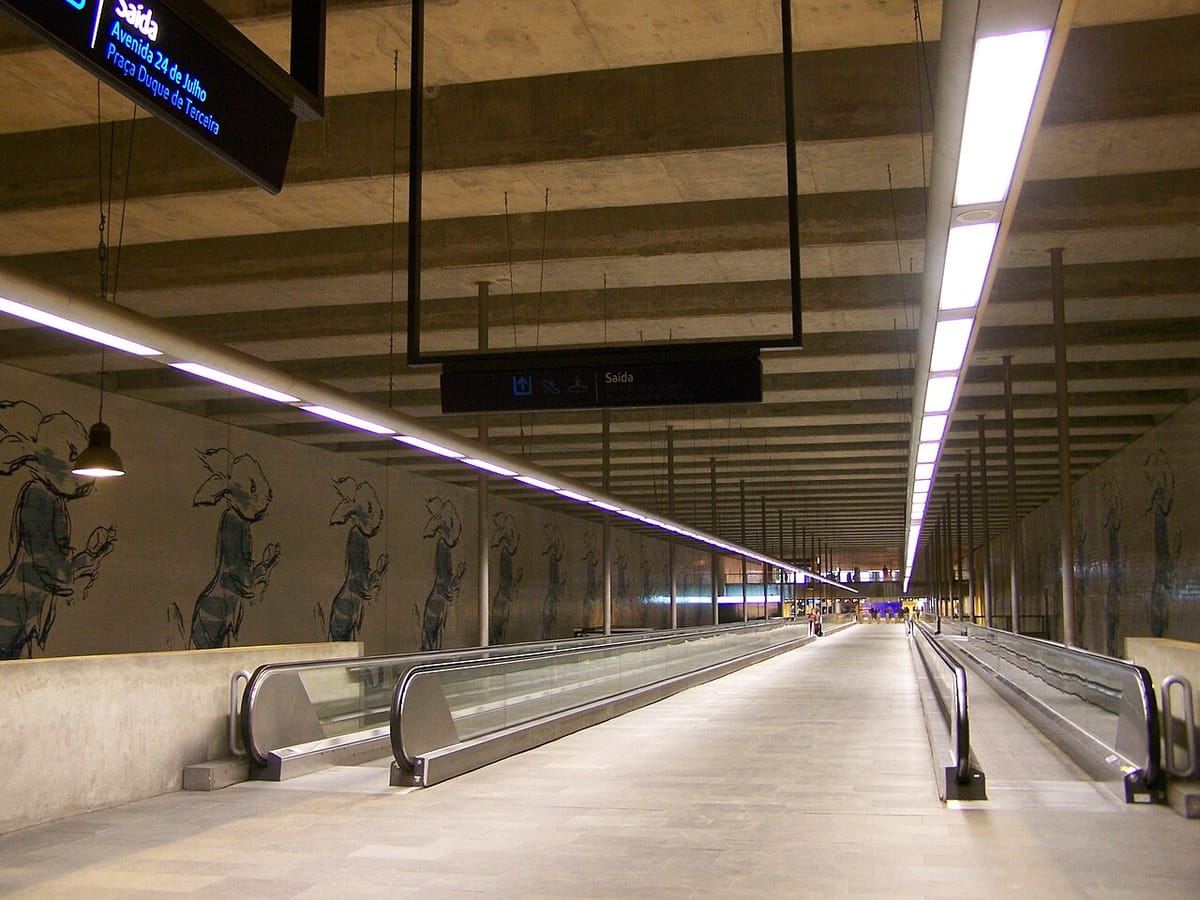
Somewhere under Cais do Sodré there is a set of escalators that has not moved since 2019. Roughly 2,500 days out of service makes it the record holder on the Lisbon underground, and the reason is not a missing part. It is a disagreement between Metropolitano de Lisboa and Infraestruturas de Portugal, which runs the Cascais-line railway station above, over which of the two owns the problem.
The detail comes from figures the Metro supplied to Observador, published on Monday, covering the full mechanical estate: 234 escalators, 133 lifts and 10 travelators, 377 machines in all, spread across 46 stations and running an estimated 18 hours a day.
From under 5 percent to a quarter of the lifts
Until 2020 the share of this equipment out of service on any given day sat below 5 percent. It then climbed steadily. Escalator unavailability reached 10.7 percent and passed 13 percent in both 2024 and 2025. Lifts deteriorated faster: 16.7 percent in 2024 and close to 25 percent last year, meaning one lift in four was out.
February 2026 was the worst month on record: 30 percent of lifts and 17 percent of escalators immobilised, 38 lifts and 40 escalators stopped at once. A month earlier, six escalators had been broken for more than 1,000 days.
Lifts matter disproportionately even though fewer passengers notice them. For anyone using a wheelchair, a walking frame or a pushchair, the lift is frequently the only route between street and platform, so a broken one does not inconvenience a journey, it cancels it. Four blue-line stations still have no mechanical equipment at all: Alto dos Moinhos, Laranjeiras, Jardim Zoológico and Praça de Espanha, the last of which is due to get lifts before the end of August.
One contract, five years, no penalties
Called before Parliament in late March, Metro president Cristina Vaz Tomé described maintenance as a chronic problem that had worsened over five years and sharply over the last two. Her diagnosis was contractual. Between 2021 and 2025 all escalator, travelator and lift maintenance on four lines sat with a single supplier, the Portuguese arm of the German firm Schmitt Elevadores, under a €1.8 million agreement signed in November 2020. An official Metro source told Observador the contracts allowed for termination and were run for the full five years anyway while the failure rate climbed.
The numbers have improved since. By 2 June only 11 lifts and nine escalators were out. Fifteen short-term contracts now run in place of the single supplier, at the same time as the company is studying longer operating hours with CP and Transtejo, and a pilot at Baixa-Chiado and Aeroporto has gone to Kone: 26 machines, five years, €6 million to 2030, with a dedicated technical crew on call around the clock in the second phase.
What this means for passengers
- Plan step-free journeys, do not assume them. Check the Metro's equipment status before committing to a route with a pushchair, a wheelchair or a suitcase.
- Cais do Sodré is the outlier. Most current faults are measured in weeks; the 2,500-day case is an ownership dispute, not a maintenance failure.
- Reliability is going to cost more. The pilot alone will cost €1.2 million this year for two stations, roughly what the Metro spent on maintenance and repair across the whole network in 2024 and again in 2025.
- Five stations are getting new escalators. A €10.5 million tender covers Alameda, Parque, Terreiro do Paço, Oriente and Odivelas, and for the first time bundles maintenance into the replacement contract.
The real test arrives in 2027, when the temporary contracts expire and the Metro settles on a permanent model: by line or by supplier type, and with what penalties. Whether the Cais do Sodré escalators outlast that decision is a question two state companies still have not answered.