ESA's Euclid Telescope Releases 1.7 Million GB of Data on More Than a Billion Objects, With Two Lisbon Astronomers Leading Its Survey Paper
Euclid's DR1-Foundation release covers 1,900 square degrees of sky, 15,000 candidate gravitational lenses and 60 million candidate quasars. Researchers at the University of Lisbon and IA head the paper on how the surveys were run, and anyone can explore the data or volunteer to classify galaxies.
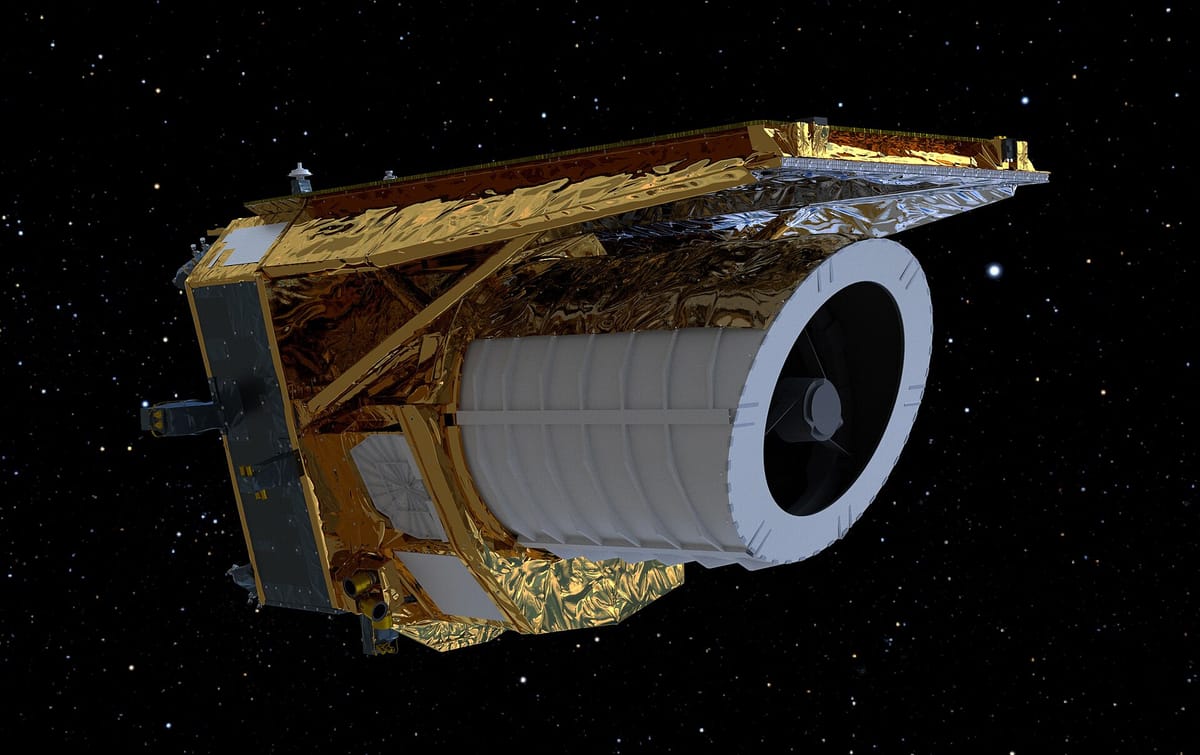
The European Space Agency (ESA) has published the first major batch of data from its Euclid space telescope, and two researchers based in Lisbon head the author list of the paper that describes how the telescope's sky surveys were carried out. The release, called DR1-Foundation, went public on 12 November and captures the light of more than a billion objects across a patch of sky ESA puts at the size of 9,500 full Moons.
It holds about 13 months of observations and around 1.7 million gigabytes of data covering 1,900 square degrees of sky. ESA says it includes some 15,000 candidate strong gravitational lenses (the largest such catalogue ever assembled), more than 60 million candidate quasars, and spectra for more than 160 million sources. Earlier Euclid releases covered only a few days of observing over about 60 square degrees.
The Portuguese part
Among the scientific papers released alongside the data, "The Euclid surveys at DR1" sets out how the mission's surveys were planned and executed, from the requirements and constraints to the operational plans used to point the spacecraft. Its first two authors, I. Tereno (the corresponding author) and J. Dinis, are both listed with the Departamento de Física (Physics Department) of the Faculdade de Ciências da Universidade de Lisboa (Faculty of Sciences of the University of Lisbon) and the Instituto de Astrofísica e Ciências do Espaço (Institute of Astrophysics and Space Sciences, IA). The paper reports that the main Euclid Wide Survey now spans 2,100 square degrees in two regions, of which 1,900 have passed higher-level checks.
The author list also includes researchers at IA's Porto node and at the Faculdade de Ciências da Universidade do Porto (Faculty of Sciences of the University of Porto). The Euclid Consortium thanks the Fundação para a Ciência e a Tecnologia (Foundation for Science and Technology, FCT), Portugal's public research funder, among the national agencies supporting the mission. SIC Notícias reported the Portuguese participation on Saturday.
Euclid launched in July 2023 and began routine science observations in February 2024. It is imaging billions of galaxies and measuring the distances to millions of them, to investigate dark energy and dark matter and to build a 3D map of the "cosmic web", the mostly invisible mesh of filaments along which galaxies cluster. The consortium behind its instruments and data analysis gathers more than 2,000 scientists from 300 institutes in 15 European countries, the United States, Canada and Japan.
How anyone in Portugal can look at the data
The release is public. ESA's DR1 page links to the data, tutorials and image viewers, and the Euclid Data Space platform lets users browse and analyse it. Schools, amateur astronomers and curious residents with no research background can also help through citizen science projects on the Zooniverse platform: Galaxy Zoo: Euclid asks volunteers to classify galaxy shapes, and Space Warps: ESA Euclid asks them to spot gravitational lenses. ESA says thousands of volunteers on Space Warps helped find the lenses in this release.
What comes next
Large as it is, the release covers only about 14 percent of the sky Euclid will eventually survey. ESA lists 16 June 2027 as the date for the complete Data Release 1, which will add weak-lensing measurements and the higher-level products scientists need for galaxy clustering studies. The papers published this week are preprints and still have to go through journal review.