A Student Renting Away From Home Can Take up to 400 Euros Off the Family's IRS Bill, if the Landlord and the Student Both Tell the Tax Office
Families deduct 30 percent of a student's rent, capped at 400 euros, when the school is more than 50 km from home. The receipt must say so, the student must register on the tax portal each year, and halls of residence count too.
A new academic year means many families are once again paying rent for a son or daughter who studies in another city. The IRS (personal income tax) code gives some of it back, but only if the student, the landlord and the family each do their part on the Portal das Finanças (tax portal).
Who qualifies
The rule is in Article 78-D of the IRS code, on education expenses. Rent counts as an education expense when it is paid for a member of the household who is no older than 25 and attends a school or university in the national education system, or one the ministries recognise as equivalent. The school must be more than 50 kilometres from the household's permanent residence.
The student does not have to change the address on their citizen card, the Autoridade Tributária e Aduaneira (Tax and Customs Authority, AT) says in its leaflet on renting to students living away from home.
How much it is worth
The family deducts 30 percent of the rent from its tax bill, up to 400 euros a year. That ceiling is reached quickly: 400 euros is 30 percent of about 1,333 euros of rent, a little over 111 euros a month across a full year.
The rent also sits inside the overall cap on education deductions. That cap is normally 800 euros per household, and it rises by 300 euros, to 1,100 euros, when the difference comes from rent. So a family whose tuition fees, school meals and books already fill the 800 euro cap can add at most 300 euros for rent, not 400.
The deduction cannot be combined with the general deduction for housing costs in Article 78-E on the same property.
Three steps, three people
The landlord must issue the right document and say what it is for. That means an electronic rent receipt, or an invoice-receipt under business code 68200 (renting of real estate), stating that the tenant is a student living away from home. A landlord exempt from both issues a written receipt saying the same and files the annual rent return (Modelo 44).
The student must register on the portal. Under "Registo de Estudante Deslocado" (registration as a student living away from home), they select the contract, give the family's parish of residence and state the period away, at most 12 months. The registration is renewed every year.
The family must check its invoices. Where the rent is billed on an invoice reported through e-Fatura, the law requires the taxpayer to flag it on the portal as rent for a student living away from home by the end of February of the following year, and the AT asks for it to be placed under the education sector.
University halls and youth hostels
The law speaks of renting "a property or part of a property", which on its face leaves out halls of residence. The AT reads it more widely. In binding ruling 25466, signed off on 15 January 2025, it says it already accepts accommodation in university residences run under business code 55900 as an education expense, even outside e-Fatura.
The same ruling went further for a student from Aveiro who could not get a place in his Lisbon institution's residence and was housed in a Pousada da Juventude (youth hostel) under an agreement between the school and the hostel. It was a contract to use a room, not a lease, and the hostel had a different business code. The AT accepted the payments anyway, citing the housing crisis and equal treatment with students in halls, and told the family to enter them in Table 6C1 of Annex H of the IRS return.
Our guide to renting a home in Portugal explains the electronic rent receipt, and students from the islands have separate rules for travel costs.
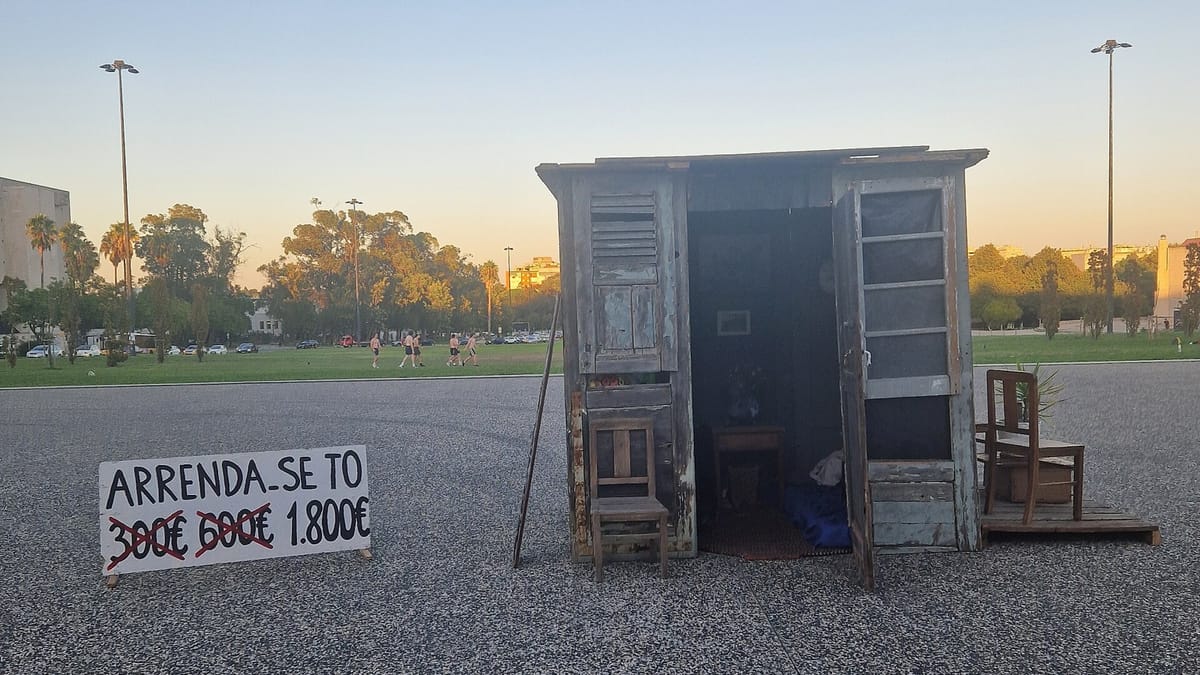
Feature image: "Arrenda-se T0", an installation by the artist Ticiano Rottenstein about student housing costs, outside the University of Lisbon rectorate in September 2023. Photo by RitaFMatos (CC BY-SA 4.0), via Wikimedia Commons.