Portugal's Jobless Register Turned Upward in July, Ending Five Straight Months of Decline at 269,100 People
The IEFP counted 269,100 registered unemployed in July, down 8.1% on the year but up 1.7% on June: the first monthly rise since February. Manual and service workers left the register in numbers while managers and specialists were added to it.
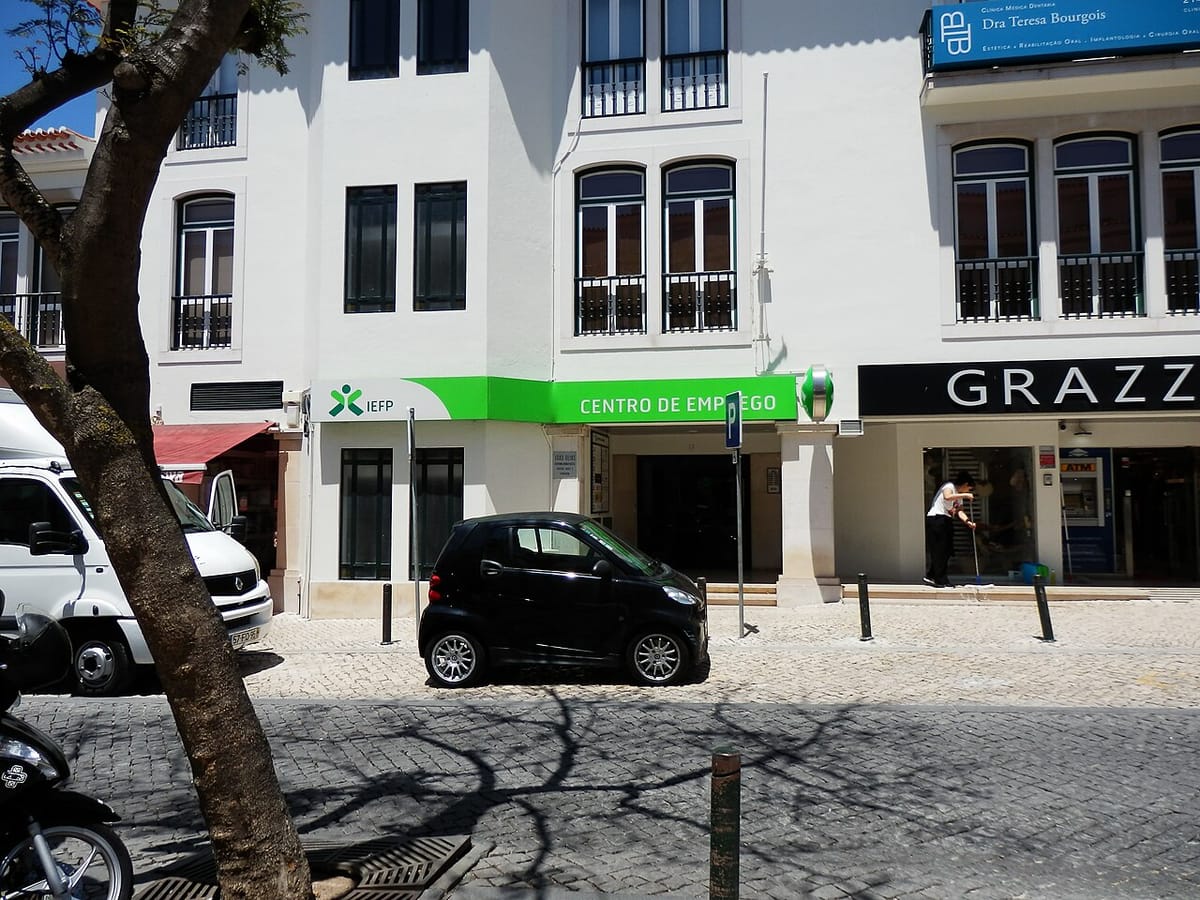
There were 269,100 people registered as unemployed at Portugal's job centres at the end of July, according to figures released on Thursday by the IEFP (Instituto do Emprego e Formação Profissional, the public employment service). That is 23,725 fewer than a year earlier, a fall of 8.1%. It is also 4,583 more than in June, a rise of 1.7%, and the first monthly increase since February.
Five consecutive months of decline have therefore come to an end. The register had been falling without interruption since the winter, a run this publication reported on in July when the year-on-year drop reached almost 29,000 people. That annual improvement is still firmly in place. The month-on-month direction is not.
Two numbers, two different questions
It is worth being precise about which unemployment figure this is, because Portugal publishes two and they rarely agree. The IEFP number is an administrative count: it records people who have actually walked into a centro de emprego and signed on, and the 269,100 represent 66.9% of a wider file of 402,238 employment-related requests. Separately, INE (the national statistics institute) publishes a survey-based unemployment rate, which fell to 5.3% earlier this month, its lowest since 2011.
The two series answer different questions. INE counts anyone actively looking for work and available to start, whether or not they have registered with the state. The IEFP counts registrations, which are shaped by whether signing on brings any benefit: someone who has exhausted their subsídio de desemprego, or never qualified, has less reason to keep the file open. Neither is wrong. They should not be reconciled into a single story.
Where the annual fall came from, and where it did not
The year-on-year improvement is concentrated among people with a working history rather than newcomers. Registrations from those seeking a new job after previous employment fell by 20,664 over twelve months, those unemployed for less than a year fell by 13,450, and the over-25s fell by 19,582.
By occupation, the sharpest annual declines were among agricultural and fisheries workers, down 20.6%, followed by skilled industrial workers at 13.6%, machine operators at 10.9%, administrative staff at 10.4% and service and security workers at 10.2%. Two groups moved the other way: legislators and senior managers rose 8.3%, and specialists in intellectual and scientific occupations rose 0.9%.
That split is the detail worth holding on to. Portugal's labour market is absorbing manual, industrial and service workers at a good clip while quietly adding graduates and managers to the register. It sits awkwardly beside the second-quarter wage data, which showed average gross pay up 5.1% but real gains of only 1.8% once inflation was taken out.
Regionally, every area recorded a year-on-year fall. The North led at 13%, ahead of Madeira at 8.5% and the Azores at 6%. Month-on-month, the increases came in the Alentejo, up 2.9%, and in the Centre.
Employers listed 18,739 unfilled vacancies through the IEFP in July, 1.4% fewer than a year earlier but 4.1% more than in June. A separate cut of the data counted 4,181 couples in which both partners are registered as unemployed, down 10.2% on the year and unchanged on the month; of everyone registered who is married or in a partnership, 8,362 people, or 7.9%, have a spouse also on the file.
How much of this is just July?
Some of it, almost certainly. July is when a cohort of school and university leavers reaches the labour market and when certain fixed-term contracts run out ahead of the August shutdown. A 1.7% monthly rise after five months of falls is not, on its own, a turn in the cycle, and the annual comparison remains solidly negative.
What would make it a turn is a repeat in August and September, particularly if the increases keep landing among managers and specialists rather than seasonal workers. That is the line to watch when the next release lands.
What this means for foreign residents
- Registering has value beyond the benefit. Signing on at a centro de emprego is how you access IEFP training, the Cheque-Formação schemes and vacancy listings, and it is a required step for claiming unemployment benefit. Legal residents with the right to work can register regardless of nationality.
- Check your contribution record before you need it. Drawing the subsídio de desemprego requires 360 days of contributions in the two years before you stop working. Time contributed in another EU country can often be aggregated, but only if you obtain the right documentation before you leave that country.
- The graduate end of the market is the soft spot. If you are job-hunting in a professional or managerial role, the rise in registrations among specialists and senior managers is the most relevant signal in this release, and it runs against the cheerful headline rate. Our guide to finding work here covers where the demand actually is.
- Vacancies through the state channel are a partial picture. The 18,739 listed openings capture only what employers choose to route through the IEFP. Large parts of the technology, tourism and professional-services markets never appear there, so treat the figure as a floor and not a measure of demand.
- Household eligibility can shift. Where both partners are registered as unemployed and there are dependent children, benefit is enhanced by 10%. It is a small provision that is easy to miss when only one partner is dealing with the paperwork.
Taken together, the July file describes a labour market that is still much healthier than a year ago but has stopped improving month to month. For anyone planning a move, a job change or a contract renewal this autumn, the annual figure is the reassuring one and the monthly figure is the one that will tell you sooner whether the ground is shifting.