Markets, Business & Tech Briefing: Floating-Concrete Wind Push, Salary-Ad Rule Dropped, Beer Bucks Europe
📋 In This Edition
- Weekend Wrap: A Quiet Exchange, a Busy Backstory
- Tech & Energy Focus: Portugal Bets on Floating Concrete for Offshore Wind
- Business & Regulatory: Salary-Ad Rule Dropped, Beer Bucks Europe
- Markets, Bonds and the Euro: A Softer Friday, a Firmer Week
- The Week Ahead
Weekend Wrap: A Quiet Exchange, a Busy Backstory
There is no trading in Lisbon this Sunday, 9 August, so this is a weekend edition — but the calm on the exchange belies how much has been moving beneath it. The market shut on Friday having clawed out a small weekly gain even as the benchmark slipped on the day, and with earnings season now firmly in the rear-view mirror the story has shifted from quarterly numbers to the slower-burning themes that will shape the autumn: the money still flowing out of the Plano de Recuperação e Resiliência (Recovery and Resilience Plan) and into Portugal's energy transition, the fine print of the country's belated pay-transparency rules, and a domestic drinks industry quietly defying a shrinking European market. None of it moved a share price this weekend, but all of it says something about where corporate Portugal is heading.
Tech & Energy Focus: Portugal Bets on Floating Concrete for Offshore Wind
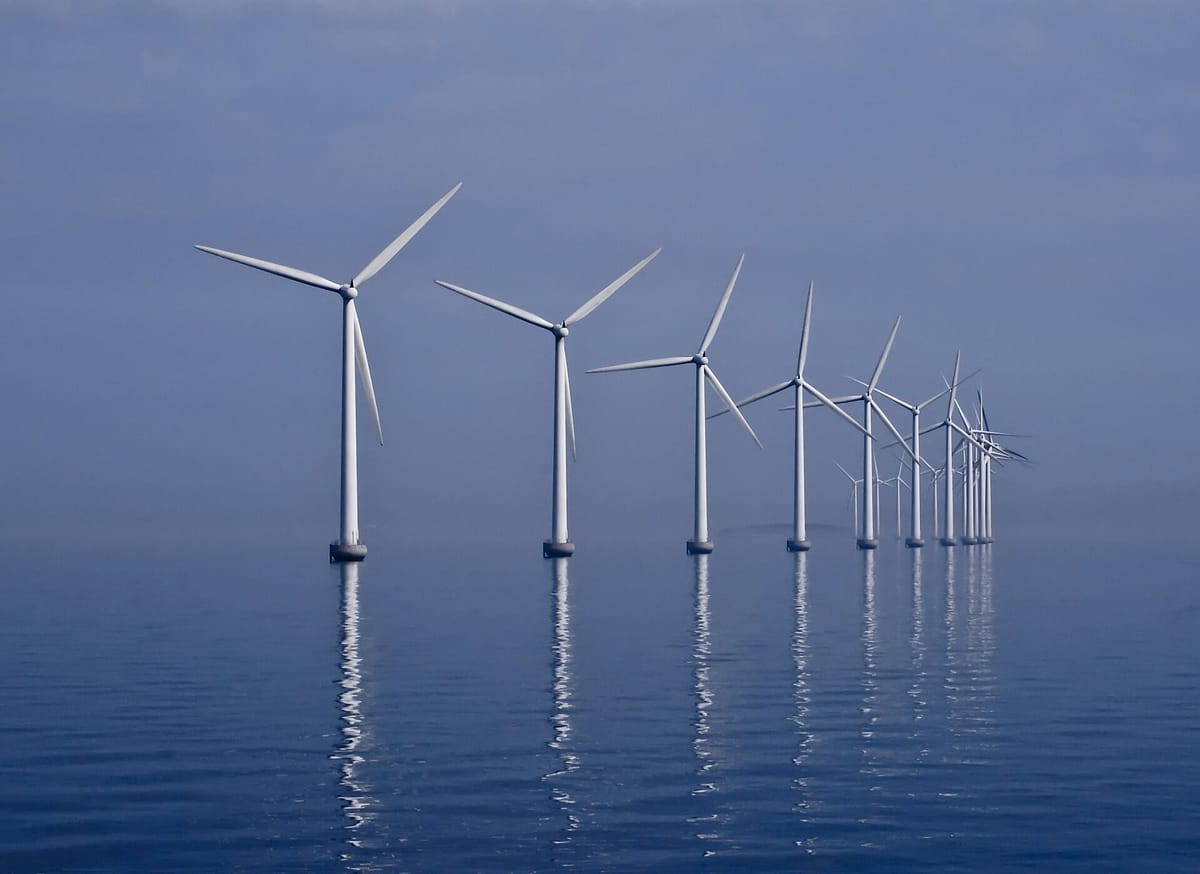
The most eye-catching development of the weekend came not from a boardroom but from a shipyard. A Portuguese consortium has unveiled a floating platform built from specially engineered concrete rather than the steel that dominates the offshore-wind industry, a design meant to carry turbines in the deep Atlantic waters off Portugal's coast where fixed foundations are impractical. The structure relies on hollow internal chambers to provide buoyancy and stability, and uses a low-permeability, crack-resistant marine concrete that its makers say can survive more than 50 years in punishing sea conditions — potentially cheaper to build and longer-lived than the steel floaters used elsewhere.
The project is led by the engineering group Etermar Energia, with the cement maker Secil supplying the marine concrete, Wavec Offshore Renewables handling monitoring and a digital twin, and further input from the research institute INESC-TEC, the pre-stressing specialist VSL International and the blue-economy cluster Fórum Oceano. It is backed by €3.2 million from the PRR's energy-transition "mobilising agendas," channelled through IAPMEI — Agência para a Competitividade e Inovação (Agency for Competitiveness and Innovation). A prototype is now under construction at Etermar's facilities and faces a two-year monitoring period to prove the concept. For a country with world-class wind resources but almost no offshore capacity in the water, a home-grown, lower-cost floating platform is exactly the kind of industrial bet Lisbon has been trying to nurture — and one that leans on Portugal's existing strengths in cement and marine engineering rather than importing the technology wholesale.
Business & Regulatory: Salary-Ad Rule Dropped, Beer Bucks Europe
Employers got a reprieve, and job-seekers a disappointment, from the government's draft law transposing the European Union's pay-transparency directive. Published at the start of the week, the proposal pointedly stops short of forcing companies to state a salary or salary range in their job advertisements — the single change that recruitment platforms and candidates had most expected — and it does not require pay to be disclosed before an interview either. What survives is the heavier back-office machinery: firms with more than 250 workers will have to report their gender pay gap every year, and those with 100 to 249 employees every three years, with the ACT — Autoridade para as Condições do Trabalho (Working Conditions Authority) — policing compliance. The softer landing spares Portuguese employers the awkwardness of publishing pay bands their rivals could read, but it also blunts the directive's central promise of wage transparency at the very first point of contact.
In the consumer economy, one sector is swimming against the European tide. Beer sales in Portugal rose 1.67% in the first half of 2026 against the same period a year earlier, according to the industry body APCV — Cervejeiros de Portugal (Brewers of Portugal) — a modest gain, but a striking one set against European Union figures showing beer consumption across the bloc falling more than 3% last year. The growth is being driven almost entirely by the alcohol-free segment, where sales climbed around 12% and production nearly 17% in the half, extending an 11.5% advance in 2025. The brewers were also quick to remind the state of their fiscal heft, citing a study that every euro of tax the sector pays directly generates some €37 for the public purse once the wider supply chain, hospitality and jobs are counted — a lobbying line, but one that underlines how a beer industry worth billions and a couple of percent of GDP has found a genuine growth engine in the drinks Portuguese consumers are increasingly choosing to order without the alcohol.
Markets, Bonds and the Euro: A Softer Friday, a Firmer Week
The market itself signed off the week on a mildly sour note that did little to spoil the bigger picture. The PSI index (Portuguese Stock Index) slipped 0.46% on Friday to close at 9,181.38 points, bucking small gains on the Paris and Madrid benchmarks, with Sonae, EDP — Energias de Portugal (Portugal Energy) — and NOS among the day's weakest names and the cork producer Corticeira Amorim and the retailer Jerónimo Martins providing what little support there was. Even so, the index held on to a gain of roughly 0.7% across the week as a whole, keeping its comfortable double-digit advance for 2026 intact.
The macro backdrop stayed as undramatic as ever. Portugal's 10-year Obrigações do Tesouro (Treasury bonds) continued to trade around 3.44%, close to the level struck at the Treasury's July auction and keeping the spread over benchmark German Bunds historically tight — a slim premium that still reflects the country's budget surpluses and shrinking debt pile. The euro, for its part, held its familiar summer range against the dollar, giving exporters and importers little to worry about as the week closed and offering no fresh signal on the interest-rate path that ultimately drives Lisbon's rate-sensitive banks and utilities.
The Week Ahead
Lisbon reopens on Monday to a thin domestic calendar, with the earnings deluge behind it and only a scattering of second-tier names left to report. That hands the initiative to the macro data — fresh euro-zone and US activity and inflation readings due through the week will do more to move the rate debate, and with it the banks and utilities, than anything on the local corporate slate. Watch, too, the price of Brent crude, which has flattered Galp's numbers all year, and any wobble in the euro. After a week that gave a little back on Friday but finished ahead, August's story is still being written away from the trading screen — in the PRR's investment pipeline, the regulators' in-trays and the slow reshaping of who owns and builds what across corporate Portugal.