Learning to Drive in Portugal: Licences, Driving Schools, and Road Rules for Expats
If you live outside Lisbon or Porto's urban cores, a car is practically essential in Portugal. Public transport thins out quickly beyond the main cities, and much of the country's beauty — from the Alentejo plains to the Minho valleys — is only...
If you live outside Lisbon or Porto's urban cores, a car is practically essential in Portugal. Public transport thins out quickly beyond the main cities, and much of the country's beauty — from the Alentejo plains to the Minho valleys — is only accessible by road. Here's everything you need to know about driving in Portugal as an expat.
Can You Drive on Your Foreign Licence?
EU/EEA Licences
Valid indefinitely in Portugal — no conversion needed. When your licence expires, you renew it through the IMT (Instituto da Mobilidade e dos Transportes) following Portuguese renewal rules.
UK Licences (Post-Brexit)
Valid for driving in Portugal for 185 days from the date you become resident. After that, you must exchange your UK licence for a Portuguese one. The exchange process:
- Apply at IMT (online via imt-online.pt or in person)
- Documents: UK licence, passport, NIF, proof of residence, medical certificate (atestado médico — from any GP, ~€30-50)
- Fee: ~€30
- Processing: 2-4 weeks
- Your UK licence is surrendered (returned to the DVLA)
US, Canadian, Brazilian, and Other Licences
Portugal has reciprocal licence exchange agreements with some countries. If your country has an agreement:
- Exchange process similar to UK (apply at IMT, surrender original)
- Some countries may require additional documentation or a medical exam
If your country does NOT have a reciprocal agreement:
- You must take the full Portuguese driving test (theory + practical)
- Enrol in a driving school (escola de condução)
- Your foreign licence is valid for driving as a tourist (up to 185 days)
International Driving Permit (IDP)
An IDP is a translation document, not a standalone licence. It's useful for the initial period but does not extend the 185-day limit for residents. Get one from your home country's automobile association before moving.
Taking the Portuguese Driving Test
If you need to take the test, here's what's involved:
Driving Schools (Escolas de Condução)
- Cost: €500-1,200 for a complete course (theory + practical lessons + exam fees)
- Theory lessons: Mandatory 32 hours (can feel excessive if you already know how to drive)
- Practical lessons: Minimum 32 hours, often more
- Language: Lessons and exams are in Portuguese. Some schools in Lisbon and the Algarve offer English-language instruction — ask before enrolling.
Theory Exam
- 30 multiple-choice questions on a computer
- Topics: road signs, priority rules, speed limits, safety, environmental regulations
- Pass mark: 27/30 (only 3 errors allowed)
- Available in Portuguese only at most centres (some offer English upon request)
- Study materials: your driving school provides a manual. Apps like "Exame de Condução" help with practice questions.
Practical Exam
- ~25 minutes of actual driving with an IMT examiner
- Urban and non-urban roads, including roundabouts, intersections, parking manoeuvres
- Examiner gives directions in Portuguese (learn the key terms: "vire à direita/esquerda", "siga em frente", "estacione aqui")
- Manual transmission is standard. If you test in an automatic, your licence is restricted to automatics only.
Road Rules and Driving Culture
Speed Limits
- Motorways (autoestradas): 120 km/h
- Main roads (estradas nacionais): 100 km/h (two lanes), 90 km/h (single lane)
- Urban areas: 50 km/h (30 km/h in some residential zones)
- Minimum motorway speed: 50 km/h (driving too slowly on motorways is an offence)
Alcohol Limits
- Standard: 0.5 g/L BAC
- Novice drivers (<3 years licence): 0.2 g/L BAC
- Professional drivers: 0.2 g/L BAC
- Random breath tests (operações stop) are common, especially on weekend nights and holidays
Roundabouts
Portugal loves roundabouts — they're everywhere and Portuguese drivers navigate them assertively. Key rules:
- Give way to traffic already in the roundabout
- Use the right lane for first and second exits
- Use the left/inner lane for third exit and beyond, then signal right and move to the outer lane before exiting
- In practice, many Portuguese drivers don't follow these rules perfectly. Drive defensively.
Parking
- Blue zones: Paid parking with meters or app (Via Verde Estacionar, ePark). Typically €0.50-1.50/hour in cities.
- Yellow lines: No parking at any time
- Double parking: Common but illegal. You will get a ticket (€30-120) or towed (€150+ recovery fee).
- Underground car parks: Available in most city centres. Prices vary (€1-3/hour, daily maximums €10-20).
Tolls
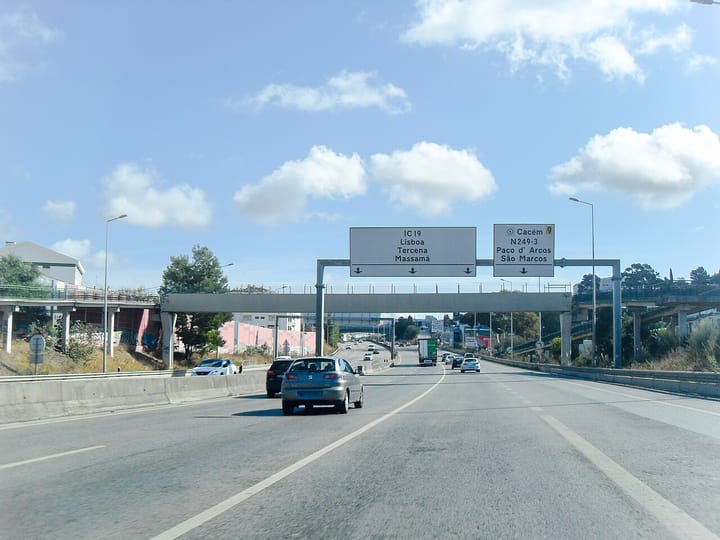
Portuguese motorways use three toll systems:
- Via Verde: Electronic transponder attached to your windscreen. Passes through dedicated lanes without stopping. Available for rental cars and personal vehicles. Annual fee: ~€6 for the device.
- Toll booths: Cash or card payment at traditional booth lanes
- Electronic-only tolls (SCUT): Camera-based tolling with no physical booths. If you don't have Via Verde, you must register your plate at a post office, payshop, or CTT terminal within 5 days, or face fines. These catch many tourists and new residents off guard.
Tip: Get Via Verde as soon as possible. It works for tolls, parking in some car parks, ferries, and even some drive-through restaurants. The app (Via Verde app) manages everything.
Fuel
- Petrol (gasolina): ~€1.70-1.90/litre (2026)
- Diesel (gasóleo): ~€1.55-1.75/litre
- Cheapest fuel: Hypermarket stations (Continente, Jumbo, Pingo Doce) are typically 5-10 cents/litre cheaper than Galp, BP, or Repsol.
- Tip: The app "Preço dos Combustíveis" shows real-time prices at nearby stations.
What Catches Expats Off Guard
- Priority to the right (prioridade à direita): At unmarked intersections, vehicles from the right have priority. This applies even when the road from the right looks like a minor side street. Learn to spot the absence of priority signs.
- Trams in Lisbon: Trams always have priority. Don't block tram tracks when stopping at lights. Give trams space — they can't stop quickly or swerve.
- Tailgating: Portuguese motorway driving involves close following distances. Maintain yours regardless of pressure from behind.
- Overtaking on the right: Illegal on motorways but commonly practiced (illegally) when cars sit in the middle/left lane. Don't be one of those cars — keep right except when overtaking.
- Traffic lights: Some lights have a flashing yellow phase meaning "proceed with caution." Red means stop — running red lights is a serious offence (€120-600 fine, potential licence points).
- Pedestrian crossings: Portuguese law requires drivers to stop for pedestrians at crossings. Enforcement has improved but compliance remains imperfect.
- Mountain roads: Narrow, winding, sometimes single-lane with passing places. Vehicle going uphill has priority. Honk before blind corners.
Required Equipment
Your car must carry:
- High-visibility vest: Must be accessible from inside the car (not in the boot). Required when exiting the vehicle on motorways or hard shoulders.
- Warning triangle: Place 30m behind your car in case of breakdown
- Spare tyre or repair kit: Not legally required but strongly recommended
- Documents: Driving licence, vehicle registration (DUA), insurance certificate (carta verde), and IPO inspection certificate must all be in the car
Vehicle Inspection (IPO)
Periodic technical inspection (Inspeção Periódica Obrigatória):
- New cars: First inspection after 4 years
- 4-8 years: Every 2 years
- 8+ years: Annually
- Cost: ~€30-35
- Where: Authorised inspection centres (centros de inspeção). Book online at ipo-online.pt
- Common failures: Worn tyres, headlight alignment, emissions (especially older diesels), brake pad wear, suspension issues
Driving in Portugal is a pleasure once you adjust — excellent motorways, beautiful scenic roads, and fuel prices lower than most of Northern Europe. Get Via Verde, learn the roundabout dance, watch for priority-from-the-right, and explore. The best of Portugal is down a road you haven't driven yet.