Italy Dispatches Two Water-Bombers as Fires Grip Guarda and Arouca, Injuring Seven Firefighters
Portugal fought fires on several fronts on 28 July, with the most stubborn blaze at Rochoso in the Guarda district. Seven firefighters were hurt, the A25 motorway was cut, and Portugal activated the EU Civil Protection Mechanism, prompting Italy to send two Canadair water-bombers.
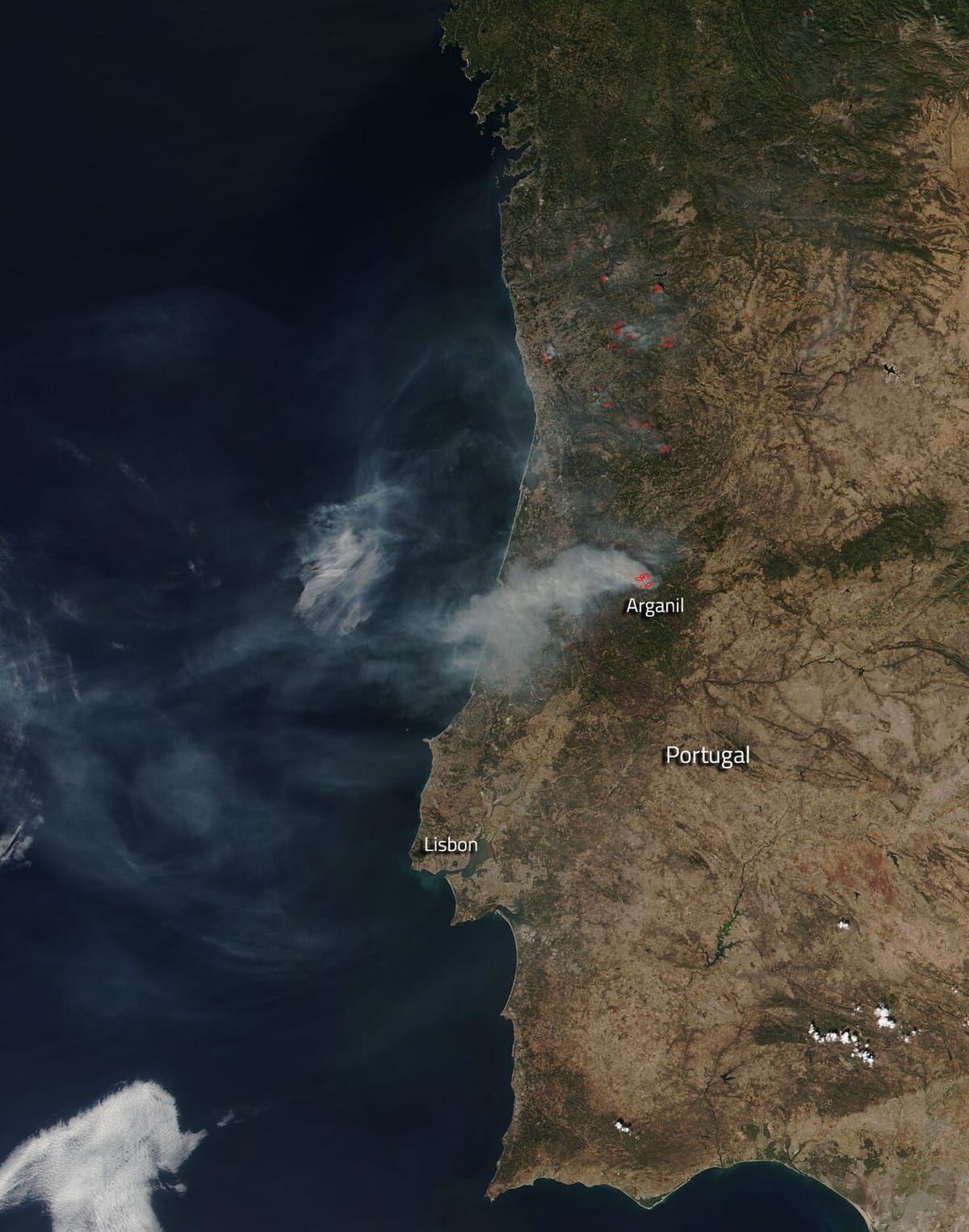
Portugal spent 28 July fighting fires on several fronts at once, with the most stubborn blaze burning in the hills of the Guarda district and a call for help going out across Europe. Italy answered by dispatching two Canadair water-bombing aircraft, and seven firefighters were hurt as crews battled flames in difficult, hard-to-reach terrain.
By the evening, two of the day's major fires — at Penafiel in the Porto district and Vila Verde in Braga — had been brought under control and entered what Portugal's civil-protection service calls the resolution phase, when active flames give way to mopping up. The fire at Rochoso, in the Guarda district, was the one that would not yield, splitting into two fronts across ground that machinery struggled to reach.
Hundreds of firefighters, dozens of vehicles
The scale of the response underlines how serious the day became. The Guarda fire alone drew 313 firefighters, 89 vehicles and six aircraft. At Penafiel, 209 operatives and 70 vehicles were deployed; at Vila Verde, 114 operatives with 33 vehicles. Of the seven injured, five suffered minor injuries at the Guarda fire and two at Vila Verde.
Two other fires had already scorched large areas. A blaze around Arouca, in the Aveiro district, consumed somewhere between roughly 4,000 and 4,755 hectares and pulled in more than 700 operatives, while a fire near Penamacor burned an estimated 2,904 hectares. The Guarda fire also forced the closure of a stretch of the A25 motorway, a key east-west route.
Europe steps in
Faced with several simultaneous fronts, Portugal activated the EU Civil Protection Mechanism, the bloc's system for sharing emergency resources between member states. Italy's two amphibious Canadair aircraft — designed to scoop water from lakes or the sea and drop it directly on flames — are among the most sought-after assets in the European fleet during peak fire season, and their arrival signalled how thinly Portugal's own resources were stretched.
The requests reflect a familiar summer pattern in which high temperatures, dry vegetation and wind combine to push the number of simultaneous ignitions beyond what national means can comfortably cover. Sharing aircraft across borders has become a standard feature of the Mediterranean fire season rather than an exceptional measure.
What it means for residents
For people living in or travelling through the affected districts, the immediate effects are practical: closed roads, smoke-filled air and, in the worst-hit areas, the threat of evacuation. The A25 closure alone disrupts one of the main corridors linking the interior to the coast.
The broader lesson is one Portugal confronts every summer. The country's rural interior, with its ageing population and abundant unmanaged woodland, remains highly vulnerable to fast-moving fires, and the reliance on European aircraft this early in the season is a reminder that the months ahead are likely to test those defences further.