Hunting Season in Portugal
Researched and written with AI tools from official sources. How we make our guides
When and where hunting is allowed in Portugal, the 250 metre rule around your house, how to keep hunters off your land, and how to get a licence yourself.
Last verified: October 2026.
Who this is for
- You own or rent a house or land in the Portuguese countryside and want to know when hunters may be nearby.
- You walk, run, or cycle on rural tracks between autumn and spring.
- You want to hunt in Portugal, as a resident or a visitor.
Not for you if: you want to own a gun for sport shooting or self-defence. Read our guide to owning a firearm instead.
Portugal's hunting year (época venatória) runs from 1 June to 31 May. Most small game seasons open between the third Sunday of August and October and close between December and February. Outside hunting zones, small game hunting is mainly on Thursdays, Sundays, and national holidays. Hunting zones cover almost 7 million hectares of Portugal, so assume your land is in one. Nobody may hunt within 250 metres of your house, its yard, or garden, or on land walled all round, without your consent. To hunt yourself, you need a hunter's certificate, a licence (€79.84 national for 2026 to 2027), and insurance.
Hunting zones and unmanaged land
The nature and forests institute (ICNF) runs hunting in mainland Portugal. Land falls into two kinds:
- Hunting zones (terreno ordenado). These are managed areas with their own rules and plans.
- Unmanaged hunting land (terreno não ordenado). Hunting is still lawful here, but under tighter national rules and shorter seasons.
There are four kinds of hunting zone:
| Type | What it is for | Who may hunt there |
|---|---|---|
| National (ZCN) | Conservation or security | All hunters, by priority order |
| Municipal (ZCM) | Hunting for as many people as possible, at low cost | All hunters, by priority order |
| Associative (ZCA) | Hunters' associations managing their own ground | Members and their guests |
| Tourist (ZCT) | Commercial hunting | Any hunter who follows the zone's published rules |
ICNF's latest indicators (to 31 May 2023) count 5,302 hunting zones covering 6,973,660 hectares. Associative zones are the most common (2,805), then tourist (1,584), municipal (909), and national (4).
In national and municipal zones, owners of land inside the zone come first in the queue for hunting places. Then come residents of the council, then other hunters.
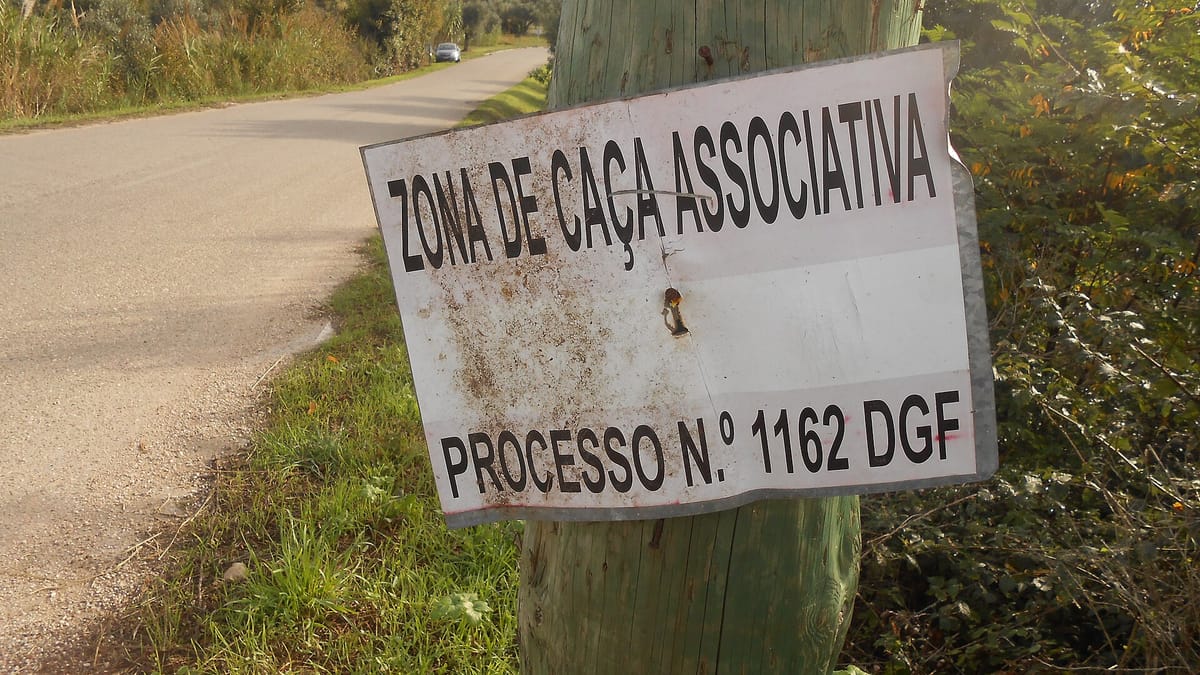
Hunting zones must be marked with signs on posts at the boundary and at every entrance, at most 100 metres apart. The boards say "Zona de Caça" with the zone type and number.
When hunting is allowed
Hours. Hunting is allowed from sunrise to sunset. The exceptions include duck shooting from a hide near water (from an hour before sunrise to an hour after sunset), and some big game hunting, such as wild boar, which can take place at night. Pigeon, thrush, and starling hunting ends at 16:00, except at passage sites ICNF names.
Days on unmanaged land:
- Thursdays, Sundays, and national public holidays, for most hunting.
- Wednesdays and Saturdays (not holidays) for falconry, bow and crossbow hunting, and fox coursing.
- Saturdays as well for fox and mongoose drives and wild boar hunts in January and February, only where ICNF allows.
Days in hunting zones:
- In national, municipal, and associative zones: small game on Thursdays, Sundays, national holidays, and one extra day the zone chooses.
- In tourist zones: the days in the zone's plan.
- Big game: the days in each zone's plan.
No hunting is allowed on national election or referendum days.
You cannot tell from outside which extra day a zone has chosen. If you walk in the countryside, assume any day from autumn to late winter could be a hunting day.
The 2026 to 2027 calendar
These are the main seasons in the national calendar. "Hunting zones" means managed land. Where no season is shown for unmanaged land, that species may only be hunted inside a zone. Each zone's plan can be stricter.
| Species | Hunting zones | Unmanaged land |
|---|---|---|
| Wild rabbit and hare | 1 September to 31 December | First Sunday of October to last Sunday of November, 1 a day |
| Fox and Egyptian mongoose | 1 October to 28 February | First Sunday of October to last Sunday of December, 1 a day |
| Red-legged partridge | 1 October to 31 January | Check the calendar |
| Rock pigeon | Third Sunday of August to 31 December, 25 a day | First Sunday of October to last Sunday of December, 15 a day |
| Magpie and carrion crow | Third Sunday of August to 28 February | Check the calendar, 1 a day |
| Mallard and coot | Third Sunday of August to 20 January, 10 a day | No season |
| Quail | 1 September to 30 November, 10 a day | No season |
| Woodpigeon and stock dove | Third Sunday of August to 20 February, 50 a day | No season |
| Thrushes and starling | 1 November to 20 February, 40 a day | No season |
| Woodcock | 1 November to 10 February, 3 a day | No season |
| Wild boar, deer, and mouflon | 1 June to 31 May, as set in each zone's plan | Boar drives only in places and on terms set by ICNF notices |
Hare coursing and falconry run from 1 September to 28 February, only in hunting zones. Rock pigeon may be hunted only in the councils listed in a separate order.
For 2026 the third Sunday of August was 16 August. The turtle dove (rola-comum) was open on only two mornings, 23 and 30 August 2026, in zones ICNF had approved.
Hunting is also banned on burned land, and within 250 metres of it, while a fire lasts and for 30 days after. The same applies to land cut off by floods. On snow-covered land, only big game may be hunted.
Where hunting is banned
Protection areas. The law bans hunting in these places:
- within 500 metres of bathing beaches, schools, hospitals, care homes, childcare centres, prisons, military and police sites, lighthouses, ports, airports, tourist sites, campsites, sports grounds, and industrial and livestock sites;
- within 250 metres of villages (a group of 10 or more homes no more than 50 metres apart);
- within 100 metres of national roads, main and secondary trunk roads, motorways, and railway lines;
- within 100 metres of apiaries and dovecotes;
- on aerodromes, cemeteries, and regional and municipal roads;
- on land with flower or vegetable crops, from sowing to harvest, and on nurseries;
- on fruit crops other than olive groves, from bud burst to harvest;
- on olive groves, drip-irrigated or micro-sprinkler orchards and vineyards, arable crops, and young forest plantings under 80 cm tall.
Signs matter. For livestock enclosures, apiaries and dovecotes, olive groves, irrigated orchards and vineyards, arable crops, and young plantings, the ban only works if the land carries the official signs. If you own one of these, the sign is your protection. ICNF publishes the sign models and how to place them.
The 250-metre rule around your house
Nobody may hunt without your consent:
- in the yard, park, or garden attached to a house;
- on any land within 250 metres of them;
- on walled land.
"Walled" means a wall or masonry all round, at least 1.5 metres high. ICNF says a wire fence does not count; hunters may enter land that is only fenced.
This is a consent rule, not an absolute ban. You can say yes. If hunters are shooting close to your house and you have not agreed, ICNF says to report it to the GNR, the police force responsible for hunting.
A hunter who wounds an animal that falls on land where hunting is banned may not enter without permission. The exception is unwalled land where the animal is visible. Then the hunter may go in alone, without a gun or dogs, to collect it.
If you own the land: keeping hunters off
There are two routes, and they work differently.
Asking to leave a hunting zone
- Associative or tourist zone (ZCA or ZCT). These zones need written agreements from landowners. If your land was included without your consent, because you could not be found, you can ask for it to be excluded at any time during the concession. Write to the ministry through ICNF, identify your land and your rights over it, attach proof, and if possible mark it on a map.
- If you signed an agreement with a ZCA or ZCT and want out, ICNF says it only removes the land after a court ends the agreement.
- Municipal zone (ZCM). Your land can be included without your signature. You can ask to have it excluded only within one year of the order that creates or renews the zone being published. You must also not have signed an agreement with the zone manager. Zone orders are published on ICNF's website. Nobody will write to you, so check them.
The exclusion takes effect when the order redrawing the zone's boundary comes into force, not when you ask.
The right to no hunting (direito à não caça)
Owners, people with a life interest (usufruct), and tenants whose lease includes hunting rights can ask to ban hunting on their land. The land becomes a no-hunting area. ICNF's indicators count 663 such areas, covering 58,043 hectares.
The conditions:
- You may not hold a hunter's certificate. For a company, hunting may not be part of its business, and no director may hold one.
- No agreement putting the land into a hunting zone may apply.
Your request must include:
- your full identification;
- the rural plots, with a digital plan;
- your rights over them;
- a statement that no hunting zone agreement applies.
The right lasts at least 6 and at most 12 years and renews automatically. It is confirmed by a government order published on ICNF's website.
It comes with duties. You must put up and maintain the official signs, and remove them within 30 days if the right ends. You also become liable for damage that game species cause on your land and on neighbouring land. If you ban hunters and wild boar then damage a neighbour's vines, that is your responsibility. ICNF can control the animals at your request and at your cost.
The right ends if you get a hunter's certificate, or if hunting happens on the land with your consent.
Game damage to crops
If game animals damage your crops and your land is in a hunting zone, contact the zone's manager. Zone holders must pay for damage their activity causes on neighbouring land. Outside a zone, you can ask ICNF for permission to reduce the population. ICNF says the state does not pay for car damage from collisions with wild animals.
How to hunt in Portugal yourself
To hunt, the law requires:
- a hunter's certificate (carta de caçador), unless you are exempt;
- a hunting licence for the season;
- civil liability insurance of at least €100,000;
- for firearms, a firearms licence of the right class from the PSP police.
On the day, carry your certificate, licence, insurance receipt, ID, and dog licences. With a gun, also carry your firearms licence and the gun's registration, plus a loan declaration if the gun is not yours. If you are under 18, carry written consent from a parent.
Hunting without a certificate, where one is required, is a crime. It can mean up to 3 months in prison or a fine.
The hunter's certificate
You can apply if you are over 16, have no condition that makes hunting dangerous, and are not banned from hunting. You apply and book the exam at the same time, with a medical certificate and a criminal record certificate. The exam is a written theory test of 20 questions.
After passing, pay the issue fee within 90 days. ICNF says the card arrives seven working days after payment.
The certificate is valid until you turn 60, then for five years at a time. Renew in the 12 months before it expires, online in ICNF's Área do Caçador or at a counter. You can still renew within five years after expiry; after that it lapses and you must sit the exam again.
You can also take the hunter's exam and the PSP firearms licence together, in a single combined procedure (procedimento único).
If you hold an EU hunting certificate and live in Portugal, you can apply to ICNF for a Portuguese certificate by equivalence, if you passed a written hunting exam at home. For foreign residents this depends on reciprocity. Bring a medical certificate, criminal record certificate, your foreign certificate and proof of your exam (with official translations if needed), and proof of residence, such as your EU registration certificate.
Fees for the 2026 to 2027 season
| Item | Fee from 1 June 2026 |
|---|---|
| Exam, under 25 | €21.50 |
| Exam, 25 and over | €43.00 |
| Certificate issue | €13.51 |
| Renewal, with the old card | €13.51 |
| Renewal in the five years after expiry | €27.03 |
| Certificate by equivalence | €37.59 |
| National hunting licence | €79.84 |
| Regional hunting licence | €45.77 |
| Non-resident licence, 30 days | €79.84 |
| Non-resident licence, full season | €154.63 |
| Duplicate licence | €8.65 |
A national licence covers the whole country; a regional licence covers one hunting region. Choose the region where you will hunt, not where you live. You can buy national and regional licences at a Multibanco cash machine with your certificate number and tax number (NIF), or at an ICNF counter. Licences for the next season go on sale from 15 May. A wrong choice at the machine cannot be changed.
Visitors
If you do not live in Portugal, you do not need a Portuguese certificate if you are allowed to hunt in your home country. You need a non-resident licence from an ICNF counter or an approved hunting organisation. Bring:
- your ID card or passport;
- proof of civil liability insurance valid in Portugal for the licence period;
- proof that you live abroad;
- your home hunting certificate or licence.
Fines
Hunting fines rise each year with the minimum wage. ICNF publishes the current amounts. From 1 January 2026, for individuals:
- hunting without a valid licence, or where hunting is not allowed: €1,278 to €9,398;
- not carrying the required documents: €140 to €1,278;
- on unmanaged land, groups of more than five hunters, or groups less than 150 metres apart: €135 to €1,247.
For companies, some ceilings reach €56,838.
What to do now
If you walk or cycle in the countryside, wear bright clothing from autumn to late winter, especially on Thursdays, Sundays, and holidays. Watch for "Zona de Caça" signs at track entrances.
If you own rural land, check whether it is in a hunting zone by searching ICNF's published zone orders for your council. Signpost any olive grove, irrigated orchard or vineyard, apiary, or stock enclosure. Diary the one-year window after any new or renewed municipal zone order. If you keep bees, see our guide to keeping bees. For other rules on rural land, see cutting down a tree and fishing Portugal's rivers.
If hunters are too close to your house and you have not agreed, call the GNR.
This guide is general information about mainland Portugal, not legal advice. Madeira and the Azores run their own hunting rules, calendars, and fees. Each hunting zone can set stricter rules than the national ones.
Sources
This guide is written from official sources and, where relevant, organisations' own websites.
- Procuradoria-Geral Regional de Lisboa, Decreto-Lei n.º 202/2004, de 18 de agosto (hunting regulation), consolidated to Decreto-Lei n.º 71/2024: https://www.pgdlisboa.pt/leis/lei_mostra_articulado.php?nid=97&tabela=leis (article 2 definitions: hunting year 1 June to 31 May, village, walled land 1.5 m; 4 fire, flood, and snow bans; 9 and 10 zone types and access; 15 priority order; 28 exclusion from ZCM; 37 land included without consent; 53 protection areas and signposting; 56 consent within 250 m and walled land; 57 to 62 right to no hunting; 63 and 65 requirements and documents; 64 entering land to collect game; 66, 67, 69, 70, 71 certificate, exam, equivalence, validity; 75 non-resident licence; 76 €100,000 insurance; 88 hours and 16:00 rule; 89 hunting days; 90 groups of five and 150 m; 114 liability for game damage; 137 offences; 140 fines updated with the minimum wage; 167 one-year ZCM exclusion window), checked 2 October 2026
- ICNF, hunting FAQ: https://www.icnf.pt/caca/cacaperguntasfrequentes (documents to hunt; exam at 16 with 20 questions; 90 days to pay; card in seven working days; national or regional licence by area hunted; Multibanco with certificate number and NIF; no change after confirming; non-residents; exclusion from ZCA, ZCT, and ZCM; wire fence does not count, 1.5 m wall; report hunters within 250 m to the GNR; no state payment for collisions; crop damage), checked 2 October 2026
- ICNF, hunting fees and fines: https://www.icnf.pt/caca/taxasecoimas (fee table dated 21 April 2026 with 2025 to 2026 and 2026 to 2027 fees: https://www.icnf.pt/api/file/doc/94a1bb5aff08c33d; hunting fines from 1 January 2026: https://www.icnf.pt/api/file/doc/e58afb5494f3316e), checked 2 October 2026
- ICNF, hunting calendar: https://www.icnf.pt/caca/calendariovenatorio (hunting days on managed and unmanaged land, no hunting on election days, turtle dove 2026 to 2027), checked 2 October 2026
- ICNF, turtle dove deliberation of 11 June 2026: https://www.icnf.pt/api/file/doc/b5b4994ca09219d3 (23 and 30 August 2026, sunrise to 11:00, approved zones only), checked 2 October 2026
- ICNF, hunting licences: https://www.icnf.pt/caca/cacar/licencasdecaca (licence types, sale from 15 May, Multibanco and counters, non-resident licence at counters or approved organisations, insurance compulsory), checked 2 October 2026
- ICNF, obtaining a hunter's certificate: https://www.icnf.pt/caca/cacar/cartadecacador/obtencaodecartadecacador (conditions, separate or combined procedure with the PSP firearms licence), checked 2 October 2026
- ICNF, renewing a hunter's certificate: https://www.icnf.pt/caca/cacar/cartadecacador/renovacaodacartadecacador (valid to 60 then five-year periods, renewal window, exceptional five-year renewal, online or at a counter), checked 2 October 2026
- ICNF, equivalence of a hunter's certificate: https://www.icnf.pt/caca/cacar/cartadecacador/equivalenciadacartadecacador (residents with EU certificate and exam, reciprocity, documents), checked 2 October 2026
- ICNF, exemption from the certificate: https://www.icnf.pt/caca/cacar/cartadecacador/dispensadecartadecacador (non-residents allowed to hunt at home, non-resident licence), checked 2 October 2026
- ICNF, hunter's certificate law and offences: https://www.icnf.pt/caca/cacar/cartadecacador/legislacaoeinfracoes (hunting without a certificate is a crime, up to 3 months in prison or a fine), checked 2 October 2026
- ICNF, hunting signs: https://www.icnf.pt/caca/ordenamentoegestao/sinalizacaovenatoria (sign models, signs every 100 m, boards every 1,000 m), checked 2 October 2026
- ICNF, main hunting sector indicators to 31 May 2023: https://www.icnf.pt/api/file/doc/d7bfa550754168d3 (5,302 zones, 6,973,660 ha, by type; 663 no-hunting areas, 58,043 ha), checked 2 October 2026
- Diário da República, Portaria n.º 309/2024/1, de 2 de dezembro, in the 1st series of that day: https://files.diariodarepublica.pt/gratuitos/1s/2024/12/23300.pdf (replacement annex to Portaria n.º 67/2024: seasons and daily limits for 2024 to 2027), checked 2 October 2026
- Diário da República, Declaração de Retificação n.º 38-B/2024/1, de 4 de dezembro: https://files.diariodarepublica.pt/1s/2024/12/23501/0000200005.pdf (corrected calendar annex, rock pigeon councils, hare coursing and falconry), checked 2 October 2026
- Diário da República, Portaria n.º 222-A/2025/1, de 15 de maio: https://files.diariodarepublica.pt/1s/2025/05/09301/0000200003.pdf (turtle dove hunting allowed in 2025 to 2026 and 2026 to 2027 by ICNF deliberation), checked 2 October 2026
Last verified October 2026. Rules and fees change; check the official source before acting.