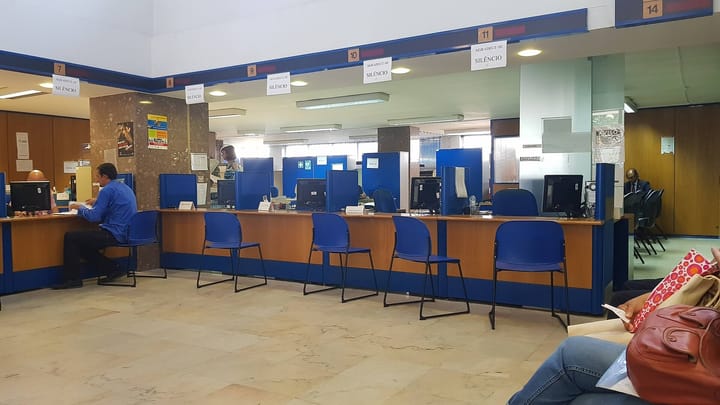
Visas and residency in Portugal
Every route from D1 to D8, the Golden Visa, family reunification, EU registration, and the CPLP route for citizens of Portuguese-speaking countries.

Last verified: September 2026.
Who this is for
- You are a non-EU citizen who wants to live in Portugal and does not know which visa fits.
- You will work for a Portuguese employer, work remotely, run a business, study, or join family here.
- You are an EU, EEA, or Swiss citizen and want to know what registration you still need.
Not for you if: You are retiring on a pension and want the full picture, from visa to healthcare: read "Retiring in Portugal".
Updated September 2026. The minimum wage that sets visa income thresholds rose to €920, the consular visa fee is now €110, the Lei de Estrangeiros was rewritten in October 2025 (job seeker and family reunification rules changed), and the new nationality law of May 2026 raised the residence period for citizenship to 7 or 10 years.
Portugal has one immigration law and a dozen doors into it. Which door you use depends on where your money comes from, who you are related to, and which passport you hold. Most non-EU citizens apply for a residence visa at a consulate, then swap it for a residence permit after arrival; plan on six to twelve months from first appointment to card in hand. EU, EEA, and Swiss citizens need no visa and register at the town hall instead. This guide is the map: every route, its cost, its timing, and where to read more. The three routes most Brief readers use, the D7 (passive income), the D8 (remote work), and the D2 (self-employment and business), each have a separate deep-dive guide.
How the system works
Almost every non-EU route follows the same two-stage pattern.
Stage one: the visto de residência (residence visa). You apply at the Portuguese consulate that covers where you live now, or at the VFS Global centre that handles applications for it. The visa is a sticker in your passport. It is valid for four months and two entries, and its only job is to get you into Portugal so you can ask for the real document. The legal decision deadline for a residence visa is 60 days, though many consulates take longer.
Stage two: the autorização de residência (residence permit) from AIMA. AIMA, the Agência para a Integração, Migrações e Asilo (Agency for Integration, Migration, and Asylum), replaced SEF in late 2023. Inside those four months you attend an appointment at a Loja AIMA (AIMA office), give biometrics, and pay the permit fees. The first permit is a plastic card valid for two years. Renewals are for three years at a time. After five years of legal residence you can apply for a permanent residence permit. Citizenship now takes longer (see the end of this guide).
There are three groups who skip or shorten this pattern: EU, EEA, and Swiss citizens, who need no visa at all; Golden Visa investors, who apply to AIMA directly; and citizens of CPLP countries (Comunidade dos Países de Língua Portuguesa, the Community of Portuguese Language Countries), who have their own agreement.
One more distinction that trips people up. A visto de estada temporária (temporary stay visa) is for stays under one year and does not lead to a residence permit. The D8 remote work visa, for example, exists in both versions. If you want to stay long term, make sure you are applying for the residence version.
Which route is yours: the comparison
Income thresholds in this table are based on the 2026 minimum wage of €920 per month, set by Decreto-Lei n.º 139/2025. All residence routes lead to the same two-year permit unless the table says otherwise.
| Route | Who it is for | Money you must show (2026) | Where you apply | Must you live in Portugal? |
|---|---|---|---|---|
| D1 (employment) | You have a job contract or a binding offer from a Portuguese employer | Contract or promise of contract; the salary counts as your means | Consulate, then AIMA | Yes |
| D2 (self-employment and business) | Freelancers, sole traders, company founders, Startup Visa holders | No fixed minimum; proof of funds for you and the business | Consulate, then AIMA | Yes |
| D3 (highly qualified, EU Blue Card) | Graduates and skilled professionals with a Portuguese employer | Salary of at least 1.5 times the national average gross salary, or three times the IAS | Consulate, then AIMA | Yes |
| D4 and D5 (study and research) | University students, researchers, interns, volunteers | €920 per month for 12 months, reduced if housing or meals are covered | Consulate, then AIMA | Yes |
| D6 (family reunification) | Spouse, partner, children, and dependent parents of a legal resident | The resident sponsor shows income and housing for the family | AIMA first, then the consulate | Yes |
| D7 (passive income) | Retirees and anyone living on pensions, rent, dividends, or savings | €920 per month, plus €460 for a second adult and €276 per child | Consulate, then AIMA | Yes |
| D8 (remote work) | Employees and freelancers working remotely for entities outside Portugal | €3,680 per month (four times the minimum wage) averaged over the last three months | Consulate, then AIMA | Yes |
| Golden Visa (ARI) | Investors who want residence without moving | €250,000 to €500,000 depending on the route, or 10 jobs | AIMA directly | Only 7 days in the first year, then 14 days per two-year period |
| Job seeker visa | People with specialised technical skills looking for qualified work | Means of subsistence for the stay | Consulate (see caveat below) | For up to 120 days while you search |
| CPLP mobility | Citizens of Brazil, Cape Verde, Angola, and the other CPLP states | Means of subsistence, or a sponsor's termo de responsabilidade | Consulate, then AIMA | Yes |
| EU registration | EU, EEA, and Swiss citizens | Work, study, or enough resources plus health cover | Câmara Municipal | Yes, registration is due after three months |
If your income is a pension or investments, read the D7 guide. If it is a salary or freelance fees from abroad, read the D8 guide. If you will earn your living in Portugal without a Portuguese employer, read the D2 guide. Everyone else, read on.
Before you start: what every application needs
Whatever route you pick, the consulate will ask for the same core file. Start collecting it three to four months before you plan to apply.
| Document | Notes |
|---|---|
| Application form | The national visa form, signed |
| Two passport photos | Recent, identical, passport format |
| Passport | Valid for at least three months beyond your planned stay, plus a copy of the data page |
| Proof of legal status | Only if you are applying in a country you are not a citizen of |
| Criminal record certificate | From your country of origin and any country where you lived for more than a year, apostilled or legalised, with a Portuguese translation. Children under 16 are exempt |
| Travel or health insurance | Must cover urgent medical care and repatriation. Brazilians with PB4 and UK pensioners with an S1 may be exempt |
| Proof of means of subsistence | See the income rule below |
| Proof of accommodation | Rental contract, deed, or a formal invitation letter from a host |
| NIF | Not on the legal list, but most consulates now expect it, and you need it for the bank account and the lease anyway |
| Route-specific proof | Job contract, business plan, pension letter, university acceptance, and so on |
The income rule. The consulates measure "means of subsistence" against the retribuição mínima mensal garantida (guaranteed minimum monthly wage). For 2026 that is €920, net of social security. The first adult must show 100 percent, each further adult 50 percent (€460), and each child or dependent adult child 30 percent (€276). For most residence visas you must show this for at least 12 months, so a single D7 applicant is proving roughly €11,040 a year. Grants, scholarships, job contracts, company contracts, and service contracts all count.
Fiscal representative. Non-EU applicants who are not yet tax resident in Portugal must appoint a representante fiscal (tax representative) when they get their NIF. Most people use a lawyer or an online NIF service.
Timing. Documents older than three to six months are usually rejected. Get the criminal record certificate last, and book the consulate appointment before you have everything, because slots in London, New York, São Paulo, and Toronto can be months away.
The routes, one by one
D1: working for a Portuguese employer
The D1 is the ordinary work visa. You need a contrato de trabalho (employment contract) or a promessa de contrato (binding job offer) from an employer in Portugal, and if your profession is regulated here (nurses, engineers, teachers, lawyers), proof that you are allowed to practise it. The salary in the contract is your proof of means. There is no separate labour market test in the visa file, but the employer must be registered with Segurança Social and the contract must meet Portuguese minimum wage and working conditions.
Since October 2025 there is no longer any way to arrive as a tourist, find a job, and regularise from inside Portugal. The manifestação de interesse (expression of interest) route closed in June 2024 and every pending application expired on 31 December 2025. If you want to work here, get the visa first.
D2: self-employment, business, and the Startup Visa
The D2 covers three groups: trabalhadores independentes (independent workers) with a service contract or a professional practice, imigrantes empreendedores (entrepreneurs) making an investment, and founders accepted into the Startup Visa programme. There is no fixed minimum investment. What the consulate wants is a credible plan, proof that the money to fund it exists (ideally already in a Portuguese bank), and, for the Startup Visa, the declaration from IAPMEI confirming your incubation contract with a certified incubator.
The full document list, the business plan format, and the social security consequences are in our separate D2 guide.
D3: highly qualified workers, the EU Blue Card, and the Tech Visa
The D3 is for atividade altamente qualificada (highly qualified activity): teaching, research, cultural work, and skilled employment. The Blue Card version (article 61.º-A of the law) needs a contract of at least six months paying at least 1.5 times the national average gross salary, or three times the IAS (Indexante dos Apoios Sociais, the social support index, €537.13 in 2026). For shortage occupations the government lists, the bar drops to 1.2 times the average salary or twice the IAS. You also need a degree or, in a regulated profession, recognised qualifications.
The Tech Visa is not a separate visa. It is a certification scheme run by IAPMEI: technology companies certified under the programme can issue a termo de responsabilidade (letter of responsibility) that replaces some of the paperwork and speeds the D3 through. AIMA runs a dedicated booking form for highly qualified visa holders, so this route usually gets the fastest first appointment.
Family members of D3 and Blue Card holders are exempt from the two-year wait for family reunification (see D6).
D4 and D5: study, research, internships, and volunteering
The study routes cover university degrees, PhDs, post-docs, secondary school exchanges, unpaid internships, vocational training, and volunteering. You need the acceptance letter from the institution and means of subsistence at the €920 rate for 12 months, which the consulate can halve if your housing is arranged and cut by up to 90 percent if meals are covered too. Students admitted to recognised Portuguese universities and anyone on a scholarship are exempt from proving means and from the insurance requirement.
Student residence permits are issued for the study period and renewed while you remain enrolled. Time on a student permit counts as legal residence for permanent residence and citizenship.
D6: family reunification
If you already hold a residence permit, you can ask AIMA to approve reagrupamento familiar (family reunification) for your spouse or partner, minor or dependent children, unmarried adult children studying in Portugal, dependent parents, and minor siblings in your guardianship. Once AIMA says yes, your relatives apply for the D6 visa at the consulate. Children of residence permit holders pay no visa fee.
The October 2025 reform made this route slower. The sponsor must now have held a valid residence permit for two years before applying, unless the relative is a minor or a dependent in your care, or you hold a D3, Blue Card, teaching, cultural, or Golden Visa permit. Spouses and partners must be at least 18. A partner's first permit is valid for 15 months. Family members must attend Portuguese language and civic training. AIMA has up to nine months to decide, extendable once in complex cases.
There is a shortcut for families moving together. If you all apply from your home country at the same time, your spouse and children can apply for a visto de residência para acompanhamento familiar (family accompaniment visa) alongside your own application, showing family ties and enough income for everyone. Ask your consulate whether it accepts this in your category.
D7: passive income and retirement
The D7 is for people who can live on income that does not depend on working in Portugal: pensions, rental income, dividends, interest, and royalties. The threshold is the minimum wage, €920 per month in 2026, plus €460 for a second adult and €276 per child, proved for at least 12 months. Consulates in high-cost countries routinely expect more than the legal floor, and a year of bank statements carries more weight than a single large balance. Pensions are taxed as ordinary income in Portugal; the old NHR exemption closed at the end of 2023.
Everything else, from the accommodation proof to the tax questions, is in our separate D7 guide.
D8: remote workers and digital nomads
The D8 is for people who work, just not for a Portuguese employer. Employees show an employment contract or an employer's declaration; freelancers show a company contract, a service contract, or evidence of services provided. Either way you must prove average monthly earnings over the last three months of at least four times the minimum wage, which is €3,680 in 2026, and a document showing where you are tax resident today.
The D8 comes as a temporary stay visa (under one year, no residence permit) or a residence visa (two-year permit, same path as everyone else). Our separate D8 guide covers the choice, the tax position, and the IFICI regime that replaced NHR.
Golden Visa: residence by investment
The autorização de residência para atividade de investimento, or ARI (residence permit for investment activity), is the only route where you apply to AIMA without a consular visa and without moving. Property has not qualified since October 2023. The 2026 routes are:
| Investment | Minimum |
|---|---|
| Units in qualifying investment or venture capital funds (no real estate exposure, at least five years) | €500,000 |
| Setting up or capitalising a Portuguese company that creates or keeps jobs | €500,000 |
| Scientific research at approved institutions | €500,000 |
| Artistic production or cultural heritage | €250,000 (€200,000 in low-density areas) |
| Job creation | At least 10 jobs |
The presence requirement is seven days in the first year and 14 days in each two-year period after that. The permit is valid for two years and renewable. AIMA's fees are the highest of any route (see the cost table), and the queue is long: applications lodged in 2024 and 2025 were still waiting for first appointments well into 2026. Family reunification is available from day one without the two-year wait.
Job seeker visa
The visto para procura de trabalho (job seeker visa) created in 2022 was rewritten in October 2025 as the visto para procura de trabalho qualificado (qualified job seeker visa). It is now restricted to people with "specialised technical skills", is valid for 120 days (extendable by 60), carries an AIMA appointment date inside that window, and lets you work in a qualified job as soon as you find one. If you have no job when it runs out, you must leave and cannot reapply for a year.
Caveat: as of September 2026 the Ministry of Foreign Affairs visa portal still shows this visa as not available at consulates, pending the Portaria that defines "specialised technical skills". Some law firms report it as live. Ask your consulate before planning around it.
CPLP mobility
Citizens of Angola, Brazil, Cape Verde, Guinea-Bissau, Equatorial Guinea, Mozambique, São Tomé and Príncipe, and Timor-Leste can use the CPLP Mobility Agreement of 2021. The 2025 reform ended the practice of arriving as a tourist and applying at AIMA. You now apply for a CPLP visa at the consulate (the document list is lighter than the standard one, and a Portuguese resident's termo de responsabilidade can replace proof of means) and then request the CPLP residence permit at AIMA after arrival. Students admitted to a Portuguese university are exempt from proving means.
EU, EEA, and Swiss citizens
You need no visa and no AIMA permit. If you stay longer than three months, you have 30 days to register at the Câmara Municipal (town hall) of the place you live and collect a Certificado de Registo de Cidadão da União Europeia (EU citizen registration certificate). Bring your passport or ID card, proof of address, and a declaration that you are working, self-employed, studying, or have enough resources and health cover. The certificate costs €15, is valid for five years, and is the document banks, Finanças, the SNS, and employers will ask for. Non-EU family members of EU citizens apply to AIMA for a cartão de residência de familiar (family member residence card) instead.
Step by step: from consulate to residence card
- Get a NIF and open a Portuguese bank account. Both can be done remotely through a lawyer or NIF service. Move at least a year's means of subsistence into the account before you apply.
- Secure accommodation. A 12-month lease registered with Finanças, a deed, or an invitation letter with the host's ID and proof of address.
- Gather the file. Criminal record, insurance, income proof, route-specific documents. Apostille and translate anything not in Portuguese or English (check your consulate; some accept English, most do not).
- Book and attend the consulate or VFS appointment. Submit in person, give fingerprints, pay €110. Keep the receipt.
- Wait for the decision. The legal deadline is 60 days. Two to four months is typical, longer at busy posts. The visa comes back with an AIMA appointment date already assigned by the Ministry of Foreign Affairs.
- Enter Portugal within the visa's four months. If your AIMA date is far off, you can ask for an earlier one through AIMA's online contact form once you are in the country.
- Attend the AIMA appointment. Bring the whole file again, plus your NIF, proof of address in Portugal, and, for work routes, your Segurança Social registration. Pay the analysis and issuance fees.
- Collect the card. AIMA posts it to your Portuguese address, usually within a few weeks of approval, though delays of several months still happen. While you wait, your comprovativo de pedido em tramitação (proof of pending application), downloadable from AIMA's online services, shows you are legal.
Costs and timing
| Item | Amount (2026) | Notes |
|---|---|---|
| Consular residence visa fee | €110 | Waived for children under six, children of residence permit holders, state scholarship holders, and highly qualified researchers |
| VFS Global service fee | Varies by country | Charged on top of the visa fee where VFS handles applications |
| AIMA analysis of a first temporary permit | €133.00 | Portaria n.º 307/2023 table as updated for 2026 |
| AIMA issuance of a first temporary permit | €114.30 | Paid at the appointment |
| Permanent residence permit | €351.10 | After five years |
| Golden Visa issuance | €8,418.90 per person | Plus an analysis fee at application |
| Golden Visa renewal | €4,210.30 per person | Every two years |
| EU citizen registration certificate | €15 | At the Câmara Municipal |
| Apostilles, translations, and criminal records | €150 to €500 | Depends on the country and the number of documents |
| Lawyer or relocation service | €1,000 to €3,000 | Optional; more for Golden Visa and D2 |
Timing, end to end: two to four months for the consulate, four months to enter, three to nine months for AIMA to issue the first card. Plan on six to twelve months from first appointment to card in hand, and do not book non-refundable flights around any single date.
Common problems
Wrong visa category. A remote worker who applies for the D7 with a salary, or a pensioner who applies for the D8, gets refused. Passive income is D7, active income earned abroad is D8, income earned in Portugal is D1, D2, or D3.
Thin income evidence. One statement showing a lump sum is not "regular and stable" income. Show 6 to 12 months of statements and the source documents behind them.
Expired documents. The criminal record certificate is usually valid for three months. If the consulate slot is delayed, you may need a new one.
Missing the AIMA window. The visa gives you four months to lodge your permit request. If you cannot make the assigned appointment, ask for another one before the visa expires and keep the written proof.
Travelling on an expired card. A residence card that expired after 30 June 2025 remains valid for six months while your renewal is pending, and a renewal receipt covers you for 180 days, but airlines and other Schengen states do not always honour these. Renew early, through AIMA's online renewal portal, and carry the receipt.
Assuming NHR still exists. It does not. New residents pay standard IRS rates unless they qualify for the narrower IFICI regime.
Believing the citizenship clock is five years. For applications lodged after 19 May 2026 it is seven years for CPLP and EU nationals and ten for everyone else.
After you have the card
Renewals. Apply online through AIMA's renewal portal before the card expires. You must still meet the conditions of your route, have filed Portuguese tax returns, and have paid social security if you work. The second and later permits last three years.
Permanent residence. After five years of legal residence you can apply at a Loja AIMA for an autorização de residência permanente. You need A2 Portuguese, a clean record, accommodation, and means. The card is renewed every five years but the status does not expire, and you can be away for up to 24 consecutive months without losing it.
Citizenship. The Lei Orgânica n.º 1/2026 of 18 May 2026 rewrote naturalisation. From 19 May 2026 you need seven years of legal residence if you are a CPLP or EU national, or ten years otherwise, counted as the sum of your periods of legal residence within a window of nine or twelve years. You must pass a test or hold a certificate in Portuguese language, culture, history, and national symbols, show knowledge of the rights and duties of citizenship and how the state is organised, and make a solemn declaration of adherence to democratic principles. The test format was still being regulated in summer 2026. Applications filed before 19 May 2026 are decided under the old five-year, A2 rules. Marriage to a Portuguese citizen for more than three years remains a separate route with no residence requirement. Children born in Portugal to foreign parents now need a parent with five years of legal residence at the time of birth. Portugal still allows dual nationality.
Schengen travel. Your Portuguese residence card lets you spend up to 90 days in any 180 in other Schengen countries. It does not let you work there.
Sources
- Portal das Comunidades / Vistos, Ministério dos Negócios Estrangeiros, Meios de subsistência: https://vistos.mne.gov.pt/pt/vistos-nacionais/documentacao-instrutoria/meios-de-subsistencia (2026 minimum wage of €920, 100/50/30 percent rule, 12-month requirement, study visa reductions)
- Vistos MNE, Tipo de visto: https://vistos.mne.gov.pt/pt/vistos-nacionais/informacao-geral/tipo-de-visto (visa categories, four-month two-entry validity, temporary stay vs residence)
- Vistos MNE, Emolumentos: https://vistos.mne.gov.pt/pt/vistos-nacionais/informacao-geral/emolumentos (€110 fee and exemptions)
- Vistos MNE, Prazos: https://vistos.mne.gov.pt/pt/vistos-nacionais/informacao-geral/prazos (60-day decision deadline)
- Vistos MNE, Documentação instrutória, Residência: https://vistos.mne.gov.pt/pt/vistos-nacionais/documentacao-instrutoria/residencia (general document list, D1, D2, Startup Visa, D3 and Blue Card thresholds, D7, D8 four-times rule, family accompaniment visa)
- Vistos MNE, Reagrupamento familiar: https://vistos.mne.gov.pt/pt/vistos-nacionais/informacao-geral/reagrupamento-familiar (eligible family, AIMA-first procedure, fee exemption for children)
- Vistos MNE, CPLP: https://vistos.mne.gov.pt/pt/vistos-nacionais/documentacao-instrutoria/cplp (CPLP visa document list and exemptions)
- Vistos MNE, Procura de Trabalho Qualificado: https://vistos.mne.gov.pt/pt/vistos-nacionais/documentacao-instrutoria/procura-de-trabalho (visa not yet available pending regulation)
- Diário da República, Lei Orgânica n.º 1/2026 de 18 de maio: https://files.diariodarepublica.pt/1s/2026/05/09500/0000200020.pdf (7 and 10 year residence rule, counting window, language and civic tests, transitional rule, marriage and birth rules)
- Diário da República, Decreto-Lei n.º 139/2025 de 29 de dezembro (minimum wage €920 for 2026), cited on the MNE means of subsistence page
- Lei n.º 61/2025 de 22 de outubro (amendments to Lei n.º 23/2007), via Andersen and Cuatrecasas summaries: https://pt.andersen.com/2025/10/23/alteracoes-ao-regime-juridico-de-entrada-permanencia-saida-e-afastamento-de-estrangeiros-do-territorio-nacional-entrada-em-vigor-de-novo-diploma/ and https://www.cuatrecasas.com/pt/portugal/laboral-1/art/alteracoes-lei-estrangeiros (job seeker visa, family reunification two-year rule and exemptions, CPLP changes, manifestação de interesse expiry)
- gov.pt, Pedir a autorização de residência permanente: https://www.gov.pt/servicos/pedir-a-autorizacao-de-residencia-permanente (five years, apply in person at a Loja AIMA)
- Câmara Municipal do Porto, Certificado de Registo do Cidadão da União Europeia: https://portaldomunicipe.cm-porto.pt/pt/-/registo-de-cidad%C3%A3o-comunit%C3%A1rio-sef (three months plus 30 days, documents, Lei n.º 37/2006)
- GrowIN Portugal AIMA fee table (secondary, mirrors Portaria n.º 307/2023 and Portaria n.º 13/2024): https://www.growinportugal.com/pt/data/aima-fees (AIMA permit, permanent residence, Golden Visa, and EU certificate fees)
- DN Brasil, AIMA notices on expired cards and on bringing forward consular visa appointments: https://dnbrasil.dn.pt/aima-avisa-que-ttulos-vencidos-at-30-de-junho-esto-vlidos-at-15-de-abril-de-2026 and https://dnbrasil.dn.pt/imigrantes-com-visto-podem-antecipar-entrevista-na-aima (six-month and 180-day rules, appointment assigned with the visa, AIMA contact form)
- The Portugal News, Portugal Golden Visa 2026: https://www.theportugalnews.com/news/2026-09-09/portugal-golden-visa-2026-is-it-still-available-and-how-does-it-work/1083411 (investment routes, presence requirement, permit validity)
- Cidadania e Visto, Prazos de entrega do título de residência AIMA 2026: https://www.cidadaniaevisto.com.br/blog/prazos-de-entrega-do-titulo-de-residencia-aima-o-que-esperar-em-2026 (waiting times, comprovativo de pedido em tramitação, two plus three year validity)
Last verified September 2026. Rules and fees change; check the official source before acting.