Scrapping a Car in Portugal
Researched and written with AI tools from official sources. How we make our guides
How to scrap a car in Portugal: find a licensed dismantler, get the certificate of destruction, keep the drop off free, and stop paying road tax.
Last verified: October 2026.
Who this is for
- You own a car registered in Portugal that is no longer worth repairing.
- Your insurer has declared your car a total loss after an accident.
- You want to stop paying road tax on a car you no longer use.
Not for you if: you want to sell a working car. Read Buying a Used Car in Portugal for how a change of owner is registered.
Updated October 2026. From 1 January 2027, annual road tax (IUC) moves to the calendar year. From 2028, a car still registered on 1 January owes that whole year's tax, so the date you scrap it matters more.
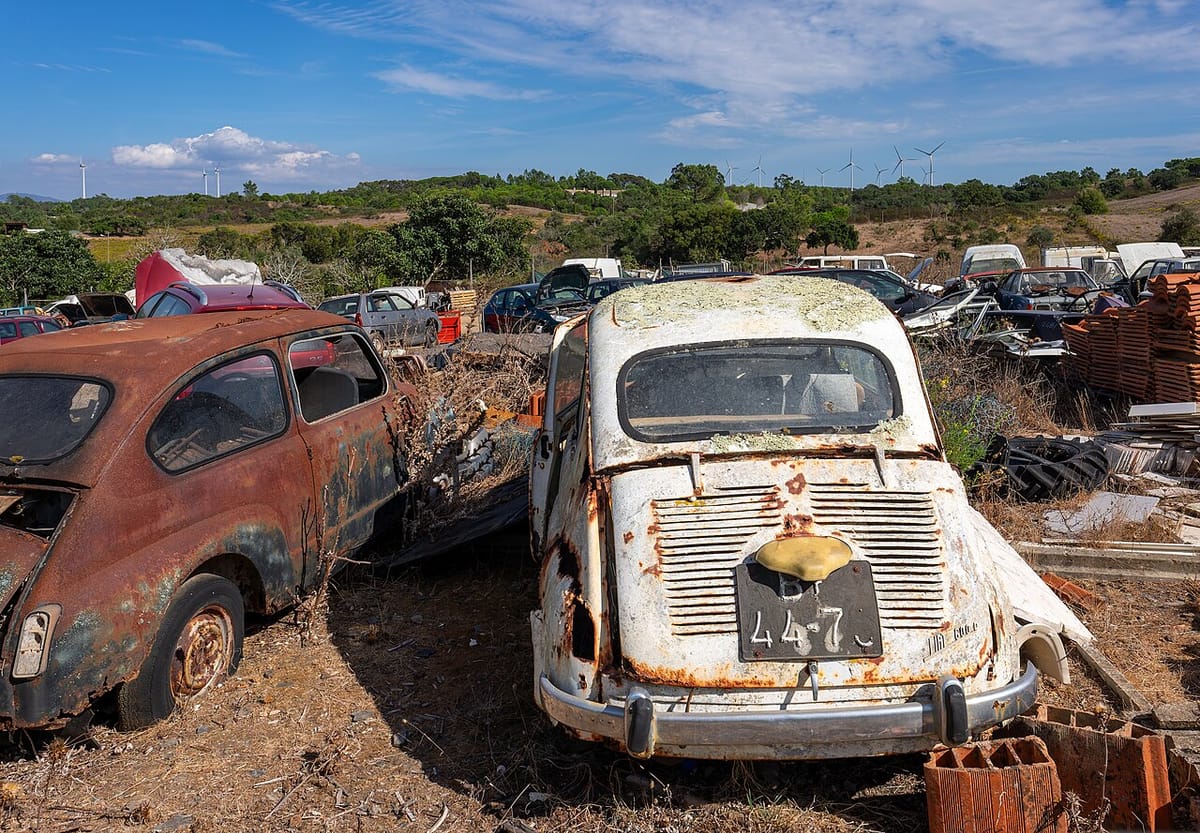
To scrap a car in Portugal, you take it to a licensed dismantler with its registration documents. The dismantler issues a certificate of destruction (certificado de destruição) on the environment agency's platform. The registration is then cancelled automatically, and you stop owing road tax. Handing over the car is usually free, as long as no main parts are missing. It normally takes one visit. A cash sale to an unlicensed scrapyard leaves the car in your name.
This guide covers private cars on the mainland.
Key terms
- End-of-life vehicle (veículo em fim de vida, VFV). A car that can no longer be driven because of an accident, breakdown, poor condition, or another reason. By law it is now waste.
- Scrapping (abate). In everyday Portuguese, "entregar o carro para abate".
- Collection centre or dismantler (centro de receção, operador de desmantelamento). Only a licensed dismantler can issue the certificate that ends your responsibility.
- Certificate of destruction. Proof that you handed the car to a licensed operator. It lets IMT, the Institute for Mobility and Transport, cancel the registration.
- Cancelling the registration (cancelamento da matrícula). This removes the car's right to be on the public road.
Step 1: find a licensed dismantler
As the owner, you are responsible for taking an end-of-life car to a licensed treatment operator.
The environment agency, APA (Agência Portuguesa do Ambiente), publishes the list of licensed dismantlers under "Centros de Abate". You can also search its public licensing register, SILOGR. Choose the waste code "16 01 04*" (end-of-life vehicles) to see licensed companies.
Since 1 January 2018, only certificates issued on APA's single online platform are valid. They carry the APA logo and a barcode.
This is the most important check. A scrapyard that pays you cash without issuing an APA certificate has not scrapped the car in law. The registration stays in your name, and so does the tax.
Step 2: hand over the car and the documents
When you deliver the car, you must:
- hand over the registration certificate (certificado de matrícula), or, for older cars, the vehicle logbook (livrete) and the title of ownership (título de registo de propriedade)
- request cancellation of the registration on IMT's Form 9 (Modelo 9), which the operator gives you on paper or digitally
Bring:
- the registration certificate, or the logbook and title
- your identity document, such as your Citizen Card, residence card, or passport
The operator checks the make, model, plate, and chassis number against the documents. It checks your details against your identity document.
If you do not have the documents. If the documents were already sent to IMT, you only need proof that they were sent. If they are simply lost, ask the operator or IMT what they will accept before you go.
Driving it there. If you drive the car to the operator yourself, it is not yet legally waste. No waste transport form is needed. If it cannot be driven, moving it counts as waste transport. As a private owner, you do not need to register on APA's system: the receiving operator issues the electronic waste form (e-GAR).
Step 3: the certificate and the cancellation
The dismantler identifies the car, checks the documents, and issues the certificate on APA's platform. Within five working days of receiving the car, it must send you the original certificate. It sends a copy, with the documents, to IMT.
The registration is cancelled automatically, in real time, through a link between APA's platform and IMT's system. IMT charges nothing to cancel the registration of an end-of-life car.
Keep the original certificate. It proves you delivered the car to a licensed operator and have no further responsibility for it. Keep it in case a tax or registration problem comes up later.
If the registration is not cancelled. Check your car's status a few days later. If you have the certificate and the registration is still active, contact IMT directly. IMT is the body that cancels registrations.
A cancellation for destruction is final. The registration can never be restored, and the car cannot get a new plate.
What it costs
Usually nothing. Handing an end-of-life car to a centre designated by the car makers, or by their collective scheme, is free. This applies even if the car has no market value.
There are two exceptions. The drop off is not free if:
- a main part is missing. The car left the factory with an engine, transmission shafts, a gearbox, catalytic converters, electronic control units, and bodywork, and one of these is gone; or
- waste has been added to the car, for example if it was used to store rubbish.
So do not sell the engine or catalytic converter before you scrap the car, and empty it first. The rules do not say whether the operator must pay you anything for the car.
Road tax: why the date matters
You owe annual road tax (IUC) until the registration is cancelled after scrapping. It does not matter whether the car moves. Each year has its own rule:
- In 2026, IUC is still due on the anniversary of the car's registration. If you scrap the car and the registration is cancelled before its next anniversary, that year's tax does not arise.
- In 2027, everyone moves to fixed dates. If a car's registration is cancelled in 2027 before its usual anniversary date, you can ask the tax office (Finanças) to cancel that year's IUC for it.
- From 2028, the yearly bill covers every vehicle registered in your name on 1 January. A car still registered on New Year's Day owes that year's IUC in full, even if you scrap it in February.
So scrap a car before its registration anniversary in 2026 or 2027, and before 1 January from 2028. Paying Road Tax and Vehicle Inspection explains how the tax is worked out and the new payment dates.
After an accident: a total loss
A car is written off (inutilizado) when damage permanently stops it being driven, or seriously affects its safety. Its registration must then be cancelled.
- If the cost is yours, you have 30 days from the date the car was written off to send it to a licensed operator, at your own expense.
- If the insurer is responsible for a written-off car, the insurer pays for sending it to the operator, also within 30 days.
When an insurer offers to settle a claim as a total loss, it must tell you three things. A certificate of destruction is needed to cancel the registration. It must say who is responsible for presenting it. Only a licensed operator can issue it. An insurer that handles the scrapping itself only needs to prove it sent the documents to IMT. See What to Do after a Car Accident in Portugal for the insurance side.
Other ways to cancel a registration
IMT lists other reasons to cancel a registration. Each uses Form 9 and costs €10:
- The car is off the road for good. If a car is used only for motor sport or on private land closed to traffic, you can cancel its registration temporarily, for up to five years. Before the period ends, ask to restore it or cancel it for good, or you can be fined. You need a statement of what the car is used for.
- The car is missing. Its location must have been unknown for more than six months. You need the police report of its disappearance and a police statement that it has not been found.
- The car was exported. You need proof it left Portugal, or a copy of its new registration. There is no fee if you show a new registration certificate from another EU country.
- You sold it but the buyer never registered it. You can ask for cancellation if you sold the car more than a year ago, the buyer never updated the register, and you asked for the car's seizure more than six months ago.
If your car was written off or exported, you must request cancellation within 30 days. Missing the deadline costs €60 to €300.
Scrapping in another EU country. Portugal accepts certificates of destruction from other EU countries if they contain all the information the law requires. You then send IMT a copy of the certificate, a completed Form 9, and the car's documents yourself.
If you abandon a car
The police or town hall can remove a car from the street if:
- it stays in the same place on the public road, or in a free car park, for 30 days in a row
- it shows clear signs of abandonment, or cannot move safely on its own, for more than 48 hours
The registered keeper then gets a notice to collect it within 45 days. That drops to 30 days if the car is so run down that a sale would not cover the costs. If no one claims it, the car is treated as abandoned and passes to the State or the town hall. The authorities send it to a waste operator and charge the costs to the owner.
Failing to take an end-of-life car to a licensed operator is a serious environmental offence. So is failing to request cancellation of its registration. For a private person, the fine is €2,000 to €20,000 for negligence, and €4,000 to €40,000 if it was deliberate.
Buying used parts from scrapped cars
If you buy second-hand parts from an end-of-life car, the seller must give you two things when you buy. One is a document proving the parts came from a licensed dismantler. The other is an invoice listing each part. Online sellers must show the dismantler's name and licence number for each part.
Checklist
- Check that the operator is on APA's list of licensed dismantlers.
- Leave the engine, gearbox, catalytic converter, electronic units, and bodywork in place. Clear out any rubbish.
- Take the registration certificate (or logbook and title) and your identity document.
- Fill in and sign Form 9 at the operator.
- Get the original certificate of destruction, with the APA logo and barcode, and keep it.
- A few days later, check that the registration shows as cancelled. Contact IMT if it does not.
- Time it before the registration anniversary in 2026 or 2027, and before 1 January from 2028.
If you live in the Azores or Madeira, check the procedure with your regional government. This guide is written for the mainland.
This guide is general information, not legal or tax advice. Rules and fees change; check the official source before you act.
Sources
This guide is written from official sources and, where relevant, organisations' own websites.
- Procuradoria-Geral Regional de Lisboa, Decreto-Lei n.º 152-D/2017, of 11 December, consolidated text: https://www.pgdlisboa.pt/leis/lei_mostra_articulado.php?nid=2953&tabela=leis (article 83(7) insurer's duty to inform on total loss; article 84(1), (3), (4), (5), (6), and (9) owner's duty, 30 days for written-off cars, abandoned cars, insurer's costs, free drop off and its two exceptions; article 85 documents, Form 9, APA platform, five working days, automatic cancellation, EU certificates, five-year retention; article 86 documents already sent to IMT; article 90(2) owner offences as serious environmental offences), checked 2 October 2026
- Procuradoria-Geral Regional de Lisboa, Lei n.º 50/2006, of 29 August, Lei-Quadro das Contraordenações Ambientais, consolidated text: https://www.pgdlisboa.pt/leis/lei_mostra_articulado.php?nid=1356&tabela=leis (article 22(3), serious offence fines for individuals and companies), checked 2 October 2026
- APA, Perguntas Frequentes, Veículos em Fim de Vida (VFV), version 2.0, September 2019 (PDF): https://apambiente.pt/sites/default/files/_Residuos/Producao_Gest%C3%A3o_Residuos/Perguntas%20Frequentes%20-%20Ve%C3%ADculos%20em%20Fim%20de%20Vida%20%28VFV%29.pdf (questions 13 to 21, 39, and 40: list of dismantlers and SILOGR code 16 01 04*, only platform certificates valid since 1 January 2018, APA logo and barcode, documents and checks, IMT cancels, free drop off and exceptions, EU certificates, contact IMT if not cancelled, no e-GAR when driven by the owner, operator issues e-GAR for private owners), checked 2 October 2026
- IMT, Cancelamento da Matrícula: https://www.imt-ip.pt/veiculos/cancelamento-matricula/ (Form 9, €10 fee for the other grounds, five-year temporary cancellation, missing, exported and EU fee waiver, sold but not transferred, end-of-life cancellation free and only with a certificate of destruction, no restoring an end-of-life registration), checked 2 October 2026
- ANSR, republished Código da Estrada (Decreto-Lei n.º 114/94 as republished by Decreto-Lei n.º 102-B/2020): https://www.ansr.pt/sites/default/files/2026-07/republicacao-do-codigo-da-estrada.pdf (article 119(1), (4), (10), (12), and (13), cancellation grounds, 30 days, no restoring after destruction, sale without transfer, €60 to €300; articles 163 to 165, improper parking, removal, 45 and 30 days, abandonment), checked 2 October 2026
- Portal das Finanças, IUC Code, article 4: https://info.portaldasfinancas.gov.pt/pt/informacao_fiscal/codigos_tributarios/iuc/Pages/iuc4.aspx (tax due until cancellation after scrapping; calendar-year tax period from 1 January 2027 under Decreto-Lei n.º 161/2026), checked 2 October 2026
- Diário da República, Decreto-Lei n.º 161/2026, of 4 August (PDF): https://files.diariodarepublica.pt/1s/2026/08/14900/0001000015.pdf (2027 transition, cancellation relief in 2027 before the anniversary, all vehicles registered on 1 January from 2028), carried from verified guide W2B-37, checked 1 October 2026
Last verified October 2026. Rules and fees change; check the official source before acting.