Getting a Portuguese Driving Licence from Scratch
Researched and written with AI tools from official sources. How we make our guides
How to get your first car licence in Portugal: who can apply, the driving school route, the theory exam with a translator, tutor rules, and the €90 in fees.
Last verified: October 2026.
Who this is for
- You live in Portugal and have never held a car licence.
- Your foreign licence cannot be exchanged in Portugal, so you must start again.
- A parent or friend is thinking of supervising your practice as a tutor.
Not for you if: you hold a licence Portugal recognises or exchanges. Read Exchanging a Foreign Driving Licence in Portugal instead.
Updated October 2026. Since 5 July 2026, a tutor such as a parent or friend can supervise your practical learning, instead of only a driving instructor. Since 8 July 2026, the theory exam can be translated for every licence category.
To get your first car licence (category B) in Portugal, you enrol at a driving school (escola de condução), pass a theory exam, and pass a practical exam. You must be 18 or over and have your normal residence in Portugal. The state fees total €90, and the school passes them on to you. School fees are extra. If your Portuguese is weak, you can ask to sit the theory exam with an approved translator. Plan on a few months.
Who has to learn from scratch
You need this guide if either of these applies to you:
- You have never held a car licence anywhere.
- Your licence is from a country whose licences Portugal does not recognise or exchange.
Portugal recognises EU and EEA licences. It also exchanges licences from many other countries, including OECD and Portuguese-speaking countries and countries that signed the international road traffic conventions. Exchanging is much quicker and cheaper than starting again, so check this first. The licence exchange guide linked above explains who qualifies.
If you drive on a foreign licence outside the limits the law allows, you face a fine of €300 to €1,500. A licence from a country outside the conventions is not valid for driving in Portugal at all. See Driving in Portugal for how long each kind of licence stays valid.
Who can apply
You can take a category B licence if all of these are true:
- You are 18 or older.
- Your normal residence is in Portugal. The rules define this as living here at least 185 days a year because of personal or work ties. Students who have lived here for at least 185 days also qualify.
- You are physically and mentally fit to drive.
- You are not banned from driving.
The transport authority, IMT (Instituto da Mobilidade e dos Transportes), issues licences.
Documents you need to enrol
You do not apply to IMT directly. You enrol at a driving school, which registers you with IMT. Bring:
- An identity document that shows your residence in Portugal, such as your residence card or citizen card.
- Your tax number (NIF).
- An electronic medical certificate (atestado médico eletrónico). Any practising doctor can issue it.
The steps, in order
- Check you cannot exchange or use your licence. Do this before you pay any school.
- Get your medical certificate. Ask any doctor, public or private, for the electronic certificate for a driving licence.
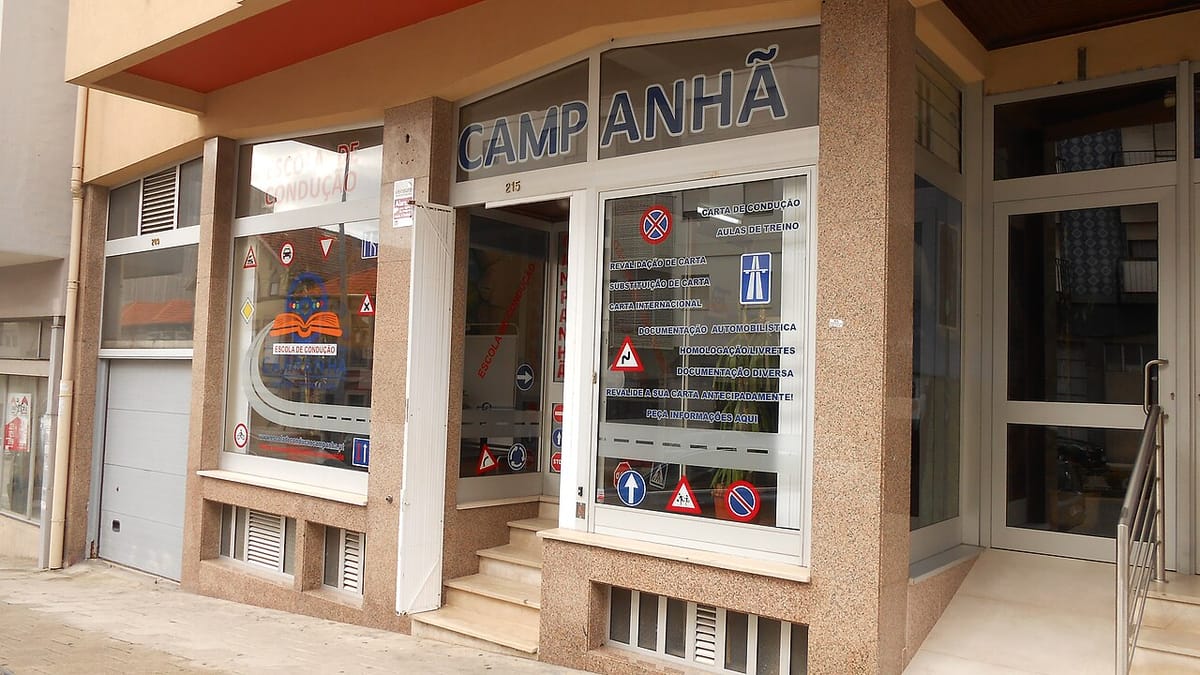
- Choose a school and enrol. The school signs a written contract with you, registers you with IMT, and requests your learner's permit (licença de aprendizagem).
- Take the theory lessons and pass the theory exam. The school books the exam at an exam centre.
- Learn to drive. Take lessons with an instructor, practise with a tutor, or mix both.
- Pass the practical exam. The school books this too.
- Confirm your photo and signature. If you hold a valid, activated Portuguese citizen card, you do this free on IMT Online. Otherwise, go to an IMT counter.
- Receive your licence. IMT posts it to the address on your learner's permit.
The theory exam
People call the theory exam the código, after the Highway Code (Código da Estrada).
For a car licence:
- You answer 30 multiple-choice questions on a computer.
- You have 30 minutes.
- You pass with at least 27 correct answers.
IMT publishes its official exam question banks free on its website, as PDF files with pictures. Practising on them is the best preparation.
On exam day, bring a valid identity document. IMT also accepts the government's id.gov app.
Taking the theory exam in another language
If your Portuguese is not good enough to understand the exam, you can ask IMT to translate it. Since 8 July 2026, this applies to every licence category. A translator registered with IMT does the translation.
Here is how it works:
- Tell your driving school you want the exam with a translator.
- Choose a translator from IMT's approved list. The school names your translator when it books the exam.
- The exam centre tells IMT, which issues a Multibanco reference for the fee.
- Pay the fee by the day before the exam.
- IMT sends the exam to the translator, who returns the translation to IMT for the exam centre.
IMT's 2026 list has translators for Arabic, Bengali, Bulgarian, English, French, German, Mandarin, Persian, Romanian, Russian, Spanish, and Ukrainian. The list changes, so check it on IMT's exam page.
Translated exams run on Tuesdays and Wednesdays from 09:00 to 11:00, and on Thursdays from 14:00 to 16:00. Each exam centre can hold only four translated exams per session, so book early.
The translator is a private professional and sets their own fee. Ask for a quote before you book.
Learning with a tutor instead of an instructor
Since 5 July 2026, if you are enrolled at a driving school, your practical learning can be supervised by a tutor. This is often a parent or friend. You still enrol at a school and take the theory lessons.
Who can be a tutor
A tutor must meet all of these conditions:
- They have held a category B licence for at least 10 years. If their licence was issued outside the EU, it must be at least 10 years old and recognised in Portugal for at least five.
- They have no conviction for a road crime or a serious or very serious traffic offence in the last five years.
- They are not a driving instructor or examiner.
- They are not paid for tutoring, in any form.
A tutor can supervise at most five learners in any 10-year period. The law does not require tutors to take a course.
What the tutor takes on
The tutor is responsible for damage and offences the learner causes while practising. The exception is when the learner disobeys the tutor's instructions.
The compulsory car insurance must cover damage caused by the learner. Talk to the insurer before the first drive.
Rules while practising
- Before you start, your school tells IMT electronically who your tutor is and confirms they qualify.
- You may not carry passengers.
- You may not drive on motorways or roads classed as motorways.
- The car must be marked as the rules require. Ask your school which sign to use.
- The tutor must avoid roads and times with heavy traffic.
- Your council can ban tutor practice in busy areas.
- The police (PSP and GNR) can order the car off the road if these rules are broken.
When you can take the practical exam
You can sit the practical exam no sooner than 90 days after the school tells IMT about your tutor. You then have two choices:
- Take a check drive (teste de aferição) at your school first. The school assesses your skills and says how many extra lessons you need.
- Put yourself forward for the exam directly. If you fail without having done the check drive, you must wait four months before you can try again this way.
Should you use a tutor?
A tutor can cut the number of paid lessons. It does not remove the school fees, the theory lessons, or the exam fees. A complete beginner may still want some lessons in a dual-control car with an instructor.
The practical exam
The practical exam for a car lasts at least 40 minutes. Up to five of those minutes go on preparing and checking the car. An IMT examiner assesses you in normal traffic.
The examiner gives directions in Portuguese. Learn the basics before the day: "vire à direita" (turn right), "vire à esquerda" (turn left), "siga em frente" (go straight on), and "estacione" (park).
What it costs
IMT's fees are fixed:
| Item | Fee |
|---|---|
| Learner's permit | €15 |
| Theory exam | €15 |
| Practical exam | €30 |
| Licence issue | €30 |
| Total | €90 |
Requests made online get a 10% discount.
The driving school's tuition is separate and is the largest cost. Schools set their own prices. Ask each school for a written quote that lists:
- Enrolment and theory lessons.
- Each practical lesson, and how many they expect you to need.
- Exam booking, and any charge to use the school's car on exam day.
- The cost of a retake and of extra lessons.
If you sit the theory exam with a translator, add IMT's translation fee and the translator's own fee.
How long it takes
No official timescale is published. Timing depends on your school, your progress, and exam slots in your area.
- With a tutor, allow at least 90 days between the school's notice to IMT and the practical exam.
- If you fail the exam after skipping the check drive, allow another four months.
- After you pass, confirm your photo and signature promptly so IMT can print your licence.
If you are not an EU citizen
If you are a non-EU citizen living here on a visa or residence permit, your Portuguese licence's validity is tied to your residence document. The licence carries a restriction code (794). It stays valid only while your visa or residence permit is valid or being renewed. Keep your residence document up to date.
Your first three years as a new driver
Every new licence starts with three years of probation (regime probatório). During that time:
- Your alcohol limit is 0.2 g/L, lower than the 0.5 g/L for other drivers.
- Your licence lapses if you commit a road crime, one very serious offence, or two serious offences. You then have to sit a special test.
Like every driver, you start with 12 points. See Understanding the Driving Licence Points System for how points are lost and earned back.
What is changing next
New EU driving licence rules came into force on 25 November 2025. Portugal must bring them into national law. Most apply four years after entry into force, accompanied driving after three years, and rules on alternatively powered vehicles after two. For car drivers, the main changes are:
- An EU-wide accompanied driving scheme for 17-year-olds.
- A probation period of at least two years for new drivers. Portugal's three years already meets this.
- A digital licence in the EU Digital Identity Wallet, with a plastic card still available on request.
Until Portugal changes its law, the minimum age for a car licence stays at 18.
This guide is general information, not legal advice. Rules and fees change; check the official source before you act.
Sources
This guide is written from official sources and, where relevant, organisations' own websites.
- IMT, car and quadricycle licences: https://www.imt-ip.pt/condutores/informacoes-gerais/quero-ser-condutor/cartas-de-conducao-de-automoveis-ligeiros-e-quadriciclos/ (age 18, residence, fitness, enrolment documents, electronic medical certificate, €15, €15, €30, €30, 10% online discount, steps), checked 1 October 2026
- IMT, first driving licence: https://www.imt-ip.pt/condutores/informacoes-gerais/quero-ser-condutor/primeira-carta-de-conducao/ (school files the first issue, free photo and signature confirmation on IMT Online with an activated citizen card, counter otherwise, licence posted to learner's permit address), checked 1 October 2026
- IMT, exams: https://www.imt-ip.pt/condutores/obtencao/provas-de-exame/ (identity document or id.gov app, translator deliberation, 2026 translator list), checked 1 October 2026
- IMT, deliberation on theory exams with a translator, 9 September 2020: https://www.imt-ip.pt/wp-content/uploads/2025/01/4375_230904113648_001.pdf (school and exam centre procedure, Multibanco fee paid by the day before, session days and times, four per session), checked 1 October 2026
- IMT, approved translators 2026: https://www.imt-ip.pt/wp-content/uploads/2026/09/Lista_tradutores-atualizada-2026.pdf (languages), checked 1 October 2026
- IMT, official exam questions: https://www.imt-ip.pt/condutores/obtencao/perguntas-de-exame/ (free question banks), checked 1 October 2026
- Procuradoria-Geral Distrital de Lisboa, Regulamento da Habilitação Legal para Conduzir (Decreto-Lei n.º 138/2012) consolidated to Decreto-Lei n.º 114/2026: https://www.pgdlisboa.pt/leis/lei_mostra_articulado.php?nid=1757&tabela=leis&ficha=1&pagina=1 (normal residence of 185 days, students, 30 questions in 30 minutes with 27 to pass under articles 43, 46, and 47, 40-minute practical exam under article 51, probation under article 122 of the Código da Estrada), checked 1 October 2026
- Diário da República, Decreto-Lei n.º 114/2026, of 8 June: https://files.diariodarepublica.pt/1s/2026/06/10900/0001900030.pdf (translated theory exam for all categories from 30 days after publication; licence validity for non-EU residents tied to the residence document, code 794), checked 1 October 2026
- Diário da República, Decreto-Lei n.º 112/2026, of 5 June: https://files.diariodarepublica.pt/1s/2026/06/10800/0001000014.pdf (tutor learning, 10-year licence rule, school notice to IMT, liability, insurance, 90 days, check drive, four-month wait, five learners in ten years, heavy traffic, PSP and GNR, council bans; in force 30 days after publication), checked 1 October 2026
- Procuradoria-Geral Distrital de Lisboa, Lei n.º 14/2014 (driving instruction) consolidated to Decreto-Lei n.º 112/2026: https://www.pgdlisboa.pt/leis/lei_mostra_articulado.php?nid=2086&tabela=leis (tutor unpaid, no conviction in five years, no passengers, no motorways, car identified), checked 1 October 2026
- ANSR, republished Código da Estrada and points system pages: https://www.ansr.pt/contraordenacoes/carta-por-pontos (0.2 g/L for drivers with under three years, probation lapse, 12 points), carried from verified guide W2A-03, checked 1 October 2026
- IMT, licences from OECD and CPLP countries, and convention countries: https://www.imt-ip.pt/condutores/reconhecimento/troca-de-titulo-de-conducao-estrangeiro/paises-aderentes-as-convencoes-e-outras-situacoes/ (exchange routes, €300 to €1,500 fine), carried from verified guide W2A-03, checked 1 October 2026
- European Commission, modernised EU driving licence rules enter into force: https://transport.ec.europa.eu/news-events/news/modernised-eu-rules-driving-licences-and-driving-disqualifications-enter-force-2025-11-25_en (25 November 2025, accompanied driving at 17, two-year probation, digital licence, application after two, three, and four years), checked 1 October 2026
Last verified October 2026. Rules and fees change; check the official source before acting.