Esri Portugal Powers the Autoridade Tributária's IMI Digitalisation Run on ArcGIS — €14 Million 2025 Revenue Lines Up Behind a 20% 2026 Growth Target and Satellite Cross-Referencing of Undeclared Buildings
Esri Portugal's ArcGIS platform sits behind the Autoridade Tributária's geospatial digitalisation of IMI calculations — €14 million 2025 revenue, a 20% 2026 growth target, 400 decentralised products, and satellite cross-referencing that flags undeclared buildings escaping the property-tax base.

Behind the Autoridade Tributária e Aduaneira's progressive digitalisation of Imposto Municipal sobre Imóveis (IMI) sits a single technology stack: ArcGIS, the geographic-information system distributed in Portugal by Esri Portugal — Sistemas e Informação Geográfica, the company has confirmed in reporting published by ECO on Wednesday 27 May 2026.
The story matters because IMI is the single property tax that lands on every freguesia in Portugal and on every owner of a registered building. The accuracy with which the AT can identify a property, attach it to a matriz predial entry, apply the right coefficient, and detect undeclared changes has a direct line into how much council revenue each municipality collects every May, August, and November.
The company behind the platform
Esri Portugal, headquartered in Parque das Nações and led by chief executive Rui Sabino, has been the exclusive distributor for Portugal, Cape Verde, Guinea-Bissau, and São Tomé and Príncipe of Esri Inc.'s ArcGIS technology since 1987. Reported 2025 revenue lands at roughly €14 million, with the 2026 trading target set at 20% year-on-year growth — implying a top line closing in on €17 million for the current cycle.
The company says that 60–65% of its activity is delivered to state entities, with the AT among the longest-standing clients. More than 400 decentralised products run on the platform across central administration, câmaras municipais, and intermunicipal communities, generating a homogeneous national view of cadastral, demographic and infrastructure data.
What the technology actually does for IMI
For IMI, ArcGIS aggregates Census data, applies the Código do IMI (CIMI) rules, and combines them with location coefficients derived from market values and demographic factors — the same inputs that feed the Valor Patrimonial Tributário (VPT) on each caderneta predial. By cross-referencing satellite imagery with declared building footprints, the platform can "identify constructions not declared or other alterations in areas that could escape taxation", in the company's own framing.
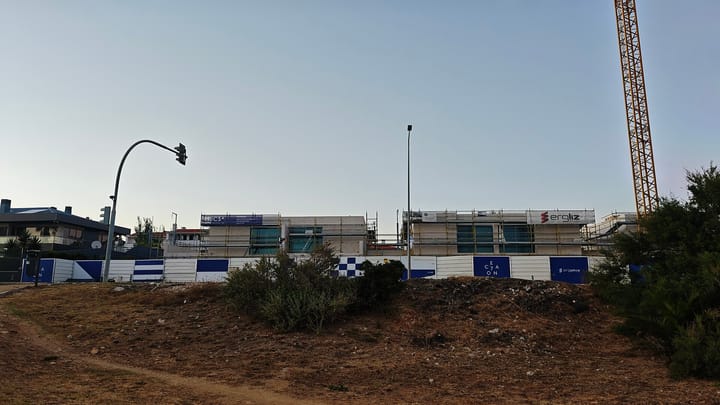
In practice, this is how the AT picks up house extensions, swimming pools, and outbuildings that owners never registered with Finanças — a slow leak that, when plugged, can lift VPT and the resulting IMI bill on assets that had been quietly under-declared for years.
Digital twins and the regional rollout
Esri's Portugal portfolio extends beyond IMI. The company is building a digital twin of the Comunidade Intermunicipal do Oeste under the "Oeste Smart Region" banner, with planned expansions to northern municipalities, Castelo Branco and parts of the Alentejo. Vila Nova de Gaia and Cascais are flagged as model municipal-tier clients. For 2026, georeferencing projects tied to water and energy management round out the pipeline.
What this means for expats and residents
- Property owners: Any unregistered extension, pool, or annexe on a Portuguese property is increasingly visible to the AT through satellite cross-referencing — regularisation now is cheaper than the IMI back-bill and the contraordenação later.
- Buyers: The accuracy of the VPT on the caderneta predial is improving, which narrows the gap between book value and market value — and feeds into the IMT/Imposto do Selo a buyer pays at the deed.
- Municipal budgets: Câmaras with high-quality cadastre data are recovering more IMI from previously under-declared assets, which over time supports local-service spending without rate increases.
- Tech sector: Esri Portugal's growth track — €14M last year, 20% targeted this year — is a quiet GovTech success story in a Portuguese ecosystem better known for fintech and tourism plays.
Why it matters now
The geographic-information layer behind IMI is moving from invisible plumbing to a quotable, accountable platform. As digital twins extend across northern and central Portugal and as the AT's satellite cross-checks accelerate, the property-tax base is being widened by inches rather than by rate changes — an under-reported revenue lever that câmaras and the Ministério das Finanças will lean on harder through the back half of 2026. On the apartment-ownership, condomínio and building-management side of the file, our guide to living in a condomínio and horizontal-property rules sets the latest reference. On the paperwork, our guide to the caderneta predial and the VPT explains the property tax record that sets your IMI.