Chega's First Constitutional Court Seat Recasts the 13-Judge Bench's Partisan Math — What the Joint Three-Party List Means for Pending Dossiers
Friday's Assembleia da República vote seated four new Tribunal Constitucional judges from a joint PSD-Chega-PS list — Chega lands its first-ever Tribunal seat. The partisan-math shift will play out across the Lei dos Estrangeiros, pensions and Lei de Bases da Saúde dossiers for nine years.

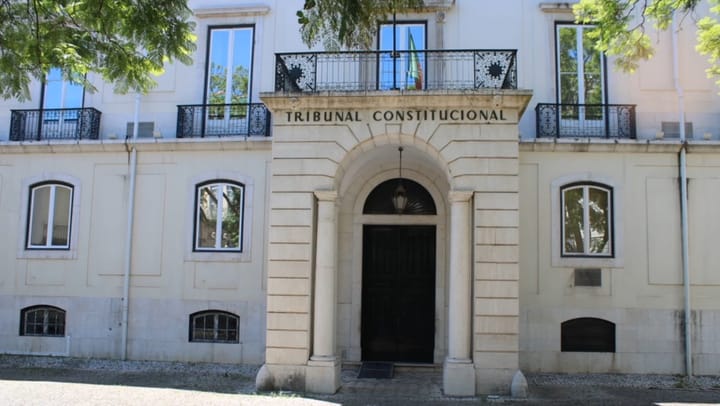
The Assembleia da República (Portuguese Parliament) sat four new judges on the Tribunal Constitucional (Constitutional Court) on Friday afternoon, completing the partial renewal cycle triggered by the September 2024 expiry of three nine-year mandates. The joint list was filed by the PSD-CDS Cabinet bloc, Chega and the PS — the three-party combination clearing the two-thirds (154-vote) threshold the Constitution requires under Article 222.º for Assembleia-elected judges. The package seats Carlos Cadilha (renewed for a second non-consecutive mandate), Filipa Calvao (a fresh PSD-list judge), Joana Faria (a fresh PS-list judge) and — the structural inflection point — Tiago de Oliveira Bertoncello, Chega's first-ever judge on the 13-member bench.
The Architecture of the 13-Judge Bench
The Tribunal Constitucional sits as a 13-judge body under Article 222.º of the Constituição da República Portuguesa (CRP, Portuguese Constitution). Ten judges are elected by Assembleia da República on a two-thirds majority; the remaining three are co-opted by those ten from among Tribunal Judiciais (judiciary) and academic-law candidates. The mandate is nine years, non-renewable in consecutive terms, with a structural rotation cadence that keeps the bench in a slow institutional drift rather than tracking the political cycle directly. The Cadilha renewal carries an explicit exception under the non-consecutive rule because his previous mandate ended in 2017; the eight-year gap clears the constitutional prohibition.
The Partisan-Math Shift
The 2017-2024 bench composition broke down operationally as 6 PS-nominated, 4 PSD/CDS-nominated and 3 co-opted — reflecting a decade-and-a-half of PS-led legislatures. The Friday vote moves the math to 5 PS, 4 PSD/CDS, 1 Chega and 3 co-opted, with the remaining seven seats up for renewal across the 2027-2033 window. The Chega seat is the new institutional dimension — it gives André Ventura's bench a permanent stake in constitutional review of the Lei dos Estrangeiros (Foreigners Law), the Lei de Bases da Saúde (Health Framework Law) and the social-rights chapter on which Chega has built its parliamentary programme. The judge's individual jurisprudential signature matters more than the appointing-party label — Bertoncello is a sitting Tribunal Administrativo (Administrative Court) judge with a published record on immigration-law and asylum-procedure dossiers — but the institutional signal is clear.
Pending Dossiers That Will Land On The New Bench
Lei dos Estrangeiros 2026 restrictions. The Assembleia da República passed the three new Lei dos Estrangeiros restrictions on 11 June with PSD-CDS-Chega votes — tightening the family-reunification scope under Article 98.º, extending the residence-permit attribution window and modifying the Manifestação de Interesse path. The PS-Bloco-Livre opposition has publicly flagged a constitutional challenge under Article 281.º (fiscalização abstracta) on the Article 98.º modifications — the Bertoncello seat will be load-bearing in the recusal calendar.
Pension reform Lei n.º 4/2007. The OE2027 envelope and the CRP Trabalho, Emprego e Formação (Labour Programme) reform package both reset the Trabalho Social clause and the contributory-period anchor. A constitutional challenge from Bloco de Esquerda and Livre is already filed in advance of the Q4 2026 promulgation window.
Lei de Bases da Saúde. The Friday SNS IT outage feeds directly into the constitutional review of the Lei de Bases da Saúde framework on public-service-of-last-resort obligations — the bench will look at Article 64.º CRP (the right to health) in a posture where the digital-architecture failure is the load-bearing operational test.
Pacote Fiscal Habitação. The May 2026 promulgation of the IVA-on-construction reform carries a Constitutional Court technical-review window from the PS opposition on the retroactive-effect provisions on AIMI (Adicional ao IMI) liability.
What This Means for the Constitutional Cycle
The Friday vote is a structural inflection on Portuguese constitutional jurisprudence for the next nine years. The Chega seat does not flip the bench — the PS-aligned majority still anchors the rights-protection chapter and the social-rights doctrine — but it adds a recognisable voice on the immigration-law and social-policy dossiers that have defined the 2024-2026 political cycle. Expat readers tracking the Lei dos Estrangeiros restrictions, the AIMA architecture and the residence-permit attribution timeline should treat the Tribunal calendar as a live watch-item across the second half of 2026.