Air Force Black Hawks Flew 56 Wildfire Missions in Their First Season, and Two Firefighting C-130s Could Join Them in 2027
The Air Force's UH-60 Black Hawks took part in 56 firefighting missions this year, flying more than 200 hours and making over 900 water drops. The Defence Minister expects two C-130s with firefighting kits in 2027 and Canadair water bombers in 2029 and 2030.
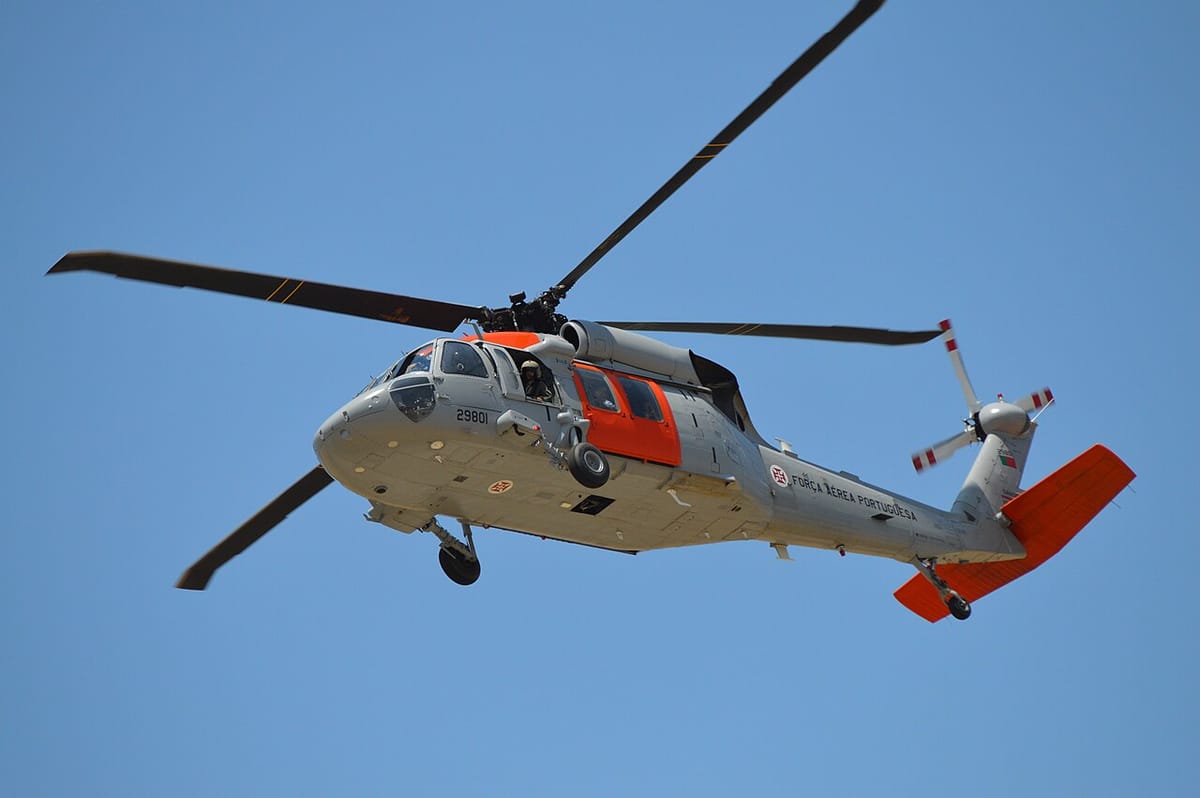
The Força Aérea (Portuguese Air Force) has given its first account of a season fighting rural fires with its own helicopters. Its UH-60 Black Hawks flew 56 firefighting missions this year, for more than 200 flight hours and more than 900 water drops. The Air Force and the Defence Minister, Nuno Melo, also said they expect two C-130 transport planes fitted with firefighting kits to join the effort in 2027.
The figures were given on Monday 19 October at the Air Force staff headquarters in Alfragide, near Lisbon, at a ceremony marking what the force bought with money from the Plano de Recuperação e Resiliência (PRR, the EU-funded Recovery and Resilience Plan).
What the recovery money bought
According to the Air Force's own account of the ceremony, the PRR paid for 13 UH-60 Black Hawk helicopters, which serve with Esquadra 551 (551 Squadron, the "Panteras"), and two AW119 Koala helicopters, which reinforced Esquadra 552 (552 Squadron, the "Zangões"). The money also went beyond aircraft. At Base Aérea N.º 8 (Air Base 8) in Ovar, the North Hangar was rebuilt and a new building was put up for 551 Squadron, both paid for mostly by the PRR and opened in 2025 and 2026.
The Air Force says this year marks the start of its own mission fighting rural fires. Lusa reported that nine of the 13 Black Hawks are meant for firefighting and four for medical emergency support. It also reported that the helicopters took part directly in the Dispositivo Especial de Combate a Incêndios Rurais (DECIR, the national rural firefighting deployment) for the first time this year. ECO reported that two Black Hawks were assigned to it.
The season in numbers
As reported by Lusa from the ceremony, 551 Squadron took part in 56 firefighting missions this year, working with the Autoridade Nacional de Emergência e Proteção Civil (ANEPC, the National Emergency and Civil Protection Authority). Those missions added up to more than 200 flight hours and more than 900 water drops. ECO put the number of fire theatres at 32.
The Secretary of State for Civil Protection, Rui Rocha, said at the ceremony that the number of fires was 5.4 percent higher than in 2025, but that the area burnt, up to the day before, was 72.4 percent lower. Those are the Government's provisional figures as quoted by Lusa; the official season report has not yet been published.
C-130s in 2027, Canadairs later
At the end of the ceremony, Nuno Melo and the Air Force chief, General Sérgio da Costa Pereira, said they expect C-130 aircraft to be in service against fires next year, fitted with the two firefighting kits the Government has bought, an investment of about 16 million euros, according to Lusa. Melo added that heavy Canadair water bombers should join them in 2029 and 2030.
General Pereira said Portugal now has "its own, permanent capacity" for fighting fires, built "practically from scratch", and called it "a true state project". He also warned that the Air Force needs to keep its trained personnel, whose years of training produce operational excellence that is "hard to replace". Melo recalled last year's criticism of the purchase of the four Black Hawks meant for medical emergencies and insisted that they will serve that purpose and can land at the heliports built for it.
Why it matters
When the Black Hawks first joined the deployment in spring, we reported on their first operational season. A fleet owned by the state and flown by military crews gives the authorities aircraft of their own. How many are available each summer, and whether the C-130 kits arrive on time, will decide how much that changes on the ground.