A Jar of Blended Honey in Portugal Must Now Print Each Country's Share, and China Supplied Half of Last Year's Imports
Decree-Law 136/2025 puts every country of harvest and its percentage on the front of a blended honey jar. Portugal imported 12,365 tonnes of honey in 2025, and 6,199 of them came from China at 1.11 euros a kilo.
Pick up a jar of blended honey in a Portuguese supermarket and the label now has to say where every part of it was harvested, and how much of it came from each country. Portugal wrote the rule into law in December, and it covers honey labelled from 14 June this year. It matters because Portugal imported more than 12,000 tonnes of honey last year, and half of it came from China at a little over one euro a kilo.
What the label must now say
Decreto-Lei n.º 136/2025 (Decree-Law 136/2025), published in the Diário da República (official gazette) on 24 December, rewrites the 2003 honey decree to transpose EU Directive 2024/1438. Since 2021 a blend had to name its countries; the new text goes further:
- every country of harvest goes on the main field of vision of the label, in descending order of weight, with the percentage from each;
- each percentage may be out by up to 5 percent, measured against the packer's traceability records;
- for honey sold in Portugal, if a blend has more than four countries and the four largest make up more than half of it, the label may give percentages for those four and simply list the rest in order;
- jars holding less than 30 grams may use two-letter country codes, such as CN or ES.
The decree also bars removing pollen or other natural components of honey unless the packer can document that filtering out foreign matter made it unavoidable. Its stated aim is to prevent fraud. Jars labelled under the old rules before 14 June may be sold until stocks run out, so older labels will linger on shelves.
Where Portugal's honey comes from
Eurostat's trade database shows Portugal imported 12,365 tonnes of natural honey in 2025, worth 22.4 million euros. China alone supplied 6,199 tonnes, just over half, at an average declared value of 1.11 euros a kilo. Spain sent 3,605 tonnes at 2.83 euros a kilo, and India 1,028 tonnes at 1.41 euros.
Honey from outside the EU came in at an average of 1.22 euros a kilo, against 2.99 euros for honey from other EU countries. China's volume fell from 7,444 tonnes in 2024, when it made up 57 percent of imports.
Portugal also sells honey. It exported 12,854 tonnes last year, 10,583 of them to Spain, at an average of 1.48 euros a kilo. The trade figures do not show how much of what left the country was harvested here.
Beekeepers' deadline on Wednesday
Beekeepers face their own deadline this week. Under a notice from the Direção-Geral de Alimentação e Veterinária (Directorate-General for Food and Veterinary Affairs, DGAV), every beekeeper must declare their hives between 1 and 30 September, on the IFAP portal or through a beekeepers' organisation. Missing it can cost an individual 100 to 3,740 euros. Our guide to keeping bees in Portugal explains the register and the declaration.
For shoppers, the advice is to read the front of the jar: under the new rules, the countries and their percentages belong there. Earlier this month the EU also stopped honey imports from Brazil over antibiotic controls.
Sources: Decree-Law 136/2025 (Diário da República, Portuguese only); Eurostat Comext, product code 0409 (natural honey), reporter Portugal, 2024 and 2025; the DGAV notice on the 2026 hive declaration (Portuguese only).
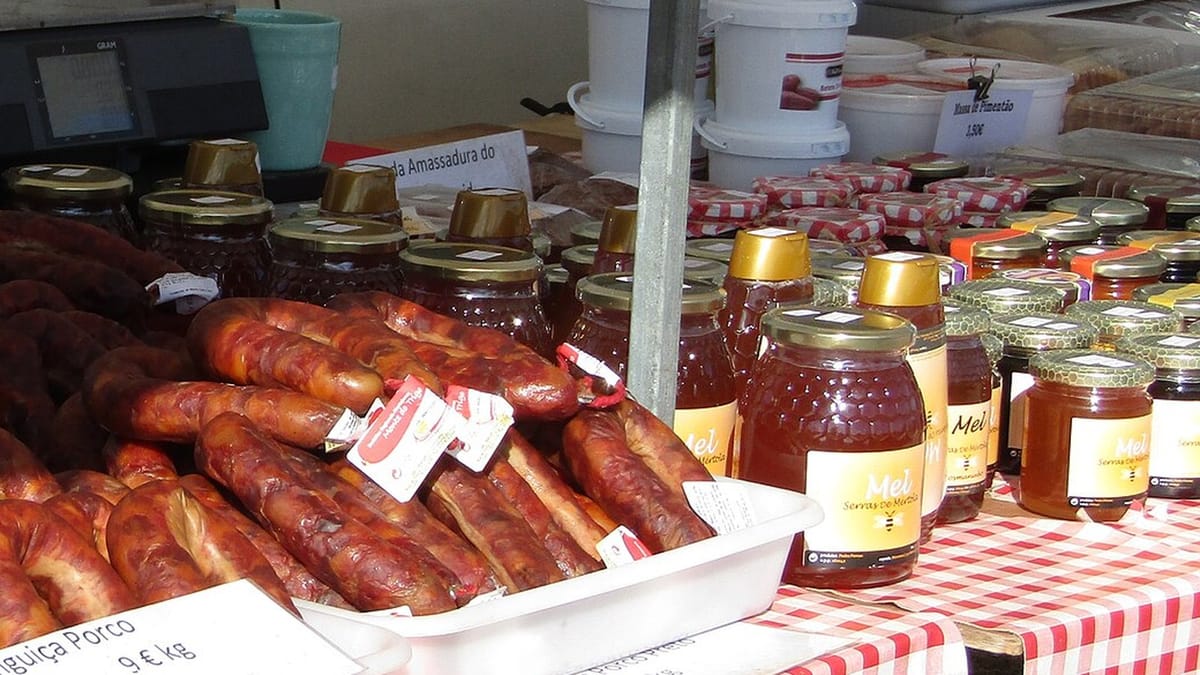
Feature image: honey from the Serras de Mértola on a stall at the monthly market in Algoz, Algarve, in February 2018. Photo by Kolforn (CC BY-SA 4.0), via Wikimedia Commons.