A Fire That Started at Mouriscas on Saturday Afternoon Crossed Into Mação by Nightfall, Drawing 578 Operatives on the Eve of the Rain
The alert came at 15:11 in Abrantes. By nightfall the fire had four fronts, 180 vehicles and 16 aircraft, with three firefighters lightly hurt and no homes at risk. It burns in a corner of the Medio Tejo that has storm-felled timber still on the ground.
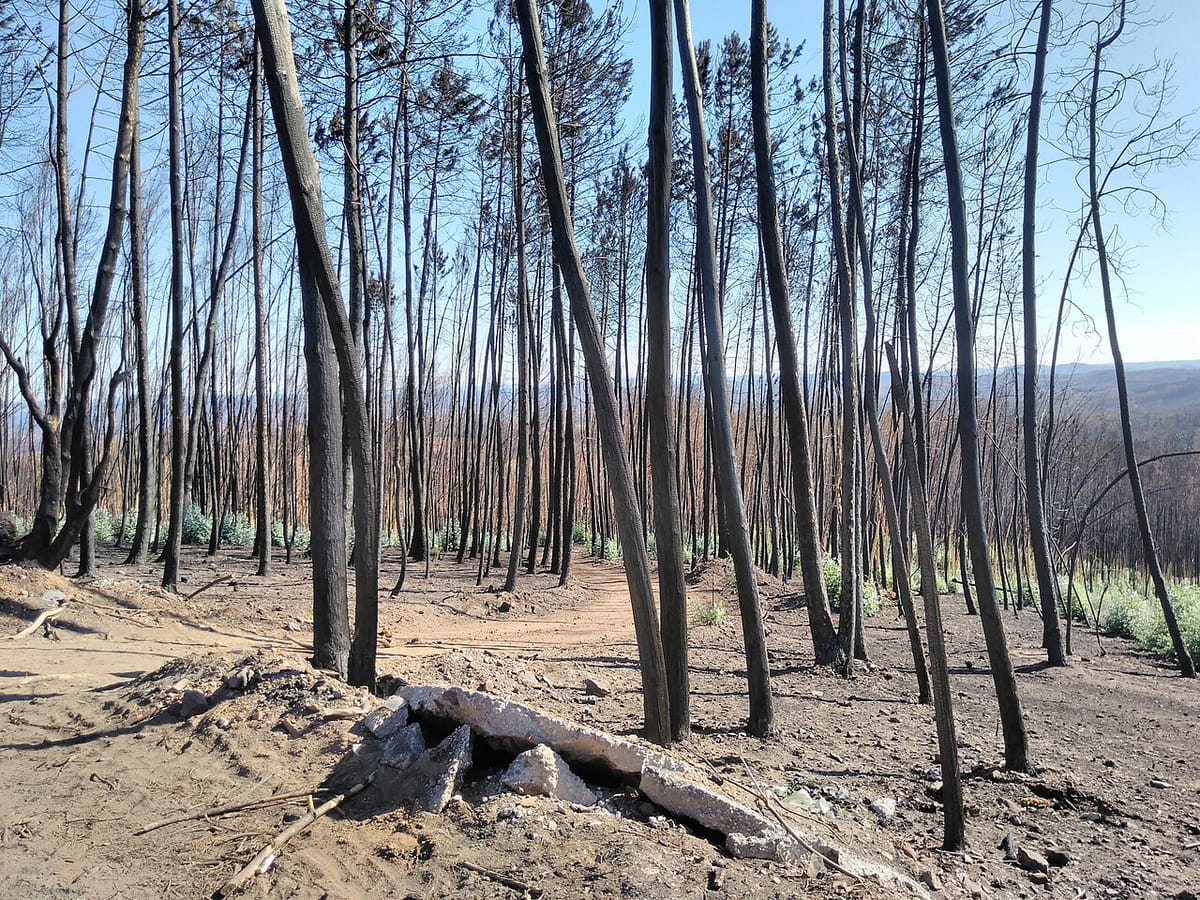
The alert came in at 15:11 on Saturday afternoon, from Mouriscas, a parish on the eastern edge of the Abrantes council in Santarém district. By nightfall the fire had four fronts, 578 people fighting it, 180 vehicles on the ground and, until the light went, 16 aircraft overhead. It had also stopped being Abrantes's problem alone: it crossed the administrative boundary into Mação.
Three firefighters were treated for minor injuries. No house was evacuated, and no settlement was reported at risk. The Abrantes council's vice-president said there was no information of populations or dwellings in danger, and Mação confirmed the flames had entered its territory in scrubland, well away from the villages of Queixoperra and Penhascoso.
By 22:00 the fire was showing signs of slowing, with one active front running along a hillside and civil protection describing it as giving way to the resources deployed against it. It was, through the afternoon and evening, the fire pulling the most resources of any in the country.
Four fires, one Saturday
Mouriscas was the largest but not the only one. A fire in the Fundão council, in Castelo Branco district, drew more than 110 operatives, 24 vehicles and five aircraft during daylight hours. Another burned in Celorico de Basto, in Braga district, having threatened several hamlets overnight before easing. A fourth, in Santa Marta de Penaguião in Vila Real district, passed 200 operatives. Three of the firefighters injured at Arouca were reported on Saturday to be recovering favourably.
What makes Saturday's map awkward is its timing. The Atlantic depression that is due to turn August into something closer to autumn reaches the western coast on Sunday, bringing rain along the whole coastline and heavier, thundery showers into the North and Centre on Monday. The last dry, windy afternoon before a weather change is a familiar shape in the Portuguese fire calendar, and Saturday fitted it.
Why this particular corner of the map burns
Mouriscas and Penhascoso sit on the Abrantes to Mação line, in the Médio Tejo. It is not a random place for a large fire.
Mação is one of the most repeatedly burned councils in mainland Portugal. Analyses of the 1990 to 2017 period place it among the municipalities where the cumulative burned area across those 28 years exceeded 180% of the council's own surface: in other words, the average hectare there burned nearly twice. In 2017 alone, the fire severity recorded in Mação reached a maximum of 70%.
Abrantes has its own recent history with the ground cover. The council counted about €16 million in damage from Storm Kristin, against roughly €1 million wired from Lisbon in the four months that followed, and the Médio Tejo region entered the 2026 fire season with storm-felled timber still lying in places where it had not been cleared. Downed pine is fuel, and it dries.
Where the season stands
The Instituto da Conservação da Natureza e das Florestas (Institute for the Conservation of Nature and Forests) publishes provisional running totals through the summer. Between 1 January and 15 August 2026 it recorded 6,388 rural fires and 56,586 hectares burned, split between 25,732 hectares of forest stands, 24,995 hectares of scrub and 5,859 hectares of farmland. By 19 August the count had reached 6,666 fires and 63,347 hectares.
Vila Real leads the district table with 13,562 hectares, about 24% of the national total, followed by Bragança with 9,909 and Viseu with 8,325. The councils with the largest burned area so far are Valpaços, Mirandela, Águeda and Vouzela. Santarém district, where Saturday's fire started, is not among the worst affected, which is part of why the Mouriscas fire drew the resources it did: they were available.
On causes, the institute's mid-August analysis is blunt. Burning of agricultural and forestry residues, the queimas and queimadas, accounts for 37% of rural fires with an investigated cause. Deliberate fire-setting is second, at 17%. All of these figures are provisional and are adjusted as the fire-information system consolidates them.
What Sunday changes, and what it does not
Rain suppresses ignition and it dampens fine fuels, but it does not settle a fire of this size by itself. A blaze that has run across four fronts through a hot afternoon leaves a perimeter that has to be walked, wetted and watched, and the crews who did the initial attack are the crews who do that too. Aerial means are grounded at nightfall and return at first light; on Sunday they will be returning into cloud and wind rather than into another day of heat.
The larger question the Médio Tejo keeps asking, and Saturday asked again, is what happens to the fuel between fires. Storm damage that is never cleared does not disappear. It waits for an afternoon with the right wind. On what the GNR finds when it investigates a fire, the GNR's own count of 173 fire-crime detentions this year out of 6,200 fires investigated, in which burning agricultural residues remains the largest identified cause sets the latest reference.