A 1924 Lisbon Jeweller Takes Its Second Shop Abroad to Paris, After Committing Six Million Euros to Ten Years on Times Square
Joalharia do Carmo opens in Paris within months. Its owner is pushing just two of its thirteen brands abroad, canned fish and filigree, while telling Lusa it plans no expansion at all of its Portuguese network.
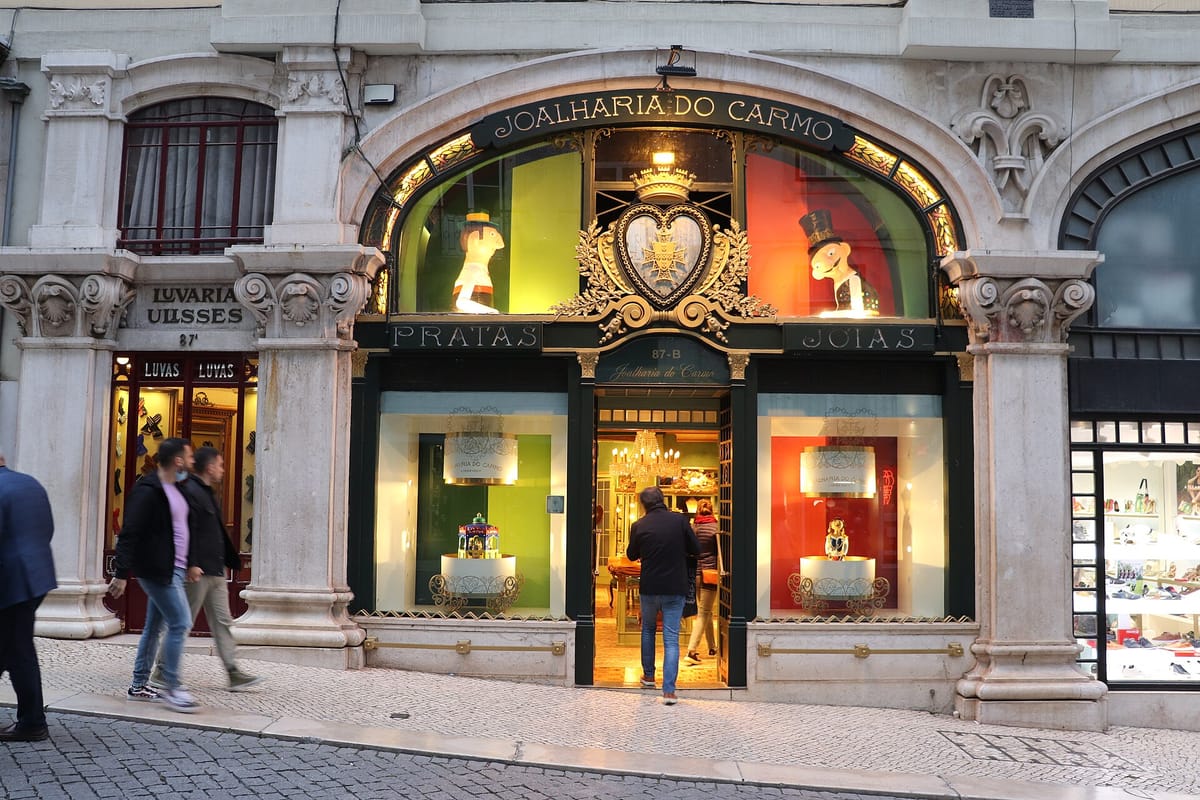
Joalharia do Carmo, a jeweller founded in 1924 on Lisbon's Rua do Carmo, will open its second shop outside Portugal in Paris within the next few months, following a first international opening on Times Square in New York in July. The plan was set out to Lusa by Sónia Santiago, director of marketing and cultural communication at O Valor do Tempo (The Value of Time), the Portuguese group that took the brand over in 2021.
"This year the focus is on the two international openings of Joalharia do Carmo," Santiago said, describing New York as done and Paris as next. "For next year and the ones that follow, everything is possible. We will stay attentive to the opportunities that arise and will move whenever we judge they make sense for the group and for our brands, keeping the ambition that has guided us: taking Portugueseness to the world with elevation."
Six million euros for ten years on Times Square
The New York commitment is the harder number in the announcement. Santiago told Lusa the investment there covers a ten-year contract worth six million euros. Investment in the openings that follow, she said, will be adjusted to the size, location and characteristics of each project, which stops short of putting a figure on Paris.
The jewellery shop is the group's second space on that square. The first was The Fantastic World of the Portuguese Sardine, which opened there in 2023 and has since become the group's most recognisable export. Placing a second Portuguese brand on the same block is a deliberate clustering strategy rather than two unrelated bets.
Two concepts, not thirteen
O Valor do Tempo runs thirteen brands, most of them restorations of long-established Portuguese businesses and sites. They include the Museu do Pão, the Casa Portuguesa do Pastel de Bacalhau, A Brasileira do Chiado, the Museu da Cerveja, Confeitaria Peixinho, A Pérola do Bolhão, Casa Pereira da Conceição, Silva & Feijóo, Figurado de Barcelos and the Centro Interpretativo da Ovelha Serra da Estrela.
Only two of those are being pushed abroad. Santiago said canned fish and filigree are the concepts with the most solid characteristics to gain international relevance, and that there are no concrete plans to internationalise the other brands. Filigree is the intricate gold and silver wirework long associated with Gondomar and the north, and it is what Joalharia do Carmo carries into a foreign market.
Asia and South America are the geographies the group says it is watching with particular interest, though it named no market and no timetable.
Consolidation at home
The domestic picture is the opposite of the export one. O Valor do Tempo says it has no expansion of its Portuguese network planned and describes itself as in a phase of consolidation and optimisation, assessing each location carefully. In practice, Santiago said, that means opening the occasional store in places judged strategic while potentially leaving locations that stop making sense for the concepts.
That is a notable position for a group whose shops sit in exactly the high-footfall tourist streets, the Chiado, the Baixa, the Bolhão, where rents have risen hardest. Expanding in New York and Paris while trimming at home suggests the economics of a Lisbon tourist-facing retail unit are no longer automatically better than a Manhattan one.
What this means for you
- A Portuguese retail model on export: the group's approach is to buy historic Portuguese businesses, restore them and sell the story alongside the product. Its success abroad is a reasonable proxy for how far heritage branding travels.
- Filigree is being positioned as a luxury export: if you buy Portuguese gold or silver filigree, expect the price positioning of the better-known names to rise as international shelf space expands.
- Watch the high street, not the headlines: a consolidation phase means some of these shops may close or move. If a particular location matters to you, the group has said openly that underperforming sites are under review.
- Craft jobs are the stated point: the group presents itself as sustaining traditional production methods. Whether international expansion increases work for Portuguese artisans or simply the brand's margins is the question worth following.
Paris is due within months, which makes it the first real test of whether the Times Square result was a location effect or a proposition that works in a European capital with its own long jewellery tradition.