The Gulbenkian Museum Reopens After 18 Months, With Nine Free Days and a New Coin Gallery
Lisbon's Calouste Gulbenkian Museum reopens on Saturday after a year and a half of renovation, with free entry through 26 July to mark the foundation's 70th anniversary. Among the changes: a new numismatics gallery and a reworked Lalique Room.
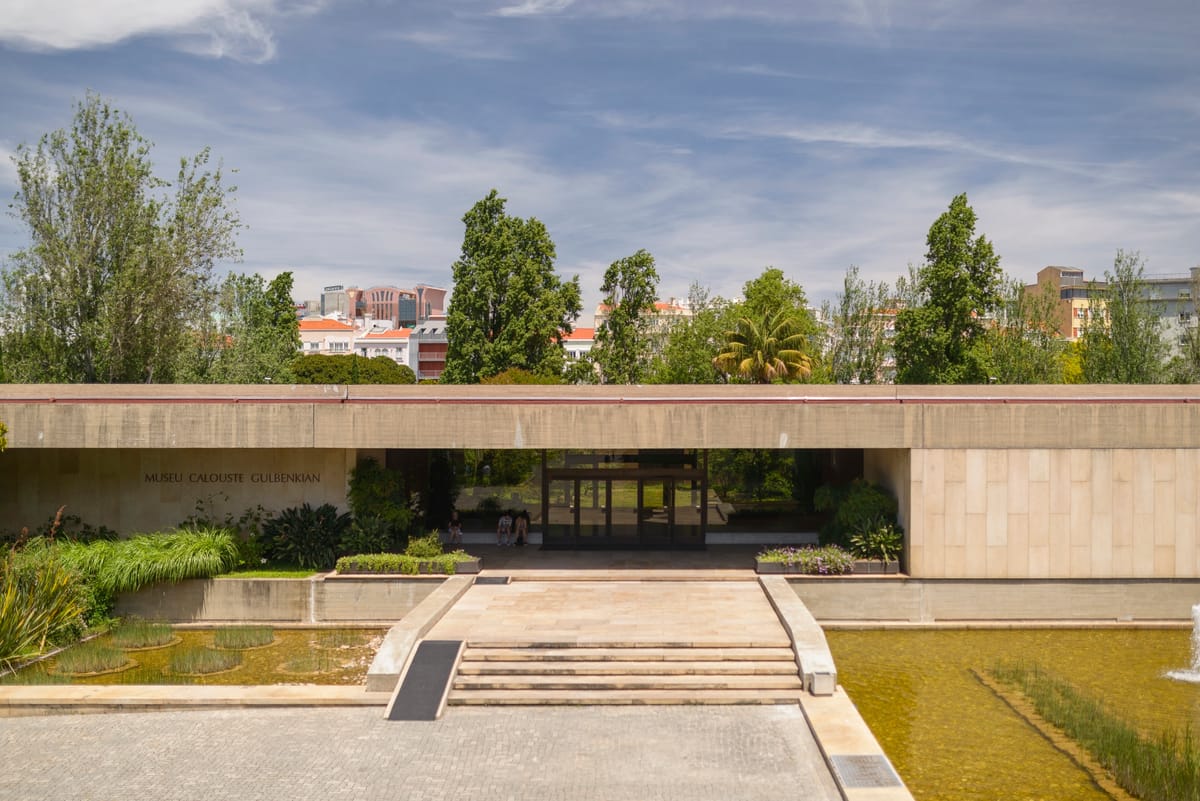
One of Lisbon's landmark museums reopens its doors on Saturday after a year and a half of renovation, and for the next nine days it will cost nothing to walk in. The Calouste Gulbenkian Museum (Museu Calouste Gulbenkian), on Avenida de Berna, welcomes the public again from 10am, with free entry running through 26 July to mark the 70th anniversary of the Calouste Gulbenkian Foundation (Fundação Calouste Gulbenkian), which falls the same day.
The building that reopens is the museum's historic core — the Founder's Collection (Coleção do Fundador), which houses the art amassed by the Armenian oil magnate Calouste Sarkis Gulbenkian, whose foundation has shaped Portuguese cultural life since 1955. It is a separate space from the foundation's modern-art building, and the works here range across ancient Egypt, Mesopotamia and classical antiquity, Islamic and Armenian art, Japanese prints and lacquers, European painting and sculpture, and the celebrated collection of jewellery and glass by René Lalique.
The renovation set out to recover the spirit of the original 1969 design, restoring the coherence of a building conceived to hold art in dialogue with architecture and the surrounding garden. New display cases, reworked lighting and improved climate control accompany a deep restoration of the pieces themselves; light-filtering films have replaced old blinds so that daylight and garden views survive without endangering the works. The museum's new director, Xavier Salomon, and the president of the foundation's board of administration (Conselho de Administração), António Feijó, presented the changes ahead of the opening.
There is more to the reopening than a fresh coat of curatorial polish. A new numismatics gallery, carved out of a former staff office never before open to visitors, is dedicated to ancient coinage. Works long kept in storage — Japanese prints, gold boxes, medals, sculptures and a Venetian parasol — return to view, and the museum's prized mosque lamps are once again shown individually in restored, anti-reflective cases after more than two decades displayed as a group. The Lalique Room (Sala Lalique) breaks from the restore-to-1969 rule, now setting the jeweller's work in conversation with paintings by Edward Burne-Jones and John Singer Sargent.
The free days are not a simple walk-up affair. Entry runs on timed slots every ten minutes, and visitors must book a ticket online and join the free Gulbenkian Card (Cartão Gulbenkian) to reserve a place; associated guided visits and printmaking workshops are also free with booking. The opening weekend carries extended hours — until midnight on Saturday and until 8pm on Sunday — before the museum settles into its regular schedule, open daily except Tuesdays.
The anniversary programme stretches well beyond the reopening. An exhibition titled “Gulbenkian, 70 anos em cartaz” (“Gulbenkian, 70 Years on the Poster”) runs until 19 October, and an opening-day concert brings together the Gulbenkian Choir and Orchestra (Coro e Orquestra Gulbenkian) under conductor Carlo Rizzi, with soprano Sonya Yoncheva. Further events — a September film cycle, new music commissions and the launch of a Gulbenkian Institute for Advanced Studies (Instituto Gulbenkian de Estudos Avançados) — run through December. For residents and visitors weighing a summer outing, the reopening arrives as the government sharpens the incentives around culture, and a free week at one of the city's great collections is an unusually easy invitation to accept. On what it now costs to keep a national museum open on a feriado, our report on the 60 euro availability supplement created for the front-of-house staff of Museus e Monumentos de Portugal who work a public holiday, indexed to the public pay table and backdated to April 2026 sets the latest reference.