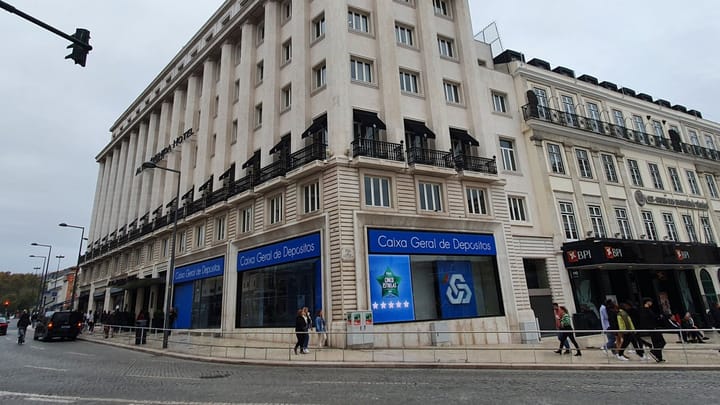
Supreme Court Rules Caixa Geral de Depósitos Must Index the Meal Allowance It Pays on Workers' Holidays
The Supremo Tribunal de Justiça has ruled that Caixa Geral de Depósitos must raise each year the meal allowance it pays to staff on holiday, overturning a lower court. It reinforces a wider principle: a benefit paid consistently for long enough becomes a right that cannot be frozen.

Portugal's Supremo Tribunal de Justiça (Supreme Court of Justice, STJ) has ruled that Caixa Geral de Depósitos (CGD), the state-owned bank, must raise each year the meal allowance it pays to workers while they are on holiday — overturning a lower-court decision that had sided with the bank. The judgment, reported on 2 July, closes one front in a long-running pay dispute and reinforces a principle that reaches well beyond a single employer: once a payment becomes a settled part of someone's remuneration, it cannot simply be frozen.
The case was brought by the Sindicato dos Trabalhadores das Empresas da Caixa (Union of Caixa Companies' Workers, STEC), and while it turns on the specifics of one bank, the reasoning speaks to any employee in Portugal who has come to rely on a recurring extra in their pay packet.
How the dispute started
The story goes back to 2017, when CGD stopped paying the subsídio de refeição (meal allowance) for the days workers spent on annual leave. Employees challenged the cut, and in 2018 the STJ found in their favour: because the bank had paid the holiday meal allowance continuously for roughly four decades, the payment had acquired what Portuguese labour law calls a natureza retributiva (retributive nature). That put it under the protection of the princípio da irredutibilidade da retribuição (principle of the irreducibility of pay) — the rule that an employer cannot unilaterally reduce what an employee is owed.
Following that ruling, the parties fixed the benefit at an annual €233.10, paid each June to workers hired up to 2017. But the two sides then split over a second question: should that figure stay flat, or should it rise over time in line with the annual updates applied to the rest of the pay scale? STEC argued for annual indexation; the bank resisted it.
What the Supreme Court decided
A first-instance court had backed CGD. The STJ has now reversed that, siding with the union and holding that the meal allowance paid on holiday must track the yearly salary revisions rather than remain stuck at a fixed amount. In practical terms, the bank must pay the differences — the gap between what it actually paid each year and what it would have paid had the benefit been updated annually.
The court did not settle everything. It sent one question back to the Tribunal da Relação de Lisboa (Lisbon Court of Appeal): whether employees hired after 30 April 2017 — that is, after the cut-off tied to the earlier settlement — are also entitled to receive this holiday meal allowance. That leaves a distinct, and potentially larger, group of workers still awaiting a definitive answer.
Why a bank's meal allowance matters to everyone else
The detail is niche; the principle is not. Portuguese law distinguishes sharply between genuinely discretionary perks and payments that have hardened into part of retribuição (remuneration). When a benefit is paid regularly, predictably and over a long period, it can stop being a favour and become a right — at which point the employer loses the freedom to cut or freeze it. The Caixa saga is a textbook illustration: a meal allowance, paid for forty years, became something the bank could no longer treat as optional.
The meal allowance is one of the most common features of a Portuguese pay slip, typically delivered as a per-day amount and carrying a tax advantage over ordinary salary — a mechanism explained in our guide to reading your employment contract and payslip. For workers, the ruling is a reminder that consistency creates entitlement; for employers, it is a warning that voluntary generosity, repeated long enough, can become a fixed obligation.
What This Means for Expats
- Recurring extras can become rights: If your employer has paid you a bonus, allowance or subsidy regularly and over a long stretch, it may have acquired retributive character — meaning it cannot lawfully be cut or frozen without your agreement.
- Watch the meal allowance specifically: It is a standard, often tax-favoured line on Portuguese payslips. Check that it is being paid consistently, including where your contract or collective agreement extends it to holiday periods.
- Collective agreements do the heavy lifting: Many pay rules — including how allowances are updated each year — sit in the sector or company acordo coletivo (collective agreement), not the national law. Read yours before assuming a benefit is fixed or optional.
- Keep your payslips: A long, consistent paper trail is exactly what turns a discretionary payment into a protected one. Your payslip history is the evidence base if a dispute ever arises.
- The ACT is your first stop: If you believe pay you are owed has been unilaterally reduced, the Autoridade para as Condições do Trabalho (Working Conditions Authority, ACT) handles labour complaints before matters reach a court.
For the Caixa workers hired before 2017, the judgment converts years of frozen allowance into back-pay owed. For everyone else, it is a quieter but useful precedent: in Portugal, what your employer does for long enough, it may eventually have to keep doing. On how Portugal chooses its top judges, the lawsuits over the Supreme Court promotion ranking explains the points system behind the 18th competition and why three appeal judges are now challenging it.