Portugal Sets New Military Recruitment Target — Nuno Melo Tells Parliament the Armed Forces Must Grow by 3,700 by End of 2027 as Defence Spending Heads to 5% of GDP
Defence Minister Nuno Melo presented the 2025-2029 Law of Major Options to Parliament on 21 April, setting a target of 3,700 extra uniformed personnel by end-2027 and a path toward 5% of GDP on defence by 2029.

Portugal will try to add 3,700 uniformed personnel to its Armed Forces by the end of 2027, Defence Minister Nuno Melo told the Assembleia da República on Tuesday 21 April 2026 as he presented the Law of Major Options for 2025–2029 (Grandes Opções 2025–2029). The number is the clearest commitment yet to the post-NATO Hague summit trajectory that will lift Portuguese defence spending from the 2% of GDP achieved last year to a 5% of GDP envelope by 2029.
Behind the headline is a harder problem than the government tends to acknowledge: Portuguese recruitment has been missing its targets for six straight years, and the 3,700-person goal is on top of an already-missed baseline — not a fresh start.
The Numbers in the Plan
On the current official count, Portugal's three branches together employ 24,517 uniformed personnel. The new target would lift that figure by roughly 15% in less than two years — a pace the Ministério da Defesa itself described to Parliament as "ambitious but necessary".
The recruitment pathway set out in the Grandes Opções:
- +3,700 personnel by the end of 2027 across the Army (Exército), the Navy (Marinha) and the Air Force (Força Aérea).
- A pay and career restructuring negotiated with the four military associations — AOFA (officers), ASMIR (retired), APS (NCOs) and AP (enlisted) — the first phase of which is already in the Budget 2026.
- Expansion of contract-basis recruitment (regime de contrato), with special incentives for posts in cyber defence, signals, UAV operations and military medicine.
- A new pipeline through the Military Academy, Escola Naval and the Academia da Força Aérea, with enrolment caps raised 18% across the three services.
The 2% Achieved, the 5% Ahead
Portugal met its NATO 2% of GDP pledge for the first time in 2025 — two years ahead of the original Prime Minister-Montenegro timeline from 2024. The reclassification of eligible spending under the updated NATO accounting rules for cybersecurity, dual-use infrastructure and veterans' health did some of that lifting; fresh Budget envelopes did the rest.
The 5% of GDP target by 2029 is a NATO-wide commitment from the June 2025 Hague summit — ratified at heads-of-state level and accepted by every Alliance member bar Spain. For Portugal, the split is:
- 3.5% of GDP on core defence — personnel, equipment, operations, and the conventional hardware NATO tracks under its usual definitions.
- 1.5% of GDP on defence-relevant critical infrastructure — a broader envelope that captures ports, airports, rail resilience, cyber protection, undersea cables, and strategic energy networks. Sines, ANA's airport concession, the ports of Leixões and Setúbal, the Rede Nacional de Transporte electricity backbone, and the IP Telecom/state-cable matrix all fall within scope.
Running the arithmetic on the current GDP projection, a 5% envelope in 2029 is roughly €15 billion per year — compared with the €6.6 billion committed for 2026 under the executed 2% envelope. The ramp is the steepest three-year defence-spending escalation in peacetime Portuguese history.
Why Now: the US-NATO Signal
The urgency comes from Washington. Repeated statements from the Trump administration over the first quarter of 2026 have reopened the question of conditional NATO funding — linking US defence guarantees to Alliance members meeting their spending commitments in observable, auditable ways. Nuno Melo did not reference those statements by name in his Parliament speech, but the framing of the Grandes Opções — citing "a múltipla pressão internacional sobre os nossos compromissos de defesa" — tracks directly with the US posture.
The other signal: the Readiness 2030 package that the European Commission put on the table in March 2026. Portugal was one of eleven member states to subscribe to the package's accelerated procurement track, which lets national defence ministries run joint tenders with common EU financing (loans and grants) for qualifying equipment. The track is open only to countries with a credible pathway to meeting the new NATO spending line — which puts Grandes Opções 2025–2029 on the tactical critical path for Portuguese access to EU defence funds.
The Recruitment Headache
The 3,700 target is ambitious in a branch-service system that has missed its recruitment goals for six years running. The 2025 intake fell 17% short of planned; 2024 fell 24% short. Attrition at year three of a contract runs in the high thirties percent for enlisted personnel. Army and Navy have the worst retention; Air Force has improved marginally since the 2024 salary step-up.
The Council of the Chiefs of Staff (CCEM) briefed Parliament's Defence Committee last autumn that any expansion target above 2,000 net personnel by 2027 would require structural changes — not just more advertising. Those changes, now embedded in Grandes Opções:
- A housing allowance for personnel stationed outside their municipal origin, modelled on the GNR and PSP housing scheme currently in its second year.
- A minimum contract length reduction from 6 to 4 years, which mirrors the 2024 reform in Spain and France. Recruitment advisers inside the ministry argue the shorter minimum is the single highest-yield change on offer.
- Civilianisation of administrative and logistics posts, freeing roughly 600 uniformed slots for operational roles. Unions are divided: AOFA supports, APS is cautious.
- Expanded recognition of foreign qualifications for specialist roles — cyber, medical, engineering — allowing recruitment of EU and CPLP nationals at officer rank faster than the current naturalisation pathway permits.
Where the Money Goes
Parliament's Budget and Finance Committee will want the detail on procurement. The known major-capital items sitting inside the 5% envelope:
- Six F-35A Lightning II aircraft in the first tranche, decision expected in Q3 2026 — the F-16 replacement has been pending since 2021.
- The KC-390 production line at Embraer Portugal (Alverca) delivering tactical airlift to both Portuguese and Allied customers, with the 12th Portuguese unit delivered in late 2025.
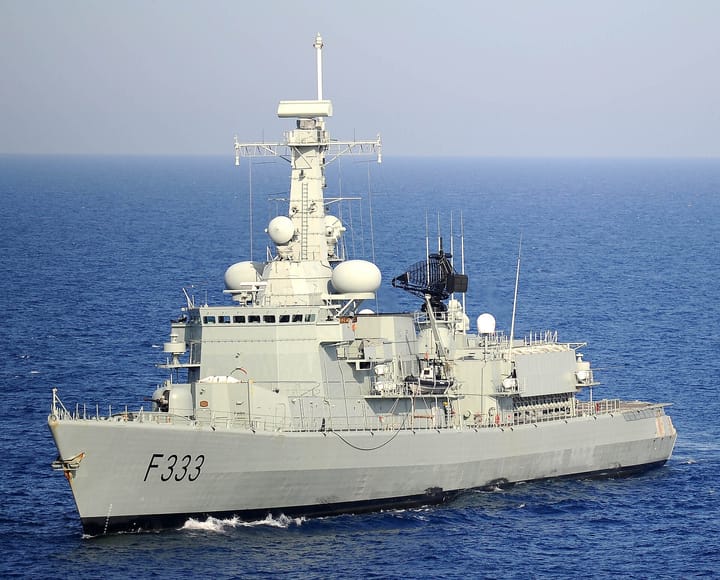
- Navy's five new multi-mission frigates (FCMM) — design phase, with Damen-Portugal-Arsenal and the Damen-French Naval Group consortium shortlisted.
- Tekever's AR3 and AR5 UAV programmes, already deploying with the Army's RAMA and the Air Force's 502 Squadron, now scaled for full-fleet induction.
- A new Integrated Military Telecommunications System (SITCOM-MIL) with Altice and NOS as civil-operator counterparties.
The money also funds the European Sky Shield Initiative Portuguese participation track, the Lás Anti-Drone Dome over Lisbon's critical installations, and the new cybersecurity operations centre at Oeiras announced in January.
The Political Read
Nuno Melo presented the plan to a Parliament in which CDS-PP (his own party) holds three seats, PSD 78, PS 74, Chega 50 and IL 9. The Grandes Opções will need a majority to pass; the government's working plurality depends on PS abstention on defence, which the Socialists have reliably delivered since the Costa era. The interesting votes are on the mechanisms: shorter contract lengths, civilianisation, and the foreign-qualification pathway. Each is a pressure-point for Chega and the PCP/BE/PAN/Livre bench in different directions.
On the Belém side, President António José Seguro has been public about his support for the NATO 5% trajectory — it came up explicitly at the Madrid summit with Pedro Sánchez on Monday. The issues that could bring a Presidential veto into play are contract-length changes (Belém's historic posture is defensive of professional continuity) and the CPLP-officer pathway, which touches the nationality-law debate. Neither is a presidential red line today; both are candidates for one.
What to Watch
- The Grandes Opções vote in plenary, expected before the Freedom Day recess on 25 April; procedural reading begins Wednesday.
- First recruitment campaign under the new pay structure, scheduled for June 2026; Nuno Melo has set an internal target of 1,800 net contracts by end of 2026.
- The F-35 decision in Q3 2026, which unlocks the first large capital line.
- The parallel ASD Convention in Lisbon on 27–29 April 2026, where Portuguese and EU defence-industrial primes will refine the procurement sequencing around the plan.
- The Sectoral Budget Working Groups (Grupos de Trabalho Orçamentais Sectoriais) inside Finance, which must cost each year's ramp against the GDP path now presented.
The Grandes Opções 2025–2029 is the first post-Hague multi-year Portuguese defence plan. Whether the 3,700 target is hit will be visible in annual figures — the Army's quadro permanente and the regime de contrato headcounts are published quarterly. The harder number to watch is the quality one: whether the new contracts are filling cyber, UAV, and engineering slots, or whether they concentrate in traditional logistics and infantry roles. The first briefing on that mix is due after Q1 2027. (Background: see our piece on the Tancos paiol Relação ruling.). (Background: see our piece on the Portuguese F-16AM Baltic Air Policing rotation in Estonia.)
Sources: Governo de Portugal, Lei das Grandes Opções 2025–2029 submitted to the Assembleia da República on 21 April 2026; Público (Helena Pereira, "Governo fixa nova meta: mais 3700 efectivos militares até ao fim de 2027", 21 April 2026); Ministério da Defesa Nacional public materials; NATO Hague Summit Declaration (June 2025); European Commission Readiness 2030 package (March 2026); Conselho de Chefes do Estado-Maior (CCEM) briefing to the Assembleia da República Defence Committee (November 2025); Budget 2026 (Lei n.º 45-A/2025). For foreign residents on the practical telecoms side, our 2026 guide to Portugal's mobile network operators — MEO, NOS, Vodafone, the ANACOM substrate, 5G coverage and the number-portability process sets the latest reference. On the defence-procurement-and-industrial-cooperation tape, our 15 May 2026 read on the Lockheed Martin Lisbon visit confirming 16 candidate F-35 industrial projects, 21 Portuguese beneficiaries and five universities already inside the engagement architecture — with the Letter of Request to the United States still the gating step toward a €5.5 billion, 27-aircraft Air Force renewal sets the latest reference. On the coastal-policing and maritime-traffic-enforcement rail, our 17 May read on the new EAV / narcolancha law entering force after a 90-day vacatio legis — 1-to-4-year prison for flagless speedboats, €25k individual / €100k corporate fines, the DGRM licensing chain and the AT customs gate on cross-border movement sets the latest reference. On the NATO 5%-of-GDP debate, LPM 2024-2033 envelope, Pacote Defesa profile, OE2027 cativações carve-out and Nuno Melo posture side of the file, our 14 June read on Portugal's defence-spending architecture squaring off against The Hague NATO summit's 5%-of-GDP debate — how the LPM Lei Orgânica 2/2019 envelope, the Pacote Defesa profile, the OE2027 cativações carve-out and the Defence Investment Window framework triangulate against the 3.5%+1.5% framing sets the latest reference. On defence spending, the row over paying 25% more than Italy for the new frigates shows how contested the navy's rearmament has become. On the defence-spending and oversight side of the file, the watchdog's critique of how the €5.8 billion loan is being policed sets out why Transparency International Portugal calls the SAFE scrutiny insufficient. On the defence-industrial side of the file, the Cabinet's national-interest declaration for a Super Tucano assembly line at Beja sets out what the Council of Ministers actually approved and what it leaves unanswered. On the defence-infrastructure side of the file, Portugal's €21 million rebuild of the Alfeite naval base explains why the Navy is buying its procurement from NATO and what is arriving at the quay. For the civilian duty behind all of this, the guide to the Dia da Defesa Nacional and Portugal's military obligations sets out who is convoked at 18, why the military census now happens automatically at 17, the six-month residence test that decides exemptions for citizens abroad, and the fine and public-office bar for not turning up. On the governance side of the rearmament file, who will actually control Portugal's €5.84 billion of EU defence borrowing covers Resolução do Conselho de Ministros 175/2026, which creates the Estrutura Nacional SAFE with a coordinator-general, three programme coordinators, two team leaders and fifteen technical staff, gives that coordinator-general authority to sign transfers to contractors regardless of value, funds the office from inside the existing defence budget, and runs the mandate to 30 June 2031.