Brussels Finds 'Grave Deficiencies' at Lisbon and Porto Airport Borders — Portugal Has Nine Days to Meet Council of the EU's 30 April Deadline
A Confidential Council Decision, a 30 April Deadline, and Fourteen Recommendations Portugal Must Meet — What Lisbon and Porto Travellers Need to Know A Council of the European Union decision formally adopted on 5 March 2026 — and reported in detail...

A Confidential Council Decision, a 30 April Deadline, and Fourteen Recommendations Portugal Must Meet — What Lisbon and Porto Travellers Need to Know
A Council of the European Union decision formally adopted on 5 March 2026 — and reported in detail by Público and ECO on Tuesday, 21 April — confirms that a surprise European Commission audit of Lisbon's Humberto Delgado and Porto's Francisco Sá Carneiro airports last December uncovered what Brussels describes as 'graves deficiências' — grave deficiencies — in the way Portugal polices its external Schengen borders. The classification matters: in the Commission's formal view, the failings create an 'elevado risco de segurança' — a high security risk — for other EU Member States.
The inspection was unannounced, ran for roughly three days between 15 and 17 December 2025, and was conducted under the Schengen evaluation mechanism. Its findings, initially reported in outline at the turn of the year, have now been crystallised into a binding Council decision with a hard remediation deadline: 30 April 2026 — nine days from today.
What the Auditors Found
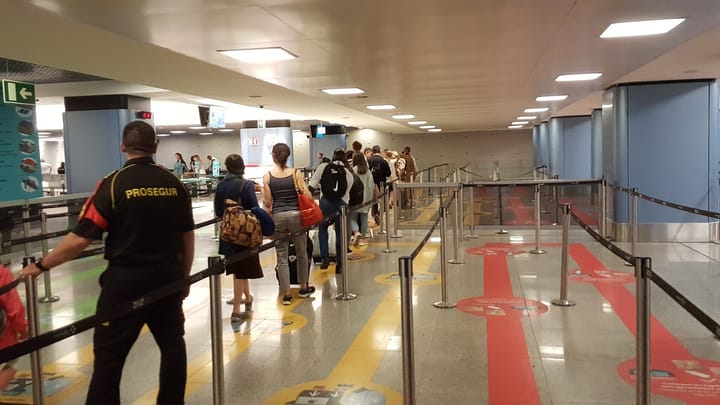
The Commission's technical team identified four principal failures at Lisbon, with parallel concerns at Porto. First, the quality of first- and second-line passport checks — the routine document inspection and the closer secondary interview reserved for suspicious cases — was described as 'muito baixa', very low. Second, waiting times at control booths were 'excessive', a polite rendering of the queues that made international headlines at the end of 2025. Third, border officers were found to be engaged in the 'systematic and unreported relaxation' of controls — in plain language, waving passengers through without the checks EU law requires, and without telling Brussels. Fourth, and perhaps most pointedly for an international airport, exit controls were in places entirely absent: travellers were leaving Portugal without their passports being scanned at all.
The scale of the exposure is significant. Between January and November 2025, more than 11.9 million non-Schengen passengers passed through Lisbon — the single largest external-border touchpoint in the country. Each weakly-checked passenger is, in Brussels' view, a potential risk that Portugal then passes on to every other Member State.
Timeline: From Surprise Audit to Binding Decision
The sequence that produced this week's disclosure is unusually compressed. The audit concluded on 17 December 2025. By 31 December, the Portuguese government had already taken emergency measures, suspending the Entry/Exit System (EES) — the new electronic register that replaced passport stamping — for non-EU citizens for three months, and deploying a first wave of GNR military reinforcements to airport control points. In early 2026, technical evaluation reports were drafted and circulated; a summary was voted through in March and transmitted to Lisbon. On 5 March 2026, the Council of the European Union formally adopted its decision containing fourteen binding recommendations, and the 30 April horizon was set for the most time-sensitive of them.
The Fourteen Recommendations
The Council's recommendations form a systematic overhaul of how Portuguese border control operates. They include mandatory systematic verification of every passenger crossing the external border; a sharp expansion in the use of eGates — the automated passport-reading gates that reduce reliance on tired human officers; improved equipment for document-fraud detection; obligatory and continuous training of border agents; stricter limits on the discretion agents have to simplify checks, with annual reporting of any such simplification; deeper integration with the Schengen Information System; tighter inter-agency coordination; reinforced risk-analysis training; and quarterly progress reports to Brussels. The headline recommendation — the one tied to the 30 April deadline — is that Portugal must ensure automated border controls are available for all persons crossing the external border at Lisbon Airport.
Where the EES Fits In
The audit's timing was not coincidental. October 2025 marked the EU-wide rollout of the Entry/Exit System, which replaces the ink passport stamp with an electronic record of every non-EU citizen's entries and exits. Portugal implemented EES at airports, land crossings, and seaports — and the system malfunctioned almost immediately, generating the hours-long queues that embarrassed the government through the winter. Secretary of State Hugo Espírito Santo described the queues at the time as a 'vergonha para o Governo' — an embarrassment for the Government — while opposition leader José Luís Carneiro accused ministers of 'falta de preparação e incompetência'. In December, Lisbon's EES deployment was partially suspended to ease the congestion; Brussels' auditors arrived during that improvised transition period and documented what they saw.
What Happens on 30 April
The 30 April deadline is specific to the automatic-border-controls requirement. By that date, Portugal must demonstrate that every traveller crossing the external Schengen border at Lisbon can pass through an automated gate. If it cannot — because the eGates are insufficient in number, because the back-end integration with the EES and the Schengen Information System is not complete, or because the airport's terminal layout does not permit physical deployment — Portugal will remain in formal breach of the Council decision. The fourteen-recommendation package as a whole is subject to quarterly reporting, meaning that even where the state clears the 30 April hurdle, it faces a running compliance obligation stretching through 2026 and into 2027.
Brussels has not indicated what sanctions would follow continued non-compliance. Under the Schengen Borders Code, persistent deficiencies can trigger recommendations for other Member States to reintroduce internal border checks on travellers arriving from Portugal — a nuclear option that would be politically explosive but is available on the statute book.
What Travellers Should Expect
For the practical traveller — whether an expat returning from a holiday, a tourist arriving for the summer, or a business traveller transiting Lisbon — the next week is likely to bring visible change at the airport. Expect more GNR officers at passport control, expanded use of the eGates that are already installed, fresh signage routing non-EU passengers through automated lanes wherever possible, and a continued push to normalise the EES after its winter suspension. Queues may not disappear, but the operational priority has shifted from 'move people through' to 'check people properly'. Arriving with a Schengen-compatible biometric passport — most passports issued since 2014 qualify — will meaningfully speed eGate clearance.
For holders of Portuguese residence cards, the immediate impact is smaller, since non-EU residents with valid títulos de residência can still use the EU/EEA citizens' lanes and are not registered through the EES in the same way as visitors. But the broader fragility of Portugal's external-border infrastructure — now formally documented by Brussels — is a reminder that the country's integration into Schengen is not a passive inheritance but a running obligation the state is currently struggling to discharge.
Political Fallout
The Council's decision has been confidential since March, and its public surfacing today pushes a slow-burning operational story into front-line politics. Opposition parties are likely to press the government on whether the 30 April deadline will be met, what the true cost of the corrective programme is, and whether ministerial responsibility attaches to the failures documented in the audit. The Ministry of Internal Administration — which oversees the GNR and Portugal's border policing — has not yet issued a detailed public response to the fourteen recommendations, although the government's December emergency measures already signalled that it took Brussels' initial findings seriously.
What is clear is that Portugal's border-control problem is no longer a rumour repeated by frustrated travellers. It is a formal finding by the Council of the European Union, with a published deadline, and a compliance regime that will outlast the immediate Easter travel surge. The nine days between today and 30 April are unlikely to resolve it in full — but they will determine whether Lisbon enters the summer season inside or outside the tolerance the Council has granted. On the European-political timetable, Saturday's cerimónia at the Paços do Concelho do Porto for Portugal's 40 years in the European Union sets the latest reference. On the cross-border public-health surveillance rail, our 18 May DGS hantavirus read — Canadian Andes-variant patient on a 10 May Tenerife-Canada repatriation flight with a 12-strong Portuguese cabin crew, FFP2 masks in cabin, post-landing decontamination, symptoms onset four days after the flight and a 45-day occupational-health surveillance window through 23 June sets the latest reference. On the EES border-throughput file, our 27 May read on ACI Europe's 45-airport survey pegging Schengen Entry/Exit System border waits at up to 3.5 hours and a 70% processing-time lift, with Henna Virkkunen offering Brussels support to Portugal and DECO mounting a passenger-compensation push for delays at Humberto Delgado, Sá Carneiro and Gago Coutinho sets the latest reference. On the paperwork a minor needs at the border, when a child needs written permission to leave Portugal sets out Article 31(4) of Lei n.º 23/2007, the three situations in which no document is required at all, what Article 23 of Decreto-Lei n.º 83/2000 says the authorisation must contain, and the one-year ceiling on how long it lasts.