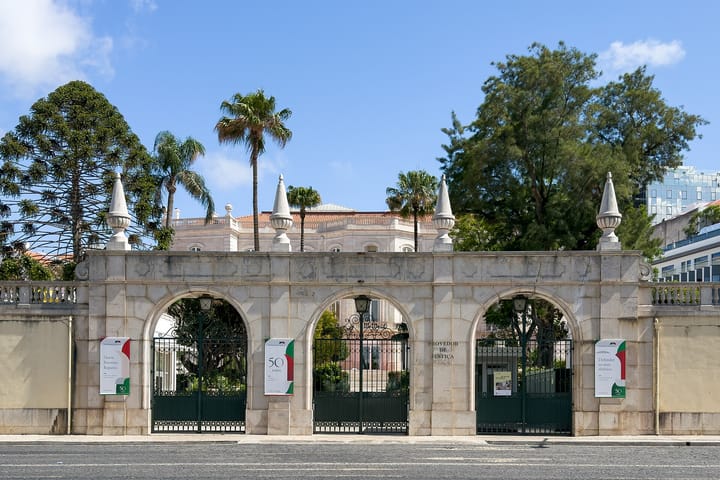
PJ's 'Linha Direta' Operation Hits AIMA on São Miguel With Nine Searches — Investigators Probe Public Employees Suspected of Fast-Tracking Cases for Payment
The Polícia Judiciária's Açores Department executed nine search warrants on the island of São Miguel on Wednesday, 29 April 2026, as part of an investigation into alleged corruption inside the regional services of AIMA — the Agência para a...

The Polícia Judiciária's Açores Department executed nine search warrants on the island of São Miguel on Wednesday, 29 April 2026, as part of an investigation into alleged corruption inside the regional services of AIMA — the Agência para a Integração, Migrações e Asilo, Portugal's immigration and asylum authority. Three of the warrants were served at the public institute's premises, three at private residences, and three at further locations PJ has not specified. The operation, codenamed Linha Direta, is being run under the supervision of the Departamento de Investigação e Acção Penal of the Açores judicial district.
According to the PJ's official communiqué dated 30 April, investigators are probing suspected unlawful conduct by public officials consisting of the "undue attribution of priority to certain services and the processing of cases, in exchange for property-based considerations". The crimes flagged are abuso de poder, recebimento indevido de vantagem and corrupção. As of publication the PJ has not disclosed the number or identity of any arguidos, and no arrests have been announced. Officers from the PJ's Unidade de Perícia Tecnológica e Informática supported the searches and seized what the force describes as substantial documentary material, including computer data and electronic correspondence.
What the searches targeted
The PJ communiqué refers only to a generic "public institute". The location and activity, however, were identified by Público on Thursday afternoon as the AIMA office in Ponta Delgada — the regional service that handles residence-permit decisions for foreign nationals living on or migrating to São Miguel and the wider Açores archipelago. Público further reports that part of the case file relates to autorizações de residência issued under Portugal's investment-residency regime, the Autorização de Residência para Investimento better known as the gold visa. PJ has not made that link in its own statement.
The pattern alleged by investigators — priority in exchange for benefit — does not, on its face, distinguish between two scenarios that matter very differently for the people whose files were touched. Either officials accelerated otherwise eligible applications, or they pushed through cases that did not meet the legal threshold. Both would be criminal under Portuguese law, but only the second would put the underlying residence permits themselves in legal jeopardy. The PJ release is silent on which version, or which mix, the investigation is testing.
Why this lands in the middle of an AIMA cycle
AIMA absorbed the residence-permit pipeline of the former SEF in October 2023 and has spent every quarter since working through the inherited backlog. The agency has set successive deadlines for clearing legacy cases and missed several of them; queues at consular posts and in-country processing times remain a routine source of complaint to the Provedor de Justiça. The Açores regional structure was built up to handle that workflow at island distance from Lisbon. An investigation that alleges officials inside that structure took payment to move cases up the queue, if the courts confirm it, will reach far beyond São Miguel: it will land on the credibility of the queue itself.
It also lands in the middle of a separate political conversation. The current government has been reframing AIMA's mandate around the new Via Verde foreign-worker programme, the tightening of family-reunification rules under the immigration reform passed last year, and the gold-visa transition that closed the property route in 2023 and rebuilt the regime around productive investment. Each of those reforms relies on AIMA's case-handling integrity to actually function. A confirmed corruption case in any one of the regional services pulls at the same thread.
What residents should — and should not — read into it
Two things worth keeping straight. First, no arguidos have been publicly named, no charges have been filed, and the PJ communiqué describes suspicions, not findings. The presumption of innocence applies to every person whose home or office was searched on Wednesday. Second, the investigation, as described, is a regional one. It targets specific behaviour by specific officials inside AIMA's Açores services. There is no indication in the PJ statement, in the DIAP supervision, or in the Público reporting that the case extends to the agency's continental services or to any other regional structure.
Residents with files currently being processed in the Açores regional service have no reason at this point to expect their case to be paused or restarted. AIMA has not announced any operational changes following the searches, and the Public Ministry has not asked for any. The likeliest near-term effect is internal: an audit of how case-priority decisions are recorded and reviewed in the regional structure, with the standard administrative-disciplinary process running parallel to the criminal investigation rather than waiting for it.
Next milestones
The DIAP Açores will now examine the seized material and decide whether to constitute arguidos formally. The PJ has indicated the inquiry is at the investigation phase, which means months, not weeks, before any judicial-instruction stage. AIMA's response, when it arrives, will be the next piece of public information; the agency had not issued a statement at time of writing. We will update this report as the institute and the Public Ministry communicate further.