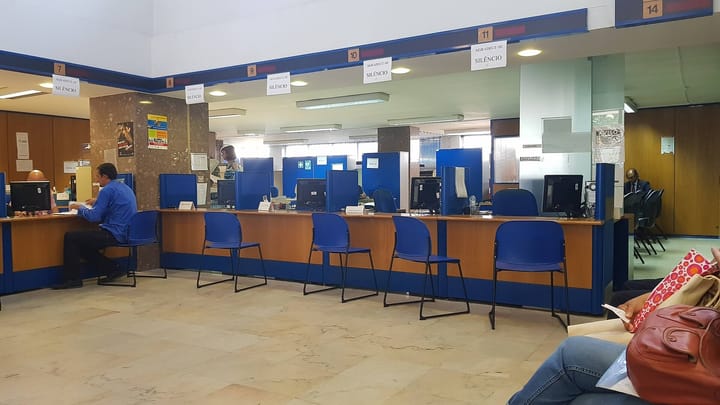
Getting a NIF (tax number) in Portugal
Who needs one, the free routes, when you need a fiscal representative, and what to do once you have it.

Last verified: September 2026.
Who this is for
- You are moving to Portugal, from inside or outside the EU, and need a NIF (tax number).
- You live abroad and need a Portuguese tax number to buy a home, open a bank account, or work.
- You are a non-EU citizen and have been told you must pay someone to be your tax representative.
Not for you if: You already have a NIF and your next job is a bank account: read "Opening a bank account in Portugal".
Updated September 2026. Since mid-2025 people without a Cartão de Cidadão can book a Finanças appointment without logging in, a lawyer or solicitador can file the request online through the e-balcão, and twelve Espaços Cidadão issue the NIF, NISS, and SNS number in one visit. The fiscal representative is no longer required at the moment you get the number.
A NIF is your Portuguese tax number. It is nine digits, it is yours for life, and you will be asked for it everywhere: at the bank, by your landlord, by the electricity company, and at the supermarket till. Anyone moving to Portugal needs one, and so does anyone abroad who buys property, opens a bank account, or works here. The number itself is free. If you are in Portugal, one visit to a tax office usually does it, and you leave with the number the same day. From abroad it takes one to three weeks through a representative.
This guide explains who needs one, which route fits your situation, what to bring, the rules on fiscal representation that catch so many newcomers out, and what to do in the first week after you have the number.
What the NIF is and what it unlocks
The NIF identifies you to the Portuguese tax system. In practice it has become a general-purpose ID number. You need it to:
- open a Portuguese bank account;
- sign a rental contract (your landlord cannot issue an official rent receipt without it);
- buy or sell property and pay the taxes that come with it;
- sign up for electricity, water, gas, internet, and a mobile contract;
- register a car or exchange a driving licence at the IMT;
- get your SNS user number and register at a health centre;
- take a job or invoice as a freelancer;
- file your annual IRS return and register for tax regimes such as IFICI;
- apply for residence with AIMA, which asks for the NIF at the appointment.
The number is also what makes the e-fatura system work. Give your NIF when you pay for things and the invoices are reported to Finanças automatically, which feeds your IRS deductions (more on that at the end).
Having a NIF does not make you a tax resident, and it does not give you any right to live in Portugal. Residence is a separate process run by AIMA (for non-EU nationals) or your Câmara Municipal (for EU nationals). The NIF is a prerequisite for those, not a substitute.
Who needs a NIF
Everyone who deals with the Portuguese state or Portuguese businesses in a formal way. That includes:
- anyone moving to Portugal, whatever their nationality;
- non-residents buying property, receiving rental income, opening a bank account, or working in Portugal even briefly;
- children, when a parent needs the number for school, healthcare, or a bank account in the child's name.
Portuguese citizens get the NIF automatically with their Cartão de Cidadão. Everyone else has to ask for it. Tourists on a short stay with no Portuguese dealings do not need one and should not bother; the number stays on the AT's books forever.
Resident or non-resident: decide before you apply
The AT registers you as either a resident or a non-resident at the moment it issues the number, and this flag shapes what happens next. You count as resident if, for example, you spend more than 183 days in Portugal in a year, or you keep a home here that you clearly intend to live in. A non-resident is everyone else.
Get the flag right on day one:
- If you are still living abroad and only preparing a move, or buying a holiday home, apply as a non-resident with your foreign address. You can switch to resident later.
- If you already live here, apply as a resident with your Portuguese address. Being registered as resident is what triggers your IRS filing duty, so do not let a hotel or short-let address slip onto the form by accident.
Check the address and status printed on the paper you are handed before you leave the counter. Correcting it later takes another appointment.
Before you start: the documents you need
Bring originals. Foreign-language documents are usually accepted in English, French, or Spanish, but a paper in another language may need a certified translation. Proof of address should be recent; counters routinely refuse anything older than three months.
| Your situation | What to bring |
|---|---|
| EU, EEA, or Swiss citizen, already living in Portugal | Passport or national ID card, plus your Certificado de Registo de Cidadão da União Europeia (EU citizen registration certificate) from your Câmara Municipal. If the certificate does not show your address, add a lease, deed, employment contract, or a letter from a public body. |
| EU, EEA, or Swiss citizen, not yet resident | Passport or national ID card, plus proof of your address abroad if it is not printed on the ID. |
| Non-EU citizen, already living in Portugal | Passport, plus one of: your AIMA residence permit; proof of an AIMA appointment or a pending application receipt; or your international or temporary protection document. Add proof of your Portuguese address if those papers do not show it. |
| Non-EU citizen, not yet resident, applying in person | Passport with a valid entry visa (not needed if you are from a visa-exempt country such as the US, UK, Canada, Brazil, or Australia), plus proof of your address abroad. |
| Anyone applying through a legal representative | Your passport (original or certified copy), proof of address, and a procuração (power of attorney) naming the representative. The signature on the procuração needs formal recognition unless the representative is an advogado (lawyer) or solicitador. |
| Minor | The child's passport or birth certificate, the parent's ID and NIF, and proof of address. |
Two practical notes on the EU certificate. You only have to register at the Câmara once you have been in Portugal for more than three months (the deadline is 30 days after that), and the Câmara can take a month or more to issue it. If you have just arrived and need a NIF now, apply as a non-resident with your home-country address and passport, then update your status once you have the certificate and a Portuguese address.
The AIMA point matters too. You do not have to wait for your residence card. Proof that you have an appointment booked, or a receipt for a pending application, is accepted for a resident NIF.
The routes: which one fits you
The AT issues NIFs through a handful of official channels. The number is free in every one of them. What costs money is paying someone to do the legwork for you.
| Route | Best for | Cost | How long |
|---|---|---|---|
| 1. Serviço de Finanças (tax office) or Loja de Cidadão counter, in person | Anyone physically in Portugal | Free | Same day |
| 2. Espaço Cidadão combined NIF + NISS + SNS number | Non-EU arrivals with an AIMA process, EU citizens, and protection applicants who have a Portuguese address | Free | Numbers are not issued at the counter; allow several weeks |
| 3. Portal das Finanças e-balcão, filed by a legal representative | People abroad who have a lawyer, solicitador, or trusted contact in Portugal | Free at the AT; the representative sets their own fee | Typically one to three weeks |
| 4. Paid online NIF service | People abroad with no contact in Portugal | Roughly €50 to €250 for the number; annual fees on top if representation is bundled | A few days to a few weeks |
| 5. Portuguese consulate | Fallback when nothing else works | Consular fee for certifying your form | Slow, and practice varies by post |
Route 1: in person at Finanças or a Loja de Cidadão
This is the route for almost everyone who is already in the country. Any Serviço de Finanças can do it, and most Lojas de Cidadão have a Finanças desk. Since 1 July 2025 you can book a Finanças appointment without a Portal das Finanças login: use the "atendimento presencial por marcação" link on the Contactos page of portaldasfinancas.gov.pt, enter your name, phone, email, and passport number, and pick a slot. You can also book, cancel, or reschedule by phone on +351 217 206 707, weekdays 9:00 to 19:00. Lojas de Cidadão take bookings through the SIGA portal and app, and also hand out queue tickets on the day.
Walk-ins are still accepted at many offices, but a booking is worth the trouble in Lisboa, Porto, and the Algarve, where queues are long. In smaller towns you will often be seen the same morning.
Route 2: the combined counter at an Espaço Cidadão
Since March 2025, twelve Espaços Cidadão (in Braga, Cascais, Lisboa, Loures, Oeiras, Porto, Setúbal, Lagos, and Olhão, with two counters each in Cascais, Lisboa, and Porto) take a single application for the three numbers a new resident needs: the NIF, the NISS (social security number), and the SNS user number. The service is run by AIMA and is open to foreign nationals with a Portuguese address who have applied for or hold a residence permit, hold EU nationality, or have applied for or been granted international protection.
It is convenient if you need all three numbers and can wait, because the numbers are not printed on the spot. If you need the NIF this week to sign a lease, use Route 1 for the NIF and come back for the rest.
Route 3: the e-balcão, through a representative
Since 1 July 2025 the AT accepts NIF requests for people without a Cartão de Cidadão through the e-balcão (electronic counter) on the Portal das Finanças. You cannot file it yourself, because you have no login yet. A legal representative with their own Portal access files it for you: in practice a lawyer, a solicitador, an accountant, or a friend or family member who holds a procuração from you.
The representative logs in, opens "Registar nova questão" in the e-balcão, and chooses Imposto ou área: Registo Contribuinte; Tipo de questão: Identific; Questão: Atrib/Alter NIF-Singulares. They attach a copy of your passport, proof of your address abroad (unless it is on your ID), their own ID, and the procuração. The AT processes the request and sends the NIF to the representative.
Note that a legal representative for this purpose is a different thing from a fiscal representative. The procuração can name the same person for both jobs, but it does not have to.
Route 4: paid online services
Dozens of firms offer to get you a NIF remotely. They are doing exactly what Route 3 describes, plus the paperwork: you sign a procuração (usually notarised and apostilled in your home country), send passport and address scans, and receive the number by email. Prices in 2026 run from about €50 to €250 for the number itself. Many bundle a fiscal representation contract at €100 to €400 a year; read the fiscal representative section before accepting that, because most people no longer need it. Check that the firm is a registered advogado, solicitador, or contabilista certificado before signing anything.
Route 5: a Portuguese consulate
The Portal das Comunidades says the NIF can be requested at any consular post. In practice most consulates only certify your signature on the AT form and expect someone in Portugal to lodge it at a Finanças office, and the fee follows the consular tariff. Turnaround runs to weeks. If you have no contact in Portugal, Route 4 is faster and more predictable.
Step by step: getting the NIF in person
- Decide whether you are applying as resident or non-resident (see above) and gather the documents for your profile.
- Book a slot on the Portal das Finanças Contactos page or by phone on 217 206 707, or plan an early arrival for a walk-in.
- At the counter, the clerk enters your details, prints a sheet with your NIF, and confirms your morada fiscal (registered tax address). Read it. Check the address, the resident or non-resident flag, and the spelling of your name.
- Ask for the Portal das Finanças password to be issued. It is posted to your registered address, on average within five working days.
- If you are a non-EU non-resident and expect to buy property, register a car, or take a job, ask at the same counter to activate electronic notifications, or nominate a fiscal representative there and then. See the next section.
- Keep the printed sheet. There is no physical card any more; the number lives in the AT database, and you can print a comprovativo (proof) from the Portal once you are logged in.
Step by step: getting the NIF from abroad
- Choose your representative: a lawyer or solicitador in Portugal, a paid NIF service, or a trusted friend or relative who is resident here.
- Sign a procuração giving them power to request the NIF (and, if you want, to act as your fiscal representative). If your representative is not a lawyer or solicitador, the signature needs formal recognition; a notary and apostille in your home country is the usual way.
- Send them a clear scan of your passport and a recent proof of address.
- They file through the e-balcão, or attend a Finanças office in person, and forward you the number.
- The Portal password is posted to the address on file, which for a non-resident is usually the representative's. Ask them to pass it on promptly and change it on first login.
The fiscal representative: who still needs one
This is the part of the process that has changed most, and the part that paid services still trade on. The rule sits in Article 19 of the Lei Geral Tributária (General Tax Law), as amended by Decreto-Lei n.º 44/2022 of 8 July.
A representante fiscal (fiscal representative) is a person or company with a tax address in Portugal who receives AT correspondence on your behalf. Here is who needs one in 2026:
| Your situation | Fiscal representative? |
|---|---|
| Anyone, at the moment of getting the NIF | Not required. The AT's own leaflet says designation is not obligatory when the number is issued. |
| Resident in Portugal (any nationality) | Not required. Residents do not have fiscal representatives. |
| Non-resident living in the EU, Norway, Iceland, or Liechtenstein | Never required, whatever you own or earn in Portugal. Always optional. |
| Non-resident living anywhere else (UK, US, Canada, Brazil, Australia, and also Switzerland) with no Portuguese tax relationship | Not required. |
| Same, but you own property or a vehicle in Portugal, sign an employment contract here, or start a self-employed activity | Required within 15 days of the triggering event, unless you activate electronic notifications instead (free). |
| Non-resident running a self-employed activity subject to IVA (VAT) in Portugal | A VAT-registered fiscal representative resident in Portugal is compulsory, and must be appointed before the activity starts. Electronic notifications do not replace this. |
The free alternative is to switch on notificações eletrónicas (electronic notifications). Once you have your Portal password, log in and go to A minha área > Notificações e Citações > Gerir Canais > Canais de Notificação, and activate either the Portal das Finanças channel or ViaCTT, the CTT electronic mailbox. Both are free. Do this before you sign the deed or the contract, not after.
Missing the 15-day deadline when a representative or electronic notification is compulsory carries a fine of €75 to €7,500, and you lose the right to file complaints and appeals with the AT until you fix it.
A few more points that matter:
- Any adult with a tax address in Portugal can be your representative; it does not have to be a professional. A representative for a VAT-registered activity carries joint liability, which is why friends usually decline that job.
- If you inherited a representative from an old arrangement and are now resident, remove them when you update your status (see below). If you are still non-resident but have electronic notifications on, you can cancel the representative on the Portal under Dados Cadastrais > Representante.
- Do not pay for representation you do not need. The only people with a structural reason to pay are non-residents running a VAT-registered business in Portugal.
Costs and timing
| Item | Cost | Timing |
|---|---|---|
| NIF at a Finanças office or Loja de Cidadão | Free | Same day |
| NIF through the e-balcão | Free at the AT | Usually one to three weeks |
| Portal das Finanças password | Free | Posted, about five working days |
| Second copy of the cartão de contribuinte (non-Portuguese citizens only) | Ask at the counter | Posted to your address, or your representative's if non-resident |
| Certificado de Registo de Cidadão da UE (Câmara Municipal) | Small municipal fee, set by Portaria | At least a month |
| Chave Móvel Digital | Free | Activated at a counter for foreign nationals |
| Paid NIF service | Roughly €50 to €250 | Days to weeks |
| Bundled fiscal representation | Roughly €100 to €400 a year | Ongoing |
| Fine for missing a compulsory representative or e-notification deadline | €75 to €7,500 | Applied after the 15-day window |
After you have the NIF: the first week
Activate the Portal das Finanças. The password arrives by post at your registered address. Log in at portaldasfinancas.gov.pt, set a permanent password, and check Dados Pessoais Relevantes. Without the Portal you cannot see notifications, register a lease, change your address, or file IRS.
Get a Chave Móvel Digital. The CMD is a free login that works for the Portal das Finanças, Segurança Social Direta, SNS 24, and most other state services. Foreign nationals can activate it at a Loja de Cidadão or Espaço Cidadão with a passport or residence card, and it needs a NIF. The phone number does not have to be Portuguese.
Register your IBAN. Under Dados Cadastrais on the Portal, add the bank account you want IRS refunds paid into. A missing or wrong IBAN is the most common reason refunds stall.
Start giving your NIF on receipts. Say "com contribuinte" or just hand over the number. General family expenses earn a 35 per cent deduction up to €250 per taxpayer per year, and there are separate deductions for invoices from restaurants, hairdressers, mechanics, vets, gyms, and public transport.
Open a bank account. Banks ask for passport or residence card, NIF, proof of address, and proof of income or occupation, and some want a Portuguese mobile number. A local IBAN (starting PT50) keeps landlords, utilities, and the AT happy, since some still resist direct debits from a foreign IBAN. Non-residents can open a non-resident account and convert it later.
Get the other numbers. The NISS from Segurança Social and the SNS user number from your health centre both need the NIF first. If you used the Espaço Cidadão combined counter, they are on the way.
Keeping the record right
The AT sends notices to the address on file, and a notice sent to an old address still starts the clock on any deadline. Three updates are compulsory for people without a Cartão de Cidadão:
- Moving house within Portugal, or abroad: update within 15 days, on the Portal under Dados Cadastrais > Morada > Entregar Pedido de Alteração, or at a Finanças appointment.
- Becoming resident (or leaving): a change that flips you from non-resident to resident, or the reverse, must be reported within 60 days. Do it through the e-balcão (Registo Contribuinte > Identific > Alteração Morada/Singulares) or in person. This is the step that also removes a fiscal representative you no longer need. A plain address change on the Portal cannot change your residence status; you need this route.
- Name or marital status changes: at a Finanças counter with the supporting document.
Cartão de Cidadão holders update their address through the card instead, and the AT picks it up automatically.
If you are aiming for the IFICI tax regime, the sequence is NIF first, then the switch to resident status, then the IFICI application on the Portal by 15 January of the year after you become resident.
Common problems
Wrong residence flag. A non-resident registered as resident gets an IRS filing obligation they did not expect; a resident registered as non-resident cannot use resident tax rules. Check the printout before leaving the counter.
Buying property or a car before switching on notifications. For non-EU non-residents the tax relationship starts on the day of the deed or registration, and the 15-day clock starts with it. Activate notifications first.
The password never arrives. It went to the address on file, which may be your representative's, or an old one. Use the "Recuperar senha" link on the Portal to trigger a new one, and fix the address first if it is wrong.
Inconsistent counters. Different offices read the document rules differently, and English is not guaranteed. Bring more proof than you think you need, bring a Portuguese-speaking friend if you can, and prefer a government-issued proof of address over a bank statement.
Two NIFs. It happens when someone applies through a paid service and then again in person. You may only hold one number; the AT cancels the later one. Check whether a firm has already obtained a number for you before applying again.
Lost the number. Log in to the Portal and print a comprovativo, or ask any Finanças counter with your passport. Non-Portuguese citizens can also request a second copy of the cartão de contribuinte, which is posted to the address on file.
Sources
- Autoridade Tributária, FAQs on NIF attribution for natural persons (FAQ 3339, 3343, 4991, 5679, 5680, 5681): https://info.portaldasfinancas.gov.pt/pt/apoio_contribuinte/questoes_frequentes/Pages/faqs-00299.aspx (documents by profile, e-balcão path, legal versus fiscal representative, AIMA appointment proof)
- Autoridade Tributária, FAQs on fiscal representation (FAQ 4627, 4628, 4630, 4634, 4650): https://info.portaldasfinancas.gov.pt/pt/apoio_contribuinte/questoes_frequentes/pages/faqs-00307.aspx (who needs a representative, EU/EEA exemption, 15-day deadline, fines, IVA exception, how to activate electronic notifications and designate or remove a representative)
- Autoridade Tributária, leaflet "Atribuição de NIF a cidadãos estrangeiros não residentes" (July 2025): https://info.portaldasfinancas.gov.pt/pt/apoio_contribuinte/Folhetos_informativos/Documents/Atribuicao_de_NIF_a_cidadaos_estrangeiros_nao_residentes.pdf (no representative required at attribution, procuração rules)
- Autoridade Tributária, leaflet "Atendimento por marcação" (July 2025): https://info.portaldasfinancas.gov.pt/pt/apoio_contribuinte/Folhetos_informativos/Documents/atendimento_por_marcacao.pdf (booking without login, CAT phone number and hours)
- Autoridade Tributária, FAQs on Portal registration and passwords (FAQ 5474, 5478): https://info.portaldasfinancas.gov.pt/pt/apoio_contribuinte/questoes_frequentes/pages/faqs-00244.aspx (password posted in about five working days, CC and CMD alternatives)
- Autoridade Tributária, "Morada" support page: https://info.portaldasfinancas.gov.pt/pt/apoio_ao_contribuinte/Cidadaos/Dados_pessoais_familia/Dados_pessoais/Morada/Paginas/default.aspx (15-day and 60-day address deadlines, Portal and e-balcão paths)
- Autoridade Tributária, FAQs on IFICI (FAQ 5857, 5858): https://info.portaldasfinancas.gov.pt/pt/apoio_contribuinte/questoes_frequentes/pages/faqs-01018.aspx (15 January deadline)
- Autoridade Tributária, notice on Decreto-Lei 44/2022 FAQs: https://info.portaldasfinancas.gov.pt/pt/destaques/Paginas/FAQs_Representante_Fiscal_do_Nao_Residente_Notif_eletronicas.aspx (legal basis of the electronic notification waiver)
- gov.pt, "Novas regras para pedido de NIF e alteração de morada para cidadãos sem Cartão de Cidadão" (2 July 2025): https://www.gov.pt/noticias/novas-regras-para-pedido-de-nif-e-alteracao-de-morada-para-cidadaos-sem-cartao-de-cidadao (e-balcão channel, booking without authentication)
- gov.pt, "Pedir o Número de Identificação Fiscal (NIF) para pessoa singular": https://www.gov.pt/servicos/pedir-o-numero-de-identificacao-fiscal-para-pessoa-singular (residence criteria, legal basis)
- gov.pt, "Pedir os números de identificação fiscal, segurança social e nacional de utente (saúde) para estrangeiros": https://www.gov.pt/servicos/pedir-os-numeros-de-identificacao-fiscal-seguranca-social-e-nacional-de-utente-saude-para-estrangeiros (combined counter eligibility, twelve Espaços Cidadão, representative rules)
- Governo de Portugal, news on the combined identification counter: https://portugal.gov.pt/gc24/comunicacao/noticias/cidadaos-estrangeiros-em-situacao-regular-ja-podem-obter-os-principais-numeros-de-identificacao-num-unico-pedido (list of the twelve locations)
- gov.pt, "Pedir a segunda via do Cartão de Contribuinte": https://www.gov.pt/servicos/pedir-a-2.-via-do-cartao-de-contribuinte (who can request, delivery by post)
- gov.pt, "Ativar a Chave Móvel Digital": https://www.gov.pt/servicos/ativar-a-chave-movel-digital (free, available to foreign nationals with passport or residence title)
- gov.pt, "Atendimento nas Lojas de Cidadão": https://www.gov.pt/guias/atendimento-nas-lojas-de-cidadao (Finanças desks, SIGA booking, walk-ins)
- AIMA, Certificado de Registo para Nacionais UE: https://aima.gov.pt/pt/nacionais-ue-e-familiares/nacionais-ue/certificado-de-registo-para-nacionais-ue (three-month rule, 30-day deadline, Câmara Municipal, one-month minimum issue time)
- Portal das Comunidades Portuguesas, "Atribuição de Número de Identificação Fiscal (NIF)": https://portaldascomunidades.mne.gov.pt/pt/atendimento/no-estrangeiro/servicos-consulares/atribuicao-de-numero-de-identificacao-fiscal-nif (consular route, no representative at request)
- Consulado Geral de Portugal em Newark and Boston, NIF pages: https://newark.consuladoportugal.mne.gov.pt/pt/assuntos-consulares/servicos-consulares/numero-de-identificacao-fiscal-nif (consulate only certifies the signature; fee per consular tariff)
- DECO Proteste, "Como pedir o número de contribuinte para estrangeiros?" (July 2024): https://www.deco.proteste.pt/familia-consumo/cidadania/dicas/pedir-numero-contribuinte-estrangeiros (corroboration that the NIF is free)
- Todos Contam (Banco de Portugal) and idealista/news on IRS deductions: https://www.todoscontam.pt/pt-pt/despesas-dedutiveis-no-irs (35 per cent general family expenses, €250 limit)
Last verified September 2026. Rules and fees change; check the official source before acting.