Driving in Portugal: Licence Exchange, Toll Systems, Speed Cameras, Parking Apps, and Importing a Car
What This Guide Covers If you plan to drive in Portugal — whether as a tourist, a new resident, or someone importing a car — the rules are different enough from most other European countries to catch you off guard. This guide covers everything from...
What This Guide Covers
If you plan to drive in Portugal — whether as a tourist, a new resident, or someone importing a car — the rules are different enough from most other European countries to catch you off guard. This guide covers everything from licence exchange rules and toll systems to insurance requirements, speed limits, parking, and the fines you will pay if you get them wrong.
Can You Drive on Your Foreign Licence?
EU/EEA licences: Valid indefinitely for driving in Portugal. You are not required to exchange your licence, though you may do so voluntarily at the IMT (Instituto da Mobilidade e dos Transportes). When your EU licence expires, you must renew it in Portugal if you are resident here.
UK licences (post-Brexit): Valid for driving in Portugal for up to 185 days from the date of entry. After that, you must exchange it for a Portuguese licence. The UK-Portugal bilateral agreement allows direct exchange without a driving test, but you must apply at IMT with your UK licence, proof of Portuguese residency, a medical certificate, and a passport-sized photo. The process takes 30 to 60 days and costs approximately EUR 30.
US, Canadian, Brazilian, and other non-EU licences: Most non-EU licences are valid for up to 185 days. After that, whether you can exchange directly or must take a Portuguese driving test depends on bilateral agreements. The US has no federal agreement with Portugal — individual state licences are not directly exchangeable, meaning American residents must take the Portuguese theory and practical driving tests. Brazil, however, has a direct exchange agreement. Check the IMT website for the current list of countries with exchange agreements.
International Driving Permits (IDPs): An IDP is a translation of your licence, not a replacement. It is recommended as a supplement when driving on a non-EU licence but does not extend the 185-day limit.
The Portuguese Toll System
Portugal's motorway tolls are a frequent source of confusion and unpaid fine letters for foreign drivers. There are three toll collection methods, and they vary by motorway:
Traditional toll booths: Found on the oldest motorways (A1, A2, A5, parts of A3). You stop, take a ticket or tap a card, and pay at the exit. Cash, debit cards, and Via Verde are accepted.
Electronic-only tolls (portagens exclusivamente eletrónicas): Many newer motorways — the A22 (Algarve), A24, A25, A28, and others — have no physical toll booths. Instead, overhead gantries photograph your licence plate and charge you electronically. If you do not have a payment method registered, the tolls accumulate as debt and you will eventually receive a fine.
Via Verde: Portugal's electronic toll transponder system. A small device attached to your windscreen is linked to a bank account or credit card and automatically pays tolls on all motorways. Via Verde is available to Portuguese residents with a Portuguese bank account. Rental cars from major agencies typically come with Via Verde or an equivalent system — always confirm this when collecting the car.
For foreign-registered cars: If you are driving a car registered outside Portugal, you have three options for electronic tolls: (1) buy a temporary prepaid transponder at border service points, post offices, or CTT stores, valid for a set number of days; (2) register your licence plate online at portagens.online and link a credit card; (3) pay at Payshop locations (found in newsagents and petrol stations) within five days of passing through a toll gantry. If you do none of these, expect a fine of EUR 25 per unpaid toll plus the original toll amount.
Speed Limits and Enforcement
Standard speed limits in Portugal:
- Urban areas: 50 km/h
- Roads outside urban areas: 90 km/h
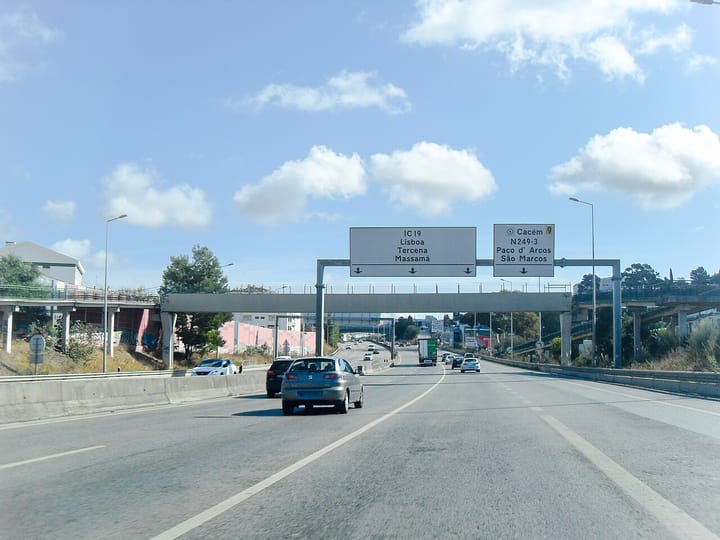
- Dual carriageways (vias reservadas): 100 km/h
- Motorways (autoestradas): 120 km/h
Minimum motorway speed is 50 km/h. Driving below this without justification is an offence.
Speed cameras (radares) are widespread and increasingly common. Portugal uses both fixed cameras and mobile radar units operated by the GNR (Guarda Nacional Republicana). Fines for speeding start at EUR 60 for minor infractions (up to 20 km/h over the limit on motorways) and escalate quickly: exceeding the limit by more than 60 km/h is a very serious offence carrying a fine of EUR 500 to EUR 2,500 and potential licence suspension.
Newly qualified drivers (those who obtained their licence within the last three years) face lower speed limits: 90 km/h on dual carriageways and 100 km/h on motorways.
Car Insurance
Third-party liability insurance (seguro de responsabilidade civil) is mandatory for all vehicles in Portugal. It covers damage you cause to other people, vehicles, and property. The minimum coverage is set by law and is typically sufficient, but many drivers opt for additional coverage.
Common policy types:
- Terceiros (third-party only): The cheapest option, covering only damage to others. Typical cost: EUR 150 to EUR 350 per year for a standard car.
- Terceiros alargado (extended third-party): Adds cover for theft, fire, natural disasters, and broken glass. Typical cost: EUR 250 to EUR 500 per year.
- Todos os riscos (comprehensive): Full coverage including damage to your own vehicle. Typical cost: EUR 400 to EUR 900 per year, depending on the car's value and your driving history.
No-claims bonuses are transferable from some EU countries — ask your Portuguese insurer. Major insurers include Fidelidade, Allianz, Generali, Tranquilidade, and OK Teleseguros (an online-only option that is often the cheapest).
Importing a Car
Bringing a car to Portugal from another EU country is possible but expensive. You must register the vehicle in Portugal and pay the ISV (Imposto Sobre Veículos), a one-time registration tax based on the car's engine capacity and CO2 emissions. For a typical mid-range car, ISV can range from EUR 1,500 to EUR 6,000 or more, depending on engine size and emissions.
Background: how to import a car under the transferência de residência exemption walks through the ISV waiver, the DAV customs declaration, the IMT homologation chain, and the realistic cost.
You are exempt from ISV if you are transferring your residence to Portugal and have owned and used the car in your previous country of residence for at least six months. The exemption must be applied for at customs (Alfândega) within 12 months of establishing residency, and the car cannot be sold for 12 months after importation. Non-EU cars also face customs duties of up to 10 per cent in addition to ISV and VAT.
Parking
Metered parking in Portuguese cities uses pay-and-display machines or, increasingly, mobile apps. In Lisbon, the main parking apps are ePark and Via Verde Estacionar. Rates vary by zone: EUR 0.80 to EUR 1.60 per hour in central Lisbon, with some premium zones near hospitals and airports charging up to EUR 2.00 per hour.
Yellow kerb markings mean no parking. Red means no stopping. Blue means paid parking during the hours displayed on the adjacent sign. Residents can apply for a resident parking permit (cartão de residente) from their local junta de freguesia, which provides free or discounted parking in their neighbourhood zone.
Illegal parking is enforced by the EMEL municipal parking authority in Lisbon and equivalent bodies in other cities. Fines start at EUR 30 and rise to EUR 120 for obstructing traffic. Your car can be clamped or towed — retrieval costs EUR 150 to EUR 250 plus daily storage fees.
Drink-Driving and Other Rules
The blood alcohol limit is 0.5 g/l for experienced drivers and 0.2 g/l for new drivers (less than three years' experience) and professional drivers. Penalties for exceeding the limit range from fines of EUR 250 to EUR 2,500 to licence suspension and criminal prosecution for levels above 1.2 g/l.
Other rules worth knowing:
- Seatbelts are mandatory for all occupants. Children under 12 or shorter than 135 cm must use an appropriate child restraint system.
- Mobile phones: Handheld phone use while driving is prohibited. Hands-free devices are permitted. The fine is EUR 120 to EUR 600.
- Headlights: Dipped headlights are mandatory in tunnels, on motorways during the day in poor visibility, and at all times on certain IP (itinerário principal) roads marked with the relevant sign.
- Reflective vest: You must carry a reflective vest in the passenger compartment (not the boot) and wear it when leaving the vehicle on a road or motorway shoulder. A warning triangle is also mandatory.
- Roundabouts: Vehicles already in the roundabout have priority. Portugal drives on the right.
Fuel and Electric Vehicle Charging
Diesel and petrol are available at stations operated by Galp, Repsol, BP, Prio, and Intermarché (often the cheapest). As of April 2026, diesel costs approximately EUR 1.85 to EUR 1.95 per litre and petrol 95 costs EUR 1.75 to EUR 1.85 per litre. Motorway stations are typically 10 to 15 cents per litre more expensive than town stations.
Portugal's electric vehicle charging network has expanded rapidly. The Mobi.E network provides access to public chargers across the country from multiple operators. You register on the Mobi.E platform, choose a charging operator (Galp Electric, EDP, Prio.E, etc.), and use their app or card to activate chargers. Fast chargers (50 kW+) cost EUR 0.30 to EUR 0.45 per kWh. Ultra-fast chargers (150-350 kW) are available on main motorway corridors.
Last updated: April 2026. Rules and prices are subject to change. This guide is for informational purposes — always verify current regulations at the IMT website or with local authorities.
👉 Related: Insurance in Portugal: Health, Home, Car, and Life Cover Explained for Residents and Newcomers
Related reading: 870 Night-Flight Violations in Three Months at Humberto Delgado — ANA Appeals Symbolic Fine While Residents Endure the Noise
Background: See the IC2 traffic restrictions imposed for the Fátima pilgrim flow.