Activating the Chave Móvel Digital in Portugal
How to get Portugal's free digital key, who can activate it online or at a counter, how the PIN and security code work, and how to sign documents.

Last verified: September 2026.
Who this is for
- Foreign residents, EU or non-EU, who hold a passport, residence permit, or residence certificate and want to use Portuguese government websites.
- Portuguese citizens and Brazilians with a Cartão de Cidadão who want the fastest online route.
- Anyone who has the key and needs to fix a lost phone number, a forgotten PIN, or the digital signature.
Not for you if: you only need a tax number. Read "Getting a NIF (tax number) in Portugal" first, because the key needs a NIF for most foreign residents.
Updated September 2026. The agency that runs the key is now ARTE, not AMA. The chosen PIN must have six to eight digits. Video call activation is listed as temporarily unavailable.
The Chave Móvel Digital (digital mobile key, usually just CMD) is the Portuguese state's free login and digital signature. It links your identity document to your mobile phone number and a PIN. One key opens the Portal das Finanças, Segurança Social Direta, SNS 24, the AIMA portal, and hundreds of other services. Citizen Card holders can activate it online in about ten minutes. Foreign residents without a Citizen Card must activate it at a counter, which usually takes one short visit. It costs nothing.
What the Chave Móvel Digital opens
Once the key is active, the same phone number and PIN log you in to:
- Portal das Finanças, for your IRS return, invoices, IMI, and IUC.
- Segurança Social Direta, for contributions, benefits, and declarations.
- SNS 24, for prescriptions, appointments, vaccination records, and your health data.
- The AIMA portal, for residence permit renewals and status checks.
- The criminal record portal, to request a certificate online.
- IMT online services, for driving licence matters.
- gov.pt, the central public services portal, plus court, registry, school enrolment, and many municipal portals.
- Some private services, including some banks and signing platforms.
You can also use it to sign PDF documents. That signature has the same legal weight as a handwritten one across the EU, so you can sign a lease or a contract without printing it.
Who can activate it
Anyone with one of the documents below can activate the key. There is no minimum age, but each person needs their own mobile number. A child under 16 must attend the counter with a parent or guardian.
If you are a Portuguese citizen, you can use a Cartão de Cidadão (Citizen Card) or a lifetime Bilhete de Identidade.
If you are a foreign national, you can use one of these:
- A passport. No NIF is needed for this route.
- A Cartão de Cidadão issued to Brazilians under the Porto Seguro treaty.
- A título de residência (residence permit, for non-EU residents). You need a Portuguese NIF.
- A cartão de residência (residence card, for EU citizens' family members). You need a NIF.
- A certificado de residência permanente (permanent residence certificate, EU or non-EU). You need a NIF.
- A certificado de autorização de residência (residence authorisation certificate). You need a NIF, and the key cannot carry a digital signature.
- The registration certificate for an EU citizen or their non-EU family. You need a NIF, and no signature.
- A temporary protection residence certificate. You need a NIF, and no signature.
The key is personal. A company cannot have one, though you can attach business roles to your own key later.
What you need before you start
Gather these before you go online or to a counter:
- The identity document you will link to the key. It must be valid.
- Your NIF, if your document is a residence permit or certificate. Get it first; see "Getting a NIF (tax number) in Portugal".
- The mobile phone you will link to the key, switched on and able to receive SMS. Bring it to the counter.
- An email address. It is the backup channel for security codes and notifications.
- For online activation with a Citizen Card: a smartcard reader and the card's authentication PIN, which came in the PIN letter.
The number can be a foreign mobile number. The login form asks for the country code. A Portuguese number is simpler day to day, because SMS codes arrive reliably and roaming never gets in the way.
How to activate it if you have a Cartão de Cidadão
Citizen Card holders have four routes. All are free.
In the gov.pt app, with face recognition. This is the quickest route and is only for Portuguese nationals with a Citizen Card. Install the gov.pt app (Android, iOS, or Huawei). Open it, tap "Ativar Chave Móvel Digital", and follow the prompts. The app photographs your card and your face, so sit somewhere well lit. Then you set your mobile number, email, and PIN.
On autenticacao.gov.pt, with a card reader. Go to the site and choose "ativar com Cartão de Cidadão". Insert the card in the reader and enter the card's authentication PIN. Fill in the registration form with your mobile number, email, and chosen PIN. Type the validation code that arrives by SMS. The key is active at once.
With your Portal das Finanças login. Choose "ativar via Portal das Finanças" on autenticacao.gov.pt and log in with your NIF and Finanças password. Your NIF must be printed on the back of your Citizen Card. A letter with a temporary PIN is posted to your card address. Do not try to log in before the letter arrives, or you may block the key. On your first login you replace the temporary PIN with your own. If you use this route, you can only switch on the digital signature at a counter.
By video call. gov.pt lists activation with support by video call, booked through the Linha Cidadão. In September 2026 autenticacao.gov.pt marks the video call service as temporarily unavailable. Check the page before you plan on it.
You can also activate the key at any of the counters listed in the next section, including when you collect a new Citizen Card at the registry office (IRN).
How to activate it as a foreign resident
Without a Citizen Card you cannot activate online, in the app, or by video call. You go to a counter. Take your document, your NIF, and the phone. You can also give your NISS and SNS user number so they are attached to the key.
Any of these counters can do it:
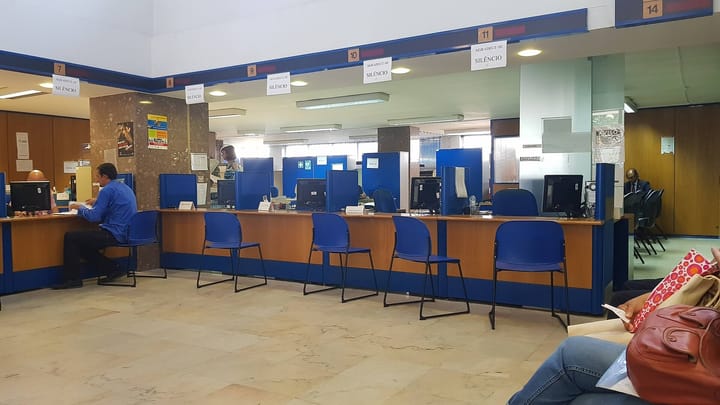
- Any Espaço Cidadão or Espaço Empresa, including those inside a Loja de Cidadão. This is the usual choice.
- Criminal record services and court secretariats.
- Portuguese consulates, if you are abroad.
- RIAC counters in the Azores.
- RENTEV (living will registry) counters in the health service.
At the counter the clerk checks your document, enters your number and email, and you choose your PIN. You confirm with an SMS code on the spot and leave with a working key. Allow ten to twenty minutes plus any queue. Many Espaços Cidadão take walk-ins; larger Lojas de Cidadão are better booked through gov.pt.
Ask the clerk to switch on the digital signature at the same time, if your document allows it. That saves a second visit.
How logging in works
The key uses two steps every time:
- Your mobile number and your CMD PIN. The PIN has six to eight digits and you chose it at activation.
- A temporary security code. It arrives by SMS, by email, or in the gov.pt app. The app can also read a QR code on screen.
With the gov.pt app installed, you can use your fingerprint or face instead of typing the code.
On a website, pick the "Chave Móvel Digital" tab, agree to share your identity data with that service, enter your number and PIN, enter the code, and confirm your details. The security code changes with every attempt, and it is never the same thing as your PIN. Nobody from the state will ever phone or email you asking for your PIN.
Setting up the digital signature
The signature is a separate function with its own signature PIN. Switch it on as soon as the key is active. You can do that online in the reserved area of autenticacao.gov.pt, or at any counter that activates the key. Keys activated through the Portal das Finanças route can only get the signature at a counter.
Some documents cannot carry a signature at all. They are the residence authorisation certificate, the EU registration certificate, and the temporary protection certificate. Passport and residence permit holders can sign.
To sign, use one of:
- The Autenticação.gov desktop application, which signs PDFs and other files, several at once, with optional timestamp.
- The gov.pt mobile app, which signs PDFs.
- The signing tool inside your browser on autenticacao.gov.pt.
- Any third-party software certified for the key, such as Docuten or BlueAuth.
The signature is embedded in the file and validates in standard PDF readers. A few readers do not display it, but it is still valid. Formal notarial acts still need a notary; ordinary contracts, leases, and forms do not.
How long it stays valid
The key expires with the document it is linked to:
- Citizen Card: the card's validity plus 30 days.
- Bilhete de Identidade: ten years from activation plus 30 days.
- Passport, residence permit, residence card, or any residence certificate: the same expiry date as that document.
When your residence permit is renewed, take the new document to an Espaço Cidadão and ask them to update the expiry date on your key. If you later get a Citizen Card, you cannot switch the key to it. Cancel the old key and activate a new one with the card.
If you lose your phone number or forget your PIN
Blocked key. Too many wrong PINs block the key. Citizen Card holders can unblock it in the reserved area of autenticacao.gov.pt, logging in with the card and a reader. Everyone else goes to an Espaço Cidadão.
Forgotten PIN. Citizen Card holders can simply activate a fresh key in the gov.pt app, or cancel and re-activate in the reserved area. Anyone can go to an Espaço Cidadão and ask for a new PIN. A forgotten signature PIN can be reset in the reserved area.
New phone number. Change it before you lose the old SIM if you can. At an Espaço Cidadão you can change the mobile number, email, both PINs, and your name, birth date, or document expiry. Bring the linked document. Online, the reserved area only lets you change the email and the signature PIN. Citizen Card holders can instead re-activate in the app with the new number.
Cancelling. You can cancel the key online in the reserved area or at an Espaço Cidadão. That is the right move if you no longer control the linked number, never received the temporary PIN letter, or want to link a different document. In some cases the Linha Cidadão can cancel by phone: 210 489 010 or 300 003 990, Monday to Friday, 9:00 to 18:00.
The reserved area is now open to foreign nationals with an active key, not only to Citizen Card holders.
Keeping it safe
Treat the key like online banking. With your phone, your PIN, and your codes, someone can act as you at Finanças, Segurança Social, and AIMA.
- Never share the PIN. No agency asks for it.
- Use the gov.pt app for codes where you can. App codes cannot be intercepted the way SMS can.
- Type autenticacao.gov.pt yourself rather than following login links in emails.
- Ask your mobile operator for a SIM swap block or account PIN.
- If the state cancels your key over a security concern, you get an SMS. Choose a different PIN when you activate a new one.
Sources
- gov.pt, "Ativar a Chave Móvel Digital" (updated 11 September 2026): https://www.gov.pt/servicos/ativar-a-chave-movel-digital (eligibility and document list, NIF requirement, no minimum age, the four online and counter routes, counter list, PIN of six to eight digits, temporary PIN letter, validity by document, responsible agency ARTE)
- Autenticação.gov, "Ativar a Chave Móvel Digital": https://www.autenticacao.gov.pt/cmd-pedido-chave (channels, video call marked temporarily unavailable, counters open to foreign nationals, NIF note)
- Autenticação.gov, "A Chave Móvel Digital": https://www.autenticacao.gov.pt/web/guest/a-chave-movel-digital (what the key is, documents it links to, signing in app or browser)
- Autenticação.gov, "Autenticação com Chave Móvel Digital": https://www.autenticacao.gov.pt/chave-movel-digital/autenticacao (PIN plus security code by SMS, gov.pt app, email, or QR code; biometrics in the app; login steps)
- Autenticação.gov, "Desbloquear, alterar PIN e cancelar a Chave Móvel Digital": https://www.autenticacao.gov.pt/desbloquear-alterar-pin-e-cancelar-a-chave-m%C3%B3vel-digital (unblocking, forgotten PIN, changing number and data, cancellation, Linha Cidadão numbers and hours, reserved area open to foreign holders)
- Autenticação.gov, "Ativar a assinatura digital da Chave Móvel Digital": https://www.autenticacao.gov.pt/web/guest/ativar-a-assinatura-digital-da-chave-movel-digital (signature activation online or at a counter, Finanças route restriction)
- Autenticação.gov, "Software para assinar com Chave Móvel Digital": https://www.autenticacao.gov.pt/software-para-assinar-com-chave-movel-digital (desktop application, certified third-party software, validity in PDF readers)
- Autenticação.gov, "Aplicação Autenticação.gov": https://www.autenticacao.gov.pt/aplicacao (desktop app and gov.pt mobile app functions)
- Lei n.º 37/2014, Portaria n.º 77/2018 as amended by Portaria n.º 190-A/2019 and Portaria n.º 312-A/2022 (legal basis of the key)
- Regulation (EU) No 910/2014 (eIDAS), article 25 (legal effect of a qualified electronic signature)
Last verified September 2026. Rules and fees change; check the official source before acting.