Appointing a fiscal representative in Portugal
Who must appoint a fiscal representative in Portugal, the free electronic notifications alternative, the 15 day deadline, the fine, and how to do it online.

Last verified: September 2026.
Who this is for
- You live outside the EU or EEA, hold a Portuguese NIF, and own property, a car, a job, or a business here.
- You are leaving Portugal for more than six months, or moving your tax address to a non-EU country.
- You live in the EU or EEA and want to know whether you need a representative at all (you do not).
Not for you if: you only need a tax number and have no property, job, or business in Portugal yet. Read "Getting a NIF (tax number) in Portugal" instead.
A fiscal representative (representante fiscal) is a person or company living in Portugal who receives your tax post and deals with Finanças for you. You must appoint one if you live outside the EU or EEA and have tax dealings in Portugal, unless you switch on electronic notifications instead. That switch is free and takes a few minutes on the Portal das Finanças. If you must appoint someone, you have 15 days. A friend can do it for free. Paid services charge a yearly fee. Missing the deadline can cost €75 to €7,500.
What a fiscal representative does
The representative is your official address for the Tax and Customs Authority (Autoridade Tributária e Aduaneira, or AT). The law treats you as living at their address. They receive assessments, notices, and deadlines, and pass them on to you.
They can also file returns for you and act on your behalf. That includes lodging complaints and appeals against tax decisions.
The representative is not a guarantor. They do not pay your income tax or your property tax if you fail to. The one exception is VAT. If you run a VAT-registered activity in Portugal, your representative can be jointly liable for that VAT. This is why businesses use an accountant rather than a friend.
Who must appoint one
The test is where you are tax resident, not your nationality.
You must appoint a representative, or switch on electronic notifications, if all three of these apply:
- You are not tax resident in Portugal.
- You are not resident in an EU country, Norway, Iceland, or Liechtenstein.
- You have a tax relationship with Portugal. The AT lists four triggers: owning property here, owning a vehicle registered here, having an employment contract here, or running a self-employed activity here.
Switzerland is not in the EU or the EEA. If you live in Switzerland, the rule applies to you. The United Kingdom has been outside the EU since 2021, so UK residents are covered too.
The rule also catches people who leave. If you are resident in Portugal and move away for more than six months, or you change your tax address to a non-EU country, the same duty applies.
You do not need a representative if you live in an EU or EEA country. For you, both a representative and electronic notifications are optional. You may still find electronic notifications useful, because they let you read Finanças post from abroad.
You do not need one to get a NIF
Since 2022, a non-resident from outside the EU can obtain a NIF without naming a representative. The AT's own guidance says the appointment is not required at the moment the number is issued. The duty only starts once you have a tax relationship with Portugal, such as buying a flat or taking a job.
Some online NIF services bundle a year of paid representation with the number. If you only need a NIF, you can decline that. Our guide "Getting a NIF (tax number) in Portugal" covers the routes.
The free alternative: electronic notifications
Since July 2022, the law says the duty to appoint a representative does not apply to anyone who signs up to receive tax notifications electronically. This is the simplest and cheapest option for most individuals, such as an owner abroad who pays IMI once a year.
Three channels count:
- Electronic notifications and citations on the Portal das Finanças.
- ViaCTT, the electronic mailbox run by the postal service CTT.
- The public electronic notifications service linked to the single digital address (morada única digital).
To switch on the Portal channel:
- Log in at portaldasfinancas.gov.pt with your NIF and password, or with Chave Móvel Digital.
- Go to Cidadãos, then Serviços, then A minha área, then Notificações e Citações, then Gerir Canais, then Canais de Notificação.
- Activate the channel you want: Portal das Finanças or ViaCTT.
The choice takes effect at once. You will get an email or SMS alert when something arrives, so keep your contact details current under Dados Cadastrais.
Two warnings. First, the notice on the Portal is what counts legally. The email is only a courtesy alert. A notice you never open still counts as delivered after the legal period. Second, if you later cancel electronic notifications and you are still a non-EU resident with tax dealings here, the cancellation only takes effect once you have named a representative.
Electronic notifications do not free you from the VAT rule below.
If you run a business: the VAT rule
If your activity in Portugal is subject to VAT (IVA), electronic notifications are not enough. You must still appoint a representative, and that person must themselves be a VAT-registered taxpayer resident in Portugal.
The timing is stricter too. The representative must be in place before your activity starts. The AT will not register a non-resident's activity without one. The representative can be jointly liable for your VAT, so most firms will only accept the role as part of a paid accounting engagement.
How long you have
The 15 day clock starts on the later of two events:
- The day you tell the AT that your tax address is abroad.
- The day your tax relationship with Portugal begins, for example the day you buy the property or sign the employment contract.
For self-employed activity, there is no 15 day window. The appointment must come first.
If you got your NIF years ago using a Portuguese address and never updated it, the duty has not yet been triggered. Updating your tax address to a foreign address is the moment that starts the clock. Make the choice between a representative and electronic notifications on the same day.
Who can be your representative
Any person or company resident in Portugal can act. That includes:
- A friend or relative who lives in Portugal.
- A foreign citizen living in Portugal, provided they hold a valid residence permit and are registered as resident with the AT.
- A lawyer (advogado), a solicitor (solicitador), or a certified accountant (contabilista certificado).
- A Portuguese-registered company, including firms that sell representation as a service.
The representative must have a Portuguese NIF, a Portal das Finanças password, and must accept the role. The AT will not register an appointment without their consent.
How to appoint one on the Portal das Finanças
Both you and your representative need Portal access. Then:
- Log in and go to Cidadãos, then Serviços, then Dados Cadastrais, then Representante, then Entregar Nomeação.
- Choose the scope. Select IRS if you are an individual with property, a car, or a job. Select IVA e IRS if you run a business here.
- Enter the representative's NIF and confirm the nomination.
- The AT posts a letter with a confirmation code to the representative's address in Portugal.
- The representative logs into their own Portal account, goes to Entregar, Representação, Nomeação de representante, chooses Confirmar, enters the code, and submits.
The representation is valid from the moment the code is submitted. The nomination expires if not confirmed within 30 days. If your representative travels a lot, warn them the letter is coming. An expired nomination means starting again.
Other ways to appoint
If you cannot use the Portal, there are two more routes.
Through the e-balcão (the online help desk inside the Portal): choose Registo de Contribuintes as the area, Identificação as the type of question, and Representação Fiscal as the question. Attach the documents below. The AT replies through the same channel.
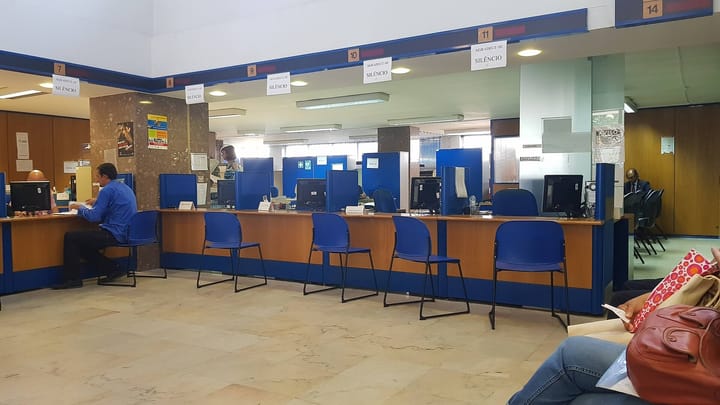
In person, at any Finanças office or Loja de Cidadão. You and the representative go together, or the representative goes alone with a power of attorney.
Documents for the e-balcão or in-person route:
- A power of attorney (procuração) or mandate contract. The signature needs certifying unless it is granted to a lawyer or solicitor named on the document. Certification costs a small fee at a notary, a lawyer, or a Câmara.
- The representative's civil ID (Citizen Card or residence permit).
- The representative's NIF.
- The representative's signed acceptance.
What it costs
Switching on electronic notifications costs nothing.
A friend or relative can act as representative for free. Paid providers charge a yearly fee. Online services advertise from about €80 a year (2026 prices) for a basic postbox role. Law firms and accountants typically charge more, and VAT-track representation costs more again because of the liability involved. Prices are set by the market, not by law, so compare a few quotes.
If you miss the deadline
Failing to appoint a representative, or to switch on electronic notifications, when the law requires it is a tax offence. The fine ranges from €75 to €7,500.
The fine is rarely the worst part. Until you close the gap, you cannot exercise your rights before the AT. You cannot lodge a complaint or appeal against an assessment you disagree with. And any notice sent to your last known address counts as delivered. People usually discover the problem when a bill has already gathered interest and penalties.
How to change or end a representation
To replace your representative, run the same nomination flow with the new person. The new nomination goes through the same letter and confirmation code steps.
To end a representation you no longer need, for example because you have moved to Portugal or to an EU country, update your tax address first. Then ask the AT to cancel the representation through the e-balcão or at a Finanças office. Do not simply let it lapse. The AT's records are what count, and your representative will keep receiving your post until the record changes.
Your representative can also resign. They must tell you in writing and inform the AT. The AT will only process the resignation if at least one year has passed since the appointment, or you have named a new representative. So if your representative wants out early, the practical fix is to appoint someone else or switch to electronic notifications.
Practical tips
- Set up Chave Móvel Digital. It lets you log into the Portal from abroad without a posted password.
- Even with a human representative, switch on electronic notifications as well. You will see what arrives and when.
- Check your Portal inbox around the IMI payment months (May, August, and November) if you own property.
- Give your representative a fast way to reach you. A notice they cannot forward in time is still served on you.
- If your affairs go beyond one property and a yearly IMI bill, pay for an hour with a Portuguese accountant before choosing.
Sources
- Portal das Finanças, FAQs on Representação Fiscal: https://info.portaldasfinancas.gov.pt/pt/apoio_contribuinte/questoes_frequentes/pages/faqs-00307.aspx (who must appoint, EU and EEA exemption, 15 day rule, fine, Portal and e-balcão paths, confirmation code and 30 day expiry, documents, who can be a representative, VAT rule)
- Lei Geral Tributária, article 19, consolidated text on the Portal das Finanças: https://info.portaldasfinancas.gov.pt/pt/informacao_fiscal/codigos_tributarios/lgt/Pages/lgt19.aspx (duty for non-residents and those absent over six months, optional for EU and EEA residents, electronic notifications exemption, resignation rules, loss of rights)
- Decreto-Lei n.º 44/2022 of 8 July (introduced the electronic notifications exemption into article 19 of the LGT): https://diariodarepublica.pt/dr/detalhe/decreto-lei/44-2022-185742880
- AT Ofício Circulado n.º 90054/2022 on representação fiscal: https://info.portaldasfinancas.gov.pt/pt/informacao_fiscal/legislacao/instrucoes_administrativas/Documents/Oficio_Circulado_90054_2022.pdf (no representative needed to obtain a NIF, the four tax relationship triggers, 15 day deadline under Decreto-Lei n.º 14/2013 article 24, VAT rule under CIVA articles 30 and 31, fine under RGIT article 124)
- ePortugal, Nomear representante fiscal: https://www.gov.pt/servicos/nomear-representante-fiscal (deadlines by situation, fine, legislation)
- Portugalist, Do you need a fiscal representative in Portugal: https://www.portugalist.com/nif-tax-representative/ (secondary source for market prices only)
Last verified September 2026. Rules and fees change; check the official source before acting.