Visiting Fátima in 2026 — The Six Anniversary Pilgrimages, the May 12-13 International Edition, the Cova da Iria Programme, the Caminho Routes from Lisboa and Porto, and a Practical Visitor Guide for Expats
Fátima draws six million visitors a year and six monthly Anniversary Pilgrimages between May and October, anchored on 13 May and 13 October. This is the practical 2026 visitor guide — the programme, the Caminho walking routes, the Cova da Iria layout and the Sanctuary etiquette.
Fátima — the small parish in the Ourém municipality where the three pastorinhos Lúcia dos Santos, Francisco Marto and Jacinta Marto reported six Marian apparitions across the summer of 1917 — is, by visitor count, the second-largest Catholic pilgrimage destination in the world after Lourdes. The Sanctuary at Cova da Iria draws around six million visitors a year. For most foreign residents in Portugal, Fátima is a place vaguely known as the religious capital of the country and somewhere to drive past on the A1 or IC2; for the millions who walk to it on foot every year, it is one of the most concrete features of Portuguese cultural and spiritual life.
This guide is written for expats and visitors who want to understand the Fátima calendar, the geography of the Sanctuary itself, the practical mechanics of getting there, and the visitor etiquette that makes the difference between blending in with the pilgrim flow and drawing perplexed glances from the staff at the Capelinha das Aparições. It assumes nothing about religious affiliation — the Sanctuary is a working pilgrimage site, but it is also a piece of architecture, a piece of public space, and an unavoidable feature of the May and October calendars in central Portugal that affects roads, rail and weekend traffic across the country.
The Six Anniversary Pilgrimages — May to October, the 13th of Each Month
The Sanctuary's liturgical year revolves around six monthly Peregrinações Aniversárias, each marking the date of one of the 1917 apparitions:
- 13 May — the first apparition. The 12-13 May Peregrinação Internacional Aniversária is the largest of the year and draws delegations from every continent. The May 2025 edition logged 141 pilgrim groups officially registered for 12 May and 150 for 13 May, with attendance estimated above 450,000 across 48 hours.
- 13 June — the second apparition. June overlaps the Corpo de Deus long weekend most years and is the second-busiest of the season after May.
- 13 July — the third apparition, where the pastorinhos reported receiving the famous "three secrets" of Fátima.
- 13 August — the fourth apparition. Held on 19 August in 1917 because the children had been arrested by the local civil administrator on the 13th and only released on the 15th; the Sanctuary preserves the 13 August date for the modern liturgical observance.
- 13 September — the fifth apparition.
- 12-13 October — the sixth and final apparition, the date of the Miracle of the Sun reported by an estimated 70,000 witnesses in 1917. The October pilgrimage closes the apparition season and is, after May, the second-largest of the year.
Each Anniversary Pilgrimage runs on the same template — Rosary at the Capelinha on the evening of the 12th, Procissão das Velas (candlelight procession) at 21:30, vigil through the night, morning Rosary on the 13th, International Anniversary Mass mid-morning with the blessing of the sick and the closing Procissão de Adeus (the farewell handkerchief procession). The presider rotates each year — the Patriarch of Lisbon, the Cardinal-Patriarch, a visiting cardinal from Rome, or, in some years, the Pope himself.
The 12-13 May 2026 Pilgrimage
The 2026 May International Pilgrimage will be presided by D. Rui Valério, 61, Patriarch of Lisbon, born in Urqueira in the same Ourém municipality that contains Fátima — a geographic match that the Sanctuary has highlighted in its run-up communications. The standard programme:
- Monday 12 May, evening — Rosary at the Capelinha das Aparições, followed at 21:30 by the Procissão das Velas through the Recinto.
- Monday 12 May into Tuesday 13 May, overnight — vigil at the Capelinha and the Recinto. The Sanctuary remains open through the night.
- Tuesday 13 May, morning — Rosary at the Capelinha at 09:00, followed by the International Anniversary Mass with blessing of the sick at the open-air altar.
- Tuesday 13 May, conclusion — the Procissão de Adeus closes the pilgrimage. The white mantle of the Virgem Peregrina is lifted from the statue, the statue is processed through the Recinto with the faithful waving white handkerchiefs, and the pilgrims disperse toward home.
The Sanctuary publishes the full bilingual programme at fatima.pt in the days running up to each pilgrimage, with mass times in Portuguese, English, French, Spanish, Italian, German, Polish and other languages distributed across the various chapels and basilicas.
The Sanctuary Geography — Cova da Iria, the Recinto, the Two Basilicas, the Capelinha
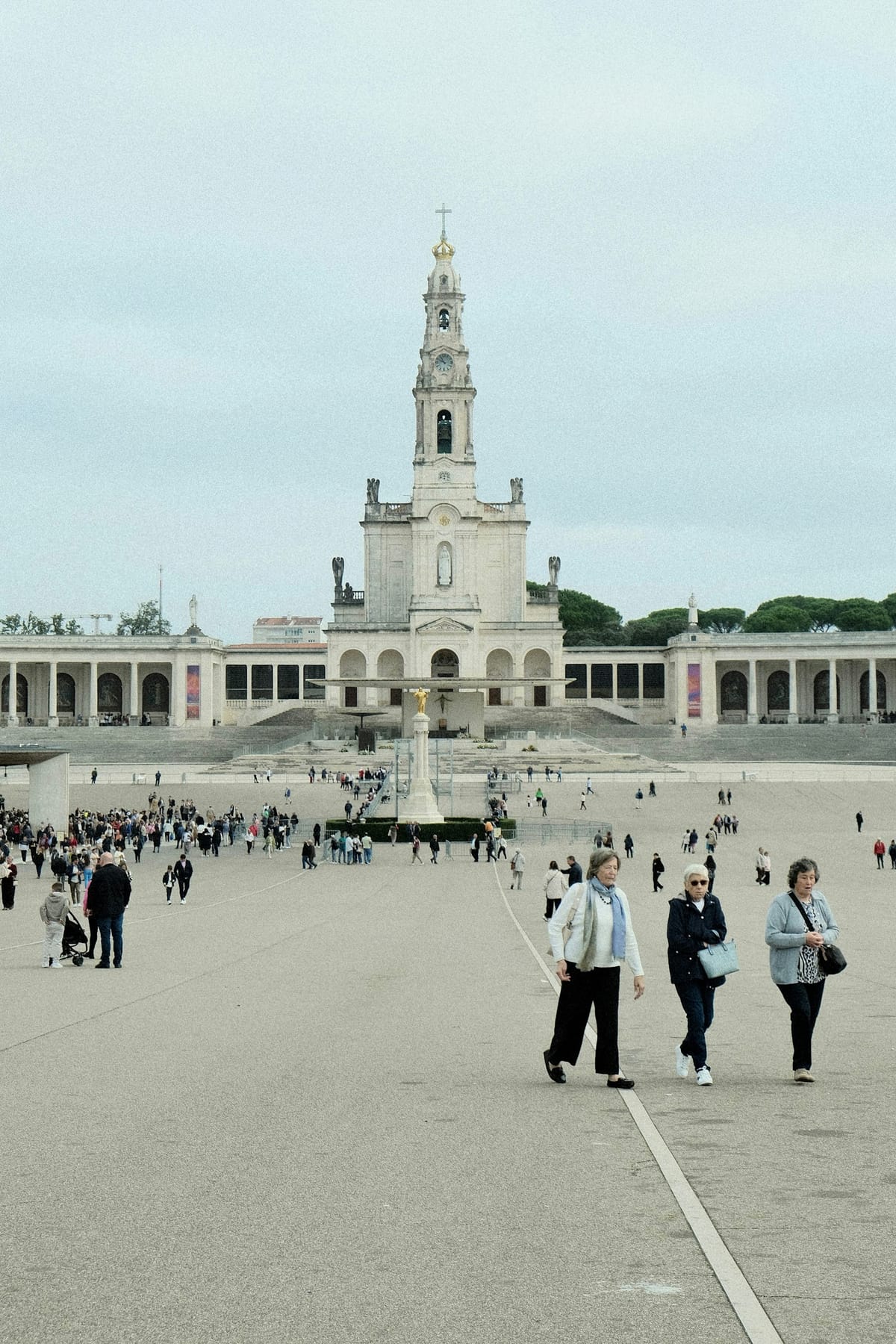
The Sanctuary sits on a roughly oval esplanade — the Recinto de Oração — about 540 metres long and 160 metres wide, large enough to hold a crowd of a million on Anniversary days. Walking the Recinto from north to south:
- Basílica da Santíssima Trindade (the modern church, completed in 2007) — the south end of the Recinto. Architect Alexandros Tombazis, capacity 8,633, used for the morning Anniversary Mass when crowd size requires.
- The Recinto itself — open-air esplanade with marble flagstones and a central pilgrim path. Many pilgrims walk the final stretch of the Recinto on their knees toward the Capelinha as a personal devotion.
- Capelinha das Aparições (the Apparitions Chapel) — the small open-sided chapel at the centre of the Recinto, marking the site of the holm oak under which the apparitions were reported. The chapel houses the original statue of Our Lady of Fátima and is the spiritual heart of the Sanctuary. Mass and Rosary are celebrated here multiple times each day.
- Basílica de Nossa Senhora do Rosário de Fátima (the original basilica, consecrated 1953) — the north end of the Recinto. Houses the tombs of the three pastorinhos: Francisco and Jacinta Marto (canonised by Pope Francis on 13 May 2017) and Lúcia dos Santos (declared Venerable in 2023). The flanking colonnade is a key shelter point during summer heat and winter rain.
Adjacent to the Recinto sits the Museu do Santuário, the Convento de Santa Clara, the Casa de Lúcia and the Casa dos Marto in nearby Aljustrel — the houses of the three pastorinhos, preserved as small open-air museums.
Daily Schedule (Outside Anniversary Days)
On a normal day at the Sanctuary, the rhythm is:
- Daily masses through the morning and afternoon at the Basilica of the Most Holy Trinity, the Basilica of Our Lady of the Rosary, the Capelinha das Aparições and the Chapel of the Death of Jesus, in Portuguese, English, Italian, French, Spanish, German and Polish at varying times.
- Rosary in the Capelinha das Aparições at 12:00, 18:30 and 21:30.
- Hour of Reparation to the Immaculate Heart of Mary at 14:00.
- Candle procession in the Recinto every evening between May and October, closing at 22:30.
- Confessions in multiple languages in the chapels around the Recinto and in the Pavilhão dos Confessionários on the south side.
Outside the May-October candle-procession season, the evening rhythm is quieter but the daytime mass schedule continues year-round.
Getting to Fátima
By car. Fátima sits 130km north of Lisboa and 200km south of Porto. The fastest road is the A1 toll motorway, exit 9 (Fátima-Batalha) — about 1h30 from Lisboa city centre and 2h00 from Porto. The IC2 (the old N1 corridor) runs in parallel and is free of tolls but slower; during pilgrimage windows the IC2 is heavily walked and IP issues protective restrictions across Aveiro, Coimbra and Leiria. Sanctuary parking — the parques do Norte and do Sul, plus the Centro Pastoral parking on the south side — totals about 10,000 vehicles, fills early on Anniversary days, and is supplemented by overflow lots on the outskirts of Cova da Iria with shuttle buses.
By rail. The Linha do Norte runs the Lisboa-Porto spine and stops at Fátima station — about 25km east of the Sanctuary itself. CP runs Intercidades and Alfa Pendular service to Fátima with shuttle-bus connections during pilgrimage windows. From the station, regional buses (Tejo, Rede Expressos, RodoTejo) handle the final leg into Cova da Iria.
By bus. Rede Expressos and FlixBus both run direct Lisboa-Fátima and Porto-Fátima coaches, terminating at the Fátima Bus Station 700m south of the Recinto. Journey time is 1h45 from Lisboa and 2h45 from Porto. Pilgrimage-day capacity is supplemented with extra rotations.
On foot — the Caminhos de Fátima. The walking routes to the Sanctuary run from across central Portugal, marked with blue and yellow arrows similar to the Camino de Santiago waymarking. The principal Caminhos:
- Caminho do Tejo — from Lisboa via Vila Franca de Xira, Azambuja, Santarém, Golegã, Torres Novas and Ourém. About 145km, walked in 5-7 days by most pilgrims.
- Caminho do Norte — from Porto via Espinho, Ovar, Aveiro, Águeda, Mealhada and Coimbra. About 240km, walked in 9-12 days.
- Caminho Nascente — from Castelo Branco and the eastern interior via Tomar. About 130km from Castelo Branco.
- Caminho do Sul — from Faro and the Algarve, the longest route at over 480km, typically walked over 20 days.
The routes are open year-round but the pilgrim densities concentrate in the days approaching 12-13 May and 12-13 October. The Federação dos Caminhos de Santiago e Fátima publishes route guides at federacaocaminhosfatima.pt with stage-by-stage detail and accommodation lists.
Sleeping in Fátima
The hotel and pilgrim-house capacity in Cova da Iria is roughly 12,000 beds, distributed across:
- Hotels — about 60 hotels and pousadas in the immediate Sanctuary area, ranging from three-star pilgrim-focused houses (Hotel Cinquentenário, Hotel Steyler, Hotel Pax) to four-star units (Hotel Fátima, Hotel Anjo de Portugal, Lux Fátima Park).
- Pilgrim houses (Casas de Acolhimento) — religious-order-run hostels offering beds at €25-€45 per person per night, the lowest end of the price ladder; typically full on Anniversary days, but reachable by phone the week before.
- Domus Pacis Fátima Hotel — the Sanctuary's own large hotel, with conference facilities for pilgrim group leaders.
On Anniversary nights, hotel rates double or triple, the pilgrim houses are full months in advance, and a substantial fraction of pilgrims sleep on the Recinto itself or in the colonnaded shelters around the Basilica of Our Lady of the Rosary. Bring a sleeping pad if you intend to do the same.
Visitor Etiquette
- Dress code. The Sanctuary is a working religious site. Knees and shoulders covered for chapel and basilica entry; modest civilian clothing for the Recinto. Sun and rain protection in any season — the Recinto is open-air.
- Silence in the Capelinha. The Apparitions Chapel is the spiritual centre of the Sanctuary; voices stay low. Photography is permitted but flash is discouraged during mass and Rosary.
- Knee-walking penance. The marble path from the entrance of the Recinto to the Capelinha is wide enough for two abreast and is used by pilgrims walking on their knees as a personal devotion. Step around them; do not photograph faces; do not interrupt.
- Candle offerings. Candles are bought from kiosks at the south side of the Recinto (€1-€10 depending on size) and burned in the open-air Brasero at the south side of the Capelinha. Do not light candles outside the brasero — the marble flagstones stain.
- Donations. Donativo boxes are inside every chapel and basilica. The Sanctuary is funded entirely by pilgrim and visitor donations.
What This Means for You
- If you are a foreign resident curious about Portuguese religious culture: visit on a normal weekday in March, April or November. The Sanctuary is open, masses are scheduled across multiple languages, and you will have space to read the architecture and the apparition history without crowd pressure.
- If you want the full Anniversary Pilgrimage experience: 12-13 May is the most international and most attended; 12-13 October is the most uniquely Portuguese and closes the apparition season. Book accommodation a month in advance for May; two weeks ahead for the smaller June, July, August and September pilgrimages.
- If you intend to walk a Caminho: stage planning starts at federacaocaminhosfatima.pt. The Caminho do Tejo from Lisboa is the most popular for first-timers — 5-7 days, well-marked, dense accommodation network, and an arrival into Cova da Iria that lines up with Anniversary windows if you start a week ahead.
- If you are visiting with children: the Sanctuary handles families exceptionally well. The Casas dos Marto in Aljustrel are short, age-appropriate visits with the original village houses of Francisco, Jacinta and Lúcia. The Sanctuary museum is included in the standard visit.
- If you have mobility constraints: the Recinto is flat marble flagstone and fully wheelchair-accessible. The Basilica of the Most Holy Trinity has lifts; the older Basilica of Our Lady of the Rosary has steps but with a ramped side entrance. Anniversary-day crowd density makes wheelchair routing difficult; the Sanctuary's volunteer Servitas service helps coordinate access.
- If you drive there during pilgrimage windows: stick to the A1 motorway, not the IC2. The free corridor is the most heavily walked road in Portugal in May, June, August and October, and the speed-reduction and pedestrian-strike risk is real.
The Sanctuary's official portal at fatima.pt publishes the daily liturgy schedule, the bilingual mass times, the Anniversary Pilgrimage programme, and the live-streaming feed for those who cannot travel. For most foreign residents in Portugal, a single visit to Fátima — even on a quiet Tuesday in early March — clarifies large parts of the country's cultural calendar that show up indirectly through public-holiday closures, school-trip rotations and the springtime traffic patterns on the IC2 and A1. It is, like the Jeronimos and the Bom Jesus do Monte and the Convento de Cristo, an essential piece of the Portuguese map. Worth seeing once, on your own terms.