Santos Populares in Portugal in 2026 — A Practical Guide to Lisbon's Marchas Populares on Avenida da Liberdade, the 12 June Bridge Holiday, Porto's São João, the Sardine and Caldo-Verde Calendar, and the Six-Festa Calendar Through 29 June
Santos Populares — the June trinity of Santo António (12-13 June, Lisbon), São João (23-24 June, Porto) and São Pedro (28-29 June) — is Portugal's biggest open-air festival cycle. The full guide to the calendar, the marchas, the sardines, the manjericos and the foreign-resident logistics.
For the four weeks between the last days of May and the end of June, Portugal becomes one open-air street party. The cycle is built around three saints — Santo António (Lisbon's patron, 12–13 June), São João (Porto's patron, 23–24 June) and São Pedro (28–29 June, with the strongest local frame in Sintra and the Algarve) — but the cultural envelope is far wider: it is one of the few moments in the Portuguese calendar when entire neighbourhoods cook in the street, drink in the street, dance in the street and stay up in the street until dawn. For foreign residents, the Santos Populares cycle is the single most accessible cultural-immersion window of the year because the whole programme runs in the public square, costs nothing to attend, and welcomes everyone who shows up.
This guide walks the full 2026 calendar — the six-saint festival sequence, the Santo António marchas on Avenida da Liberdade, Porto's plastic-hammer-and-bonfire São João, the sardinha-and-caldo-verde food architecture, the manjericos with their paper-poem rhymes, the bridge-holiday and bairro-by-bairro logistics, and the practical tips foreign residents need to navigate the festival without missing the moments that matter.
The Calendar — Six Saints in Six Weeks
The festival cycle officially opens with the Festas de Lisboa on the last days of May and runs through 29 June. The six saints celebrated in sequence are:
- Santo Estêvão — 3 June (the opening saint, marked in select Lisbon parishes)
- Santo António — night of 12 to 13 June (Lisbon's patron, the largest single celebration)
- São Bartolomeu — 14 June (intermediate)
- São João — night of 23 to 24 June (Porto, Braga, Évora; the second-largest celebration after Santo António)
- São Pedro — night of 28 to 29 June (Sintra, Seixal, the Algarve; the closing saint)
- São Marçal — 30 June (a small Northern variant in select Beja and Évora parishes)
The two anchor moments are 12–13 June in Lisbon and 23–24 June in Porto. Both are formal municipal holidays in the respective cities (Santo António in Lisbon, São João in Porto), which means city-level public services close, schools close, and the main bus and metro lines run modified schedules. The 13 June 2026 falls on a Saturday, which means the holiday's commercial-shutdown effect is muted — restaurants and arraiais run at full capacity, and the on-the-ground feel is closer to a long weekend than a working-week midweek pause.
Lisbon — Santo António
The Lisbon programme is anchored by three pieces: the Marchas Populares on Avenida da Liberdade on the night of 12 June; the arraiais populares across Alfama, Mouraria, Bica, Madragoa, Bairro Alto, Castelo, Graça, Ajuda and other historic bairros through the entire month; and the Casamentos de Santo António, the collective free wedding ceremony at the Sé Cathedral on the night of 12 June (a tradition since 1958, organised annually by the Câmara Municipal de Lisboa).
The Marchas are the visual centrepiece. Twenty traditional Lisbon neighbourhoods — Alfama, Mouraria, Bairro Alto, Madragoa, Bica, Lumiar, Olivais, Marvila, Castelo, Graça, Ajuda, São Vicente, Penha de França, Belém, Carnide, Santa Engrácia, Campo de Ourique, Alcântara, Lapa and one rotating bairro — each present a choreographed parade of about 80–100 marchantes in matching costumes singing original lyrics scored to the bairro's melody. The parade starts at 21h00 at the top of Avenida da Liberdade on 12 June and works its way down to Praça do Marquês de Pombal over about three hours. The whole route is free to attend; arrive by 19h00 if you want a position behind the front rail at any of the saint-statue stations along the avenue. The 2026 theme is 'Somos Lisboa, Somos Europa'.
The arraiais are where the city actually parties. Each historic bairro sets up trestle tables, paper bunting, lights strung between balconies, a sardine grill or two, a beer-and-wine bar, a small stage and a sound system. The classic order is to start in Alfama (the most-visited but also the most condensed), walk uphill to Mouraria for a slightly less touristed feel, descend through Graça to São Vicente for the early-evening view across the Tejo, and end in Bairro Alto for after-midnight dancing. The arraiais run from about 19h00 each night from Friday 5 June through Tuesday 30 June; the peak nights are 12 June (Santo António) and the weekends of 6–7, 13–14 and 20–21 June.
Porto — São João
Porto's São João is the country's most physical celebration. The night of 23 to 24 June turns the entire historic centre — Ribeira, Cais de Gaia, Massarelos, Foz, Miragaia, Fontainhas, Bonfim — into a continuous street party that runs from sunset on 23 June through dawn on 24 June. The defining objects are three: the plastic hammer (martelo de plástico), the leek (alho-porro) and the balão de São João (a paper hot-air lantern sent up over the Douro at midnight).
The plastic-hammer ritual is uniquely Porto: passers-by greet each other on the street with a gentle squeak-toy bonk on the head from a plastic hammer purchased from any street vendor for €2–€3. The hammer largely replaced the older leek tradition, in which one used a leek instead — but leek is still found at many traditional arraiais and is the more ironic choice for those who want to lean into the older custom. Both are friendly, both are universal, both are expected. The hammers are sold on every corner of the city centre from about 18h00 onwards and are usually €2 (small) or €3 (large).
The fireworks display over the Douro at 00h00 on 24 June, fired from the river opposite the Ribeira and from the Vila Nova de Gaia bank, is the night's apex moment. The best free viewing positions are the Cais da Estiva and Cais da Ribeira on the Porto side and the Cais de Gaia on the Vila Nova de Gaia side, but both are extremely crowded by 22h30; arrive earlier or watch from the higher streets (Rua das Aldas, Sé do Porto, Mosteiro da Serra do Pilar) for fewer crowds and a similar view.
After the fireworks the tradition is to walk the caminhada da Ribeira a Matosinhos: a roughly 8-kilometre walk along the Foz to Castelo do Queijo and out to Matosinhos beach to greet the sunrise. The route is free, well-lit, generally safe, and fully populated through the night; the metro returns from Matosinhos to the city centre from about 06h00. The morning ends at the beach with a banho-de-mar (a symbolic dip in the cold Atlantic) for the brave.
The Food Architecture
The Santos Populares menu is fixed, simple and cheap. The four core dishes that you will see at every arraial are:
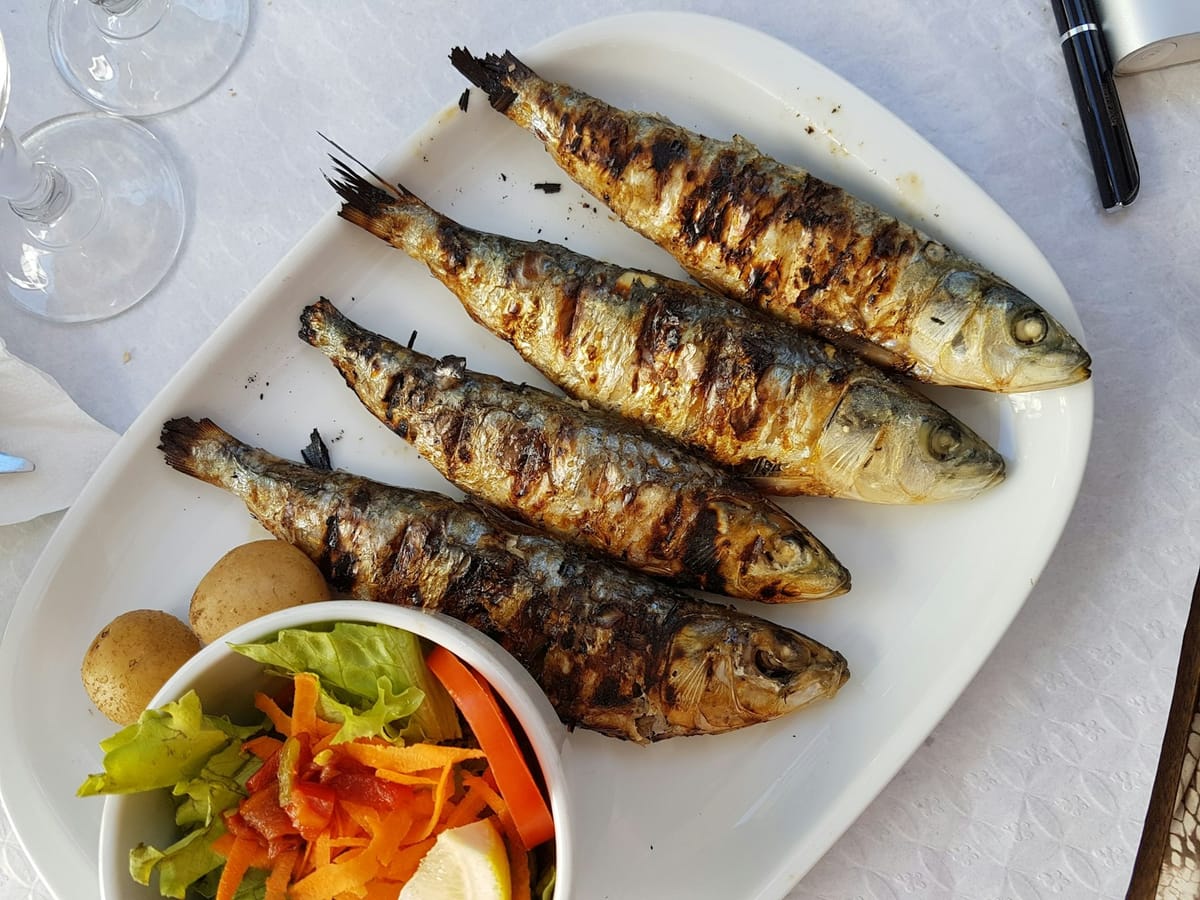
- Sardinhas assadas — grilled sardines, served on a slice of broa (corn bread) that catches the oil. June is peak sardine season; the fish are at maximum fattiness and the price-per-kilo at the lojas is at the year's lowest. At the arraiais, expect to pay €2.00–€3.50 per sardine; at fish restaurants in the same week, expect €4.00–€6.00.
- Caldo verde — a kale, potato and chouriço soup served in a paper cup with a slice of broa. The Northern speciality has become the second-most-served Santos dish nationwide; expect €2.50–€3.50 a cup at the arraial.
- Bifana — a marinated pork sandwich, the protein staple at every arraial. €2.50–€4.00.
- Carne de porco à alentejana or entrecosto — pork in clams or grilled ribs, the more substantial sit-down option at the larger arraial sit-down stalls. €5.00–€8.00.
To drink: imperial (small beer) at €1.50–€2.00, caneca (large beer) at €2.50–€3.50, vinho da casa (house wine) at €1.50 a cup, sangria at €3.00–€4.00, and água-pé (a low-alcohol grape ferment) in the Alentejo arraiais. Soft drinks and water are available at every stand at €1.00–€1.50.
The Manjerico
The third icon of the festival, after the sardine and the marcha, is the manjerico — a small bushy basil plant in a clay pot, traditionally given as a gift on the night of 12 June with a folded paper poem (quadra popular) tucked into a wooden flag at the centre of the pot. The poems are short rhyming verses, usually self-deprecating or romantic, occasionally political. The traditional gesture is that you smell the manjerico by brushing your hand against the leaves and then bringing your hand to your nose — never by directly bending down to the leaves, which is considered bad luck for the plant and its giver.
Manjericos are sold from late May at every flower shop, hardware store, supermarket and street vendor in Lisbon, Porto and the bigger municipalities. The plain pot runs €1.50–€3.00; the decorated arraial-themed pots with paper hats and bows run €4.00–€8.00. The plant itself rarely survives more than a few weeks indoors — it is meant to be a gift of the moment, not a long-term houseplant.
The Bridge Holiday — 12 and 13 June 2026
Santo António is a municipal holiday in Lisbon, falling on Friday 12 June 2026. With Saturday 13 June and Sunday 14 June following, this gives Lisbon residents a natural three-day weekend without needing to bridge a working day. Outside Lisbon city limits, 12 June 2026 is a normal working day — public services in Cascais, Sintra, Almada, Loures and other surrounding municipalities open as usual; only services located inside Lisbon city limits close.
São João is a municipal holiday in Porto, falling on Wednesday 24 June 2026. The midweek timing means São João 2026 is the more disruptive of the two for working professionals — most Porto businesses operate a half-day on 23 June or close entirely from midday, and 24 June is a full holiday in the city. Foreign residents working remotely for non-Portuguese employers should expect their team to take 23–24 June off if based in Porto, or 12 June if based in Lisbon. Schools close on the respective days in each city.
The full 10 June national holiday (Dia de Portugal, de Camões e das Comunidades Portuguesas) falls on Wednesday 10 June 2026 — a midweek public holiday two days before Santo António. This produces the Portuguese phenomenon of the ponte (bridge): many private-sector employers will offer Thursday 11 June as a discretionary day off so that staff can run from Tuesday 9 June to Sunday 14 June as a six-day window covering both Dia de Portugal and Santo António. Confirm the bridge with your employer in advance — it is not a statutory entitlement.
Bairro-by-Bairro Logistics — Lisbon
The classic Santo António circuit in Lisbon walks five bairros in one evening:
- Alfama — start at Largo do Chafariz de Dentro or Largo de São Miguel by 19h00. The most-visited and most-condensed; the original Santo António arraial neighborhood. Get there before 20h00 or fight for space.
- Mouraria — a 10-minute uphill walk from Alfama through Largo da Severa. Less touristed, more local-feel. The arraial centres on Largo do Achada and Rua do Capelão.
- Graça — a 15-minute walk uphill from Mouraria. The Miradouro da Graça is a strong sunset stop; the arraial then descends to Largo da Graça itself.
- São Vicente — a 5-minute walk downhill from Graça. The arraial centres on the church square; the view from the Miradouro de Santa Luzia is the postcard.
- Bairro Alto — a metro ride or a 25-minute walk via Chiado. The after-midnight dancing destination; the smaller, more music-focused arraial.
Public-transport tip: the Carris 28E tram runs through Graça-Alfama-Sé and is a useful spine of the night, but the lines are extreme during Santo António — expect 60–90 minute waits at the peak. The Linha Verde metro (Cais do Sodré–Telheiras) is faster for getting in and out of the bairro circuit. The metro runs late on the night of 12 June (typically until 03h00 instead of the regular 01h00); confirm with the Metro de Lisboa app.
Bairro-by-Bairro Logistics — Porto
The classic São João circuit in Porto walks the river:
- Fontainhas — start at the Miradouro das Fontainhas at sunset (22h00 in late June). The traditional fire-jumping spot.
- Sé do Porto — descend through the Cathedral square; the medieval streets above the Ribeira are heavily decorated with bunting.
- Ribeira — by 22h30 you should be at Cais da Estiva for the midnight fireworks. Public access is free; arrive early.
- Cais de Gaia — cross the Ponte Luís I before midnight to view the fireworks from the Vila Nova de Gaia side; the view is symmetrical and slightly less crowded.
- Foz / Matosinhos — after the fireworks, walk west along the river-and-then-coast for the dawn-greeting at Matosinhos beach. About 8 km, lit and populated through the night.
Public-transport tip: the Porto metro Linha D (the yellow line, São Bento–Vila Nova de Gaia) extends operating hours through the night of 23–24 June. The STCP buses run special São João lines from Matosinhos and Castelo do Queijo back to the city centre from 06h00 onwards.
Sintra and the Algarve — São Pedro
The closing saint is São Pedro on the night of 28–29 June. The strongest local frames are Sintra (where São Pedro is the patron and the historic Feira de São Pedro on the field below the Quinta da Regaleira runs through the weekend with a horse fair, an artisan market and a parade), and the Algarve (where São Pedro is the patron of fishermen and the celebration is concentrated in coastal villages from Olhão through Santa Luzia to Tavira). Sintra's celebration is the easier-access option for Lisbon-based residents: the train from Rossio to Sintra runs every 20 minutes and the festival is a 15-minute walk from the Sintra station.
For Foreign Residents
The Santos Populares cycle is the most welcoming Portuguese cultural moment for newcomers. There are no tickets, no reservations, no language requirement beyond a smile, and the food and drink price-points sit firmly in the under-€5 bracket. A few practical notes:
- Cash is essential. Most arraial food and drink stalls do not take cards, even Multibanco contactless. Bring €40–€60 in small notes and coins for an evening; ATMs in the bairros run dry by 21h00 on the peak nights.
- Wear closed-toe shoes. The streets are packed, the cobbles are slick with sardine oil and spilt beer by midnight, and the open-flame grills mean stray sparks. Sandals are a bad choice.
- Mind the late-bus shutdown. Public transport runs late on the festival nights but not all night. The metro typically closes 03h00–04h00; the night-bus network covers the gap to morning service. Uber and Bolt surge prices are substantial after midnight on 12 June and 23 June; confirm a ride home strategy before going out.
- Greet, don't gawk. The arraiais are the bairro's living-room for the month. Look local residents in the eye, say boa noite, smile at the children chasing each other through the bunting. The festival rewards participants more than spectators.
- Plan for sleep loss. The peak nights are loud — the music outside your window, the firecrackers, the shouting on the way home from the arraial — and central Lisbon and central Porto residents will not get a full night's sleep on 12–13 June or 23–24 June. The trade-off is the four most exuberant nights of the Portuguese calendar; embrace, don't resist.
- Bring a small umbrella or a thin shawl. June nights in Lisbon and Porto are warm in the early evening and cool by 03h00 — particularly down at the river in Porto, where the Atlantic breeze drops the temperature 5–6°C between midnight and dawn.
The Two Calendars — Bookmark Now
The two anchor calendar dates for 2026 are Friday 12 to Saturday 13 June for Lisbon's Santo António and Tuesday 23 to Wednesday 24 June for Porto's São João. The Sintra/Algarve São Pedro on the night of Sunday 28 to Monday 29 June closes the cycle. The Festas de Lisboa programme is published each year by the Câmara Municipal de Lisboa in early May; the Festas de São João do Porto programme is published by the Câmara Municipal do Porto and the EGEAC in late May. Both are free to download and free to attend.
If you have only one festival night to choose, choose 12 June in Lisbon if your priority is choreographed beauty (the Marchas) or 23 June in Porto if your priority is collective ecstasy (the river-and-fireworks). Either way, plan early, sleep late the day before, eat lightly during the day, wear comfortable shoes and bring cash. The Santos Populares is where Portugal stops being a country you live in and starts being a country you participate in.