Saab Walks the Portuguese Defence Industrial Pitch Public — €5 Billion Over 20 Years for the Gripen E, OGMA in Final Assembly, Critical Software Building the Simulator and an RBS15 Naval Add-On Sweetener
Saab walks its Portuguese defence-industrial pitch public: €5 billion over 20 years for the Gripen E, OGMA in Alverca on final-assembly potential, Critical Software on the AI simulator, Thyssenkrupp-Vangest-Kristaltek as suppliers — and the RBS15 anti-ship missile as a Marinha sweetener.
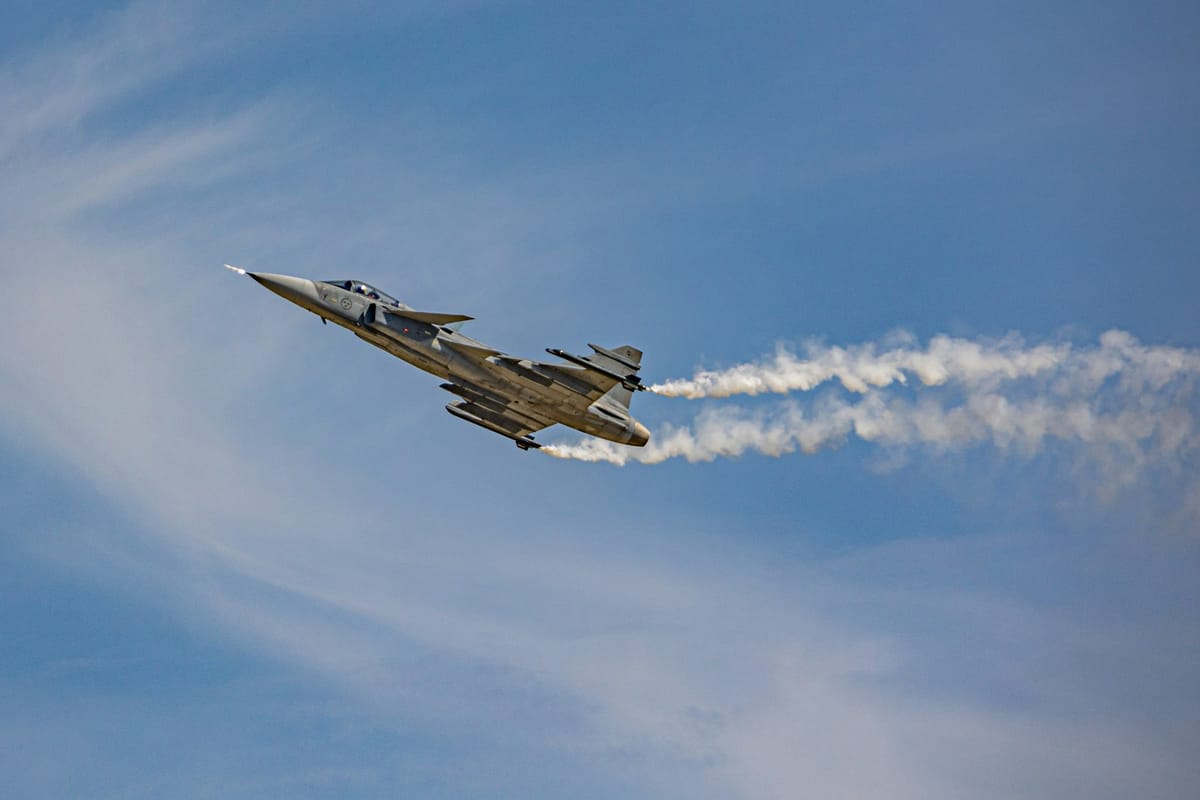
Sweden's Saab has begun making its industrial pitch to replace Portugal's ageing F-16 fleet with the Gripen E public — and the central argument is not the aircraft itself but where it would be built. ECO's Saturday reportage walks through the package: an estimated €5 billion programme over 20 years for what would likely be a 27- to 30-aircraft buy, with a meaningful share of final assembly done at OGMA in Alverca and a layered web of Portuguese suppliers already booked into the production chain.
The price, set against the obvious comparison
€5 billion for a 20-year multi-role programme places the Gripen E roughly at the price point that would historically buy 27 Lockheed Martin F-35s on initial acquisition alone, before factoring the F-35's notably higher per-flight-hour operating cost. Saab's pitch leans on this differential. 'O custo de aquisição é importante, mas não é tudo', Saab's Daniel Boestad told ECO; the company puts Gripen sustainment at roughly one-third the per-hour cost of competing US fifth-generation aircraft. The full short-list against Saab is the F-35 and the four-nation Eurofighter consortium.
The OGMA play
Saab's strategic anchor is OGMA — Indústria Aeronáutica de Portugal, the Alverca-based aerostructures and MRO house that already maintains a global Embraer KC-390 footprint and that Saab has publicly described as a 'muito grande potencial' partner for the Gripen line. Sub-assembly and final-assembly conversations are open, and a Memorandum of Understanding has already been signed with the AED Cluster Portugal. Vice-president Johan Segertoft framed the model in a single line: 'Não são feitos pela Suécia, mas sim com a Suécia'. Existing Portuguese suppliers already in the Gripen industrial chain include Thyssenkrupp Portugal, Vangest and Kristaltek; Critical Software in Coimbra is building the AI-powered pilot training simulator the Swedish Air Force already uses.
The aircraft, briefly
Gripen E is a single-engine multi-role designed against a Russia-facing Nordic threat picture — exactly the doctrine Portuguese Air Force planners are now writing into the post-2025 NATO posture. Saab cites 80–90% fleet availability, the ability to rearm-refuel-launch with a four-person ground crew in 10 minutes, an engine swap in one hour, takeoff and landing from 800-metre road stretches, and a payload that demonstrated nine missiles in tests. The Renascença read on transition cost — published 24 April — put F-16 pilots at roughly one year to convert to type, in line with the Swedish national training pipeline.
The naval bonus
Saab is also walking through the door at the Marinha: the company is offering its RBS15 anti-ship missile as a refit option for the Vasco da Gama-class frigates and for the next-generation NSC programme. The RBS15 carries a 200-kg warhead, has a range above 300 km and is air-, sea- and land-launchable — a capability Portuguese naval planners do not currently field.
What is not yet decided
The formal Portuguese F-16-replacement procurement process has not yet been opened. The Defence Ministry is closing on €5.8 billion in European SAFE-loan capacity through May 2026 to widen the broader military investment envelope, but the air-combat decision will sit alongside the unresolved NATO Sesimbra-Seixal ammunition depot file and the broader 2% NATO spending build-out. With Lockheed Martin and the Eurofighter consortium yet to make their full Portuguese-industrial counter-pitches public, the Gripen plan is the first to be set out in detail — but the procurement architecture itself remains for the Defence Council and the next Conselho Superior de Defesa Nacional to set.
For the Portuguese aerospace cluster, the calculation is simple: local-production is on the table in a way it almost never has been in a Portuguese fast-jet acquisition. Whether OGMA's Alverca lines end up turning Gripen E airframes will depend on what Lockheed Martin and the Eurofighter consortium are willing to put on the same table.