Portugal's GDP per Capita Falls to 76.2% of the EU Average Once Its Record Population Is Counted — Eurostat's Preliminary 81% Sheds Four Ranking Places to 22nd of 27
Eurostat pencils Portugal at 81% of the EU average in 2025 GDP per capita. Recalculated against INE's confirmed 11,424,031 residents, that drops to 76.2% — and from 18th to 22nd of 27 member states. More people, the same output, a thinner per-head slice.

Portugal entered 2025 telling a story of economic convergence with Europe. The arithmetic has just complicated that story. Eurostat's preliminary reading puts the country's gross domestic product (GDP) per capita at roughly 81% of the European Union average last year, measured in purchasing power standards (PPS) — the unit that strips out price differences between countries. But that figure rests on a population estimate that Portugal's own statisticians have since revised sharply upward. Plug in the confirmed headcount, and the per-head number falls to 76.2% of the EU average, dragging the country from 18th to 22nd place among the 27 member states.
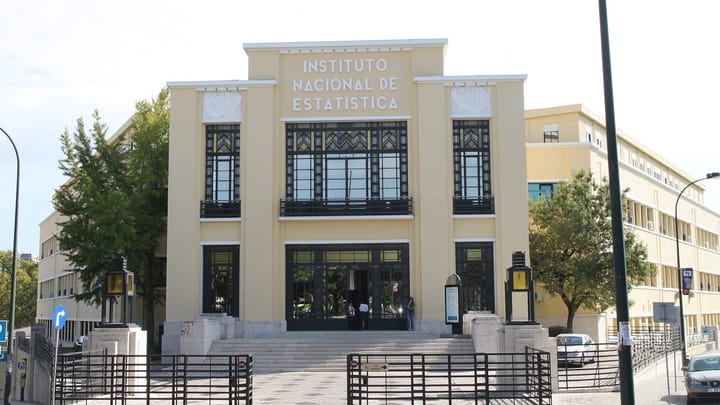
The mechanism is almost embarrassingly simple. GDP per capita is national output divided by the number of people. The output did not shrink. The denominator grew. When the Instituto Nacional de Estatística (National Statistics Institute) confirmed 11,424,031 residents at the end of 2025 — a record, and meaningfully higher than the population Eurostat had assumed for its first pass — the same economic pie suddenly had to be sliced across more plates.
The numbers behind the slip
- EU average: Portugal moves from a preliminary 81% to 76.2% of the EU-27 average once the higher resident count is applied (the EU average sits near €41,600 per inhabitant in purchasing power terms).
- Eurozone average: the country slides from 78.6% to roughly 74% of the single-currency bloc's mean.
- Ranking: from 18th to 22nd of 27 in the EU, and from 15th to 17th within the eurozone.
- Population growth: the resident total rose by 59,113 in 2025, following increases of 326,090 in 2022, 275,929 in 2023 and 188,252 in 2024 — a four-year surge driven overwhelmingly by immigration.
Convergence in reverse
The longer arc is the uncomfortable part. Portugal stood at 85% of the then-EU average in 1999, near the height of its post-accession catch-up. By 2019 it had drifted to 77.2%. The 2025 reading, on the revised population, sits below 77% — meaning that on this measure the country is no closer to the European mean than it was on the eve of the pandemic, and further from it than a quarter-century ago. The convergence that successive governments have claimed as a policy achievement looks, through this lens, like stagnation dressed as progress.
None of this means Portuguese households became individually poorer in 2025. Output per worker did not collapse; the economy kept expanding, and the registered jobless roll actually shrank over the year. What changed is that growth has been spread across a population swelling far faster than national income. A larger workforce can lift total GDP while leaving the average resident's share flat or falling — precisely the pattern an immigration-led expansion tends to produce in its early years, before newcomers' productivity and earnings catch up.
That dynamic collides with another statistic the country has been digesting: total debt continues to climb, and a recent survey found only 16% of residents save more than a fifth of their income. A thinner per-head output figure, high fixed costs and modest savings are not three separate stories. They are the same squeeze viewed from different angles.
Why the measure matters beyond bragging rights
GDP per capita relative to the EU average is not a vanity metric. Brussels uses regional versions of it to allocate cohesion and structural funds; regions below 75% of the average qualify as "less developed" and draw the largest transfers. A country sliding back toward — rather than away from — those thresholds has implications for the next EU budget cycle and for the framing of Portugal's recovery-and-resilience spending. It also shapes how international investors and ratings agencies read the trajectory of an economy that markets a narrative of catch-up growth.
What This Means for Expats
- Wages stay the sticking point: a per-capita figure stuck near three-quarters of the EU average is the statistical shadow of Portugal's persistently low salaries. If you are weighing a job offer here against one elsewhere in Western Europe, this is the macro backdrop to the pay gap you will feel in practice.
- Cost of living versus income: the figures are quoted in purchasing power standards, which already adjust for Portugal's lower prices. The country is still below average even after that adjustment — a reminder that cheaper coffee does not fully offset thinner pay.
- You are part of the denominator: the very newcomers reshaping these statistics include the expat and immigrant population. The per-head dip reflects rapid population growth, not a contraction — important context if headlines make the economy sound like it is shrinking. It is not; it is being shared more widely.
- Watch the EU-funds angle: if relative income keeps slipping, more Portuguese regions could requalify for higher EU transfers in the next programming period — money that ultimately flows into infrastructure, housing and services that residents use.
- Mind the framing: expect this number to become a political football. The opposition will read 76.2% as proof of failed convergence; the government will point to Eurostat's higher 81% headline and to job growth. Both figures are real; they differ only in which population count you trust.
The gap between Eurostat's 81% and the population-adjusted 76.2% is, in the end, a gap between an estimate and a census. As the EU statistics agency reconciles its figures with INE's confirmed headcount in the coming revisions, expect the lower number to harden. Portugal did not get poorer in 2025. It simply got more crowded faster than it got richer — and on a per-person basis, that is a distinction without much difference. On what an hour of Portuguese work actually produces, our reading of Eurostat's September release, which puts Portuguese output per hour fourth from the bottom of the EU27 on both growth and level, against the fourth-longest working year in the Union sets the latest reference.