Portugal's F-16AM Detachment in Estonia Tops Ten Russian Intercepts in Five Weeks — Tuesday's Latest Alpha Scramble From Ämari Air Base Reframes the NATO 1.18%-of-GDP Argument as Berlin Pushes Lisbon Toward 2% by 2029 and 5% by 2035
Two F-16AM Fighting Falcons from Portugal's Air Force detachment at Ämari Air Base in Estonia scrambled on Tuesday to intercept Russian aircraft — the roughly tenth Alpha Scramble since the four-month NATO eAP rotation began on 1 April with four jets and 95 personnel.
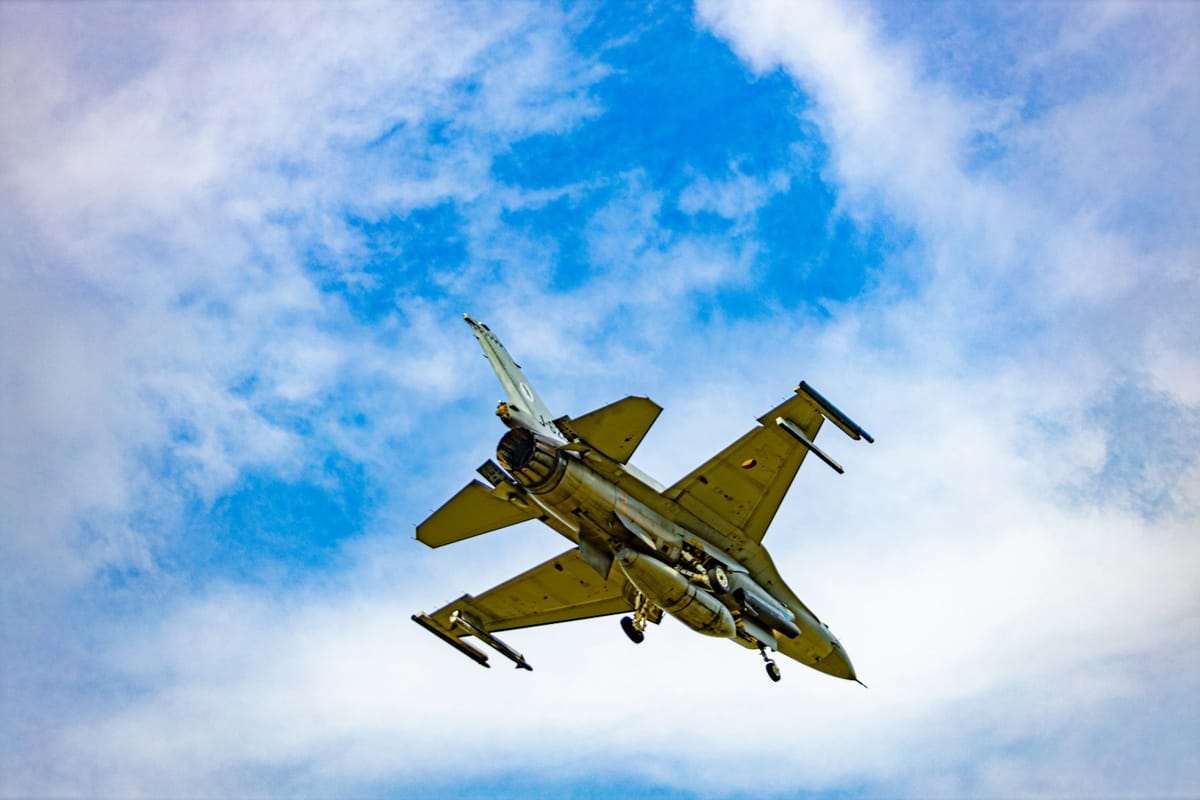
The Portuguese Air Force's F-16AM detachment at Ämari Air Base in Estonia logged what is now its roughly tenth Alpha Scramble in five weeks on Tuesday, with two of the four Fighting Falcons launching from the Estonian base on a NATO Combined Air Operations Centre alert from Uedem, Germany after unidentified aircraft were detected over international Baltic waters in the vicinity of NATO airspace. The Força Aérea Portuguesa's official communiqué confirmed the intercept "decorreu com êxito" — proceeded successfully — with the Portuguese pilots gathering position and altitude data before returning to base, the latest in a tempo of intercepts that began the moment the rotation took over the eastern flank from the Italian Eurofighter detachment on 1 April.
The Portuguese contingent at Ämari numbers four F-16AM Fighting Falcons and 95 military personnel from the Esquadra 201 — Falcões — based at Monte Real and the support cadre, on a four-month rotation running 1 April to 31 July 2026 under NATO's enhanced Air Policing 2026 (eAP26) operational umbrella. Ämari is the principal Estonian fighter base and the operational hub from which the rotation covers the entire Baltic airspace — Estonia, Latvia and Lithuania — none of the three Baltic states fielding their own fighter capability and depending on the rotating NATO detachments to scramble in response to the Russian flight tempo over the Baltic Sea.
The intercept tempo — first scramble 6 April, tenth in five weeks
The first Alpha Scramble for the rotation came on 6 April 2026, less than a week after the Portuguese flag went up at Ämari, when the detachment intercepted a Russian Ilyushin Il-76 Candid heavy transport flying close to NATO airspace from the direction of Kaliningrad. That intercept was the rotation's baptism in the Baltic and the operational signature of the redeployed F-16AM mid-life-update Falcons that had been on rotation in Albania and Kosovo earlier in the year. By Wednesday's communiqué, the intercept tally for the rotation had climbed to roughly ten — a tempo that broadly tracks the wider NATO Baltic norm of 500 alliance-wide scrambles per year and that the Portuguese rotation is now contributing to at the eastern edge.
The Russian aircraft list since 1 April spans the Il-76 transport on the rotation's first scramble, Su-30 fighter pairs (one of which briefly entered Estonian airspace near Vaindloo Island in March, just before the Portuguese contingent took over from the Italian Eurofighter detachment that closed out the previous rotation), and the Tu-22M3 long-range bombers that have been patrolling the Baltic with Kh-22 and Kh-32 cruise missiles in the months since the Iran war reopened the Hormuz front. The Portuguese rotation's Alpha Scramble cadence is the operational evidence the Force Aérea places on the table when arguing for the eastern-flank deployment record at the political level.
The defence-budget read — 1.18%, 2% by 2029, 5% by 2035
The Estonia rotation tempo is landing on a Lisbon defence-policy debate that the Berlin Wirtschaftstag visit on 5 May made acutely visible. The 2026 Defence Budget Programme is set at €3.77 billion in consolidated spending, a 14.8% increase on the 2025 execution and an absolute-record envelope but still only about 1.18% of GDP. The Government has reaffirmed the timeline of reaching the NATO 2%-of-GDP target by 2029 and the 5%-by-2035 commitment that the alliance closed out of the 2025 NATO summit, both targets that the Berlin meeting between Prime Minister Luís Montenegro and Chancellor Friedrich Merz on 5 May framed as conditions for deeper EU defence-industrial integration.
The €487-million 2026 spending uplift is concentrated on three lines that the Estonia rotation showcases: the F-16AM mid-life-update programme that keeps the 28-jet Esquadra 201 fleet in service into the early 2030s ahead of an eventual F-35A or KF-21 replacement; the recapitalisation of the C-390 Embraer transport fleet that Portuguese Air Force Industries will supply through 2028; and the 2026-2030 Lei de Programação Militar that the Council of Ministers signed off on at the 9 January Salgueiros approval. Helena Carreiras, the Defence Minister, has framed the trajectory as "a continuous upward path of defence budgets and investment" — a phrase the Portuguese government has used in every NATO summit communiqué since 2024.
Portugal's ninth Baltic Air Policing rotation — and second from Ämari
The 2026 Estonia rotation is Portugal's ninth participation in NATO's Baltic Air Policing programme since the alliance launched it in 2004 to cover the airspace of the three Baltic accession states, and the second time Portuguese fighters have operated from Ämari Air Base specifically. The previous Ämari rotation came in 2022, when the contingent was based on the F-16M variant and ran for the four-month rotation that ended at the height of the Russian invasion of Ukraine. The 2026 rotation reads through a far more constrained airspace than 2022: the Russian flight tempo over the Baltic is the highest since 2022 (NATO logged more than 500 scrambles in 2025, second only to the historical 570-peak of 2022), the Estonian airspace incursion record has the Russian Su-30 March entry near Vaindloo Island, and the Polish and Romanian eastern-flank rotations are running concurrent maximum-alert postures.
What this means for foreign residents
For foreign residents tracking Portugal's strategic posture and the structural read on Portuguese defence-spending architecture, the Estonia rotation is the year's most visible operational signal. Tax and budget framing. The 14.8% defence-budget uplift in the 2026 OE is part of the same fiscal envelope that the IMF Article IV mission asked Lisbon to defend in its 6 May concluding statement; the structural choice between defence-spend escalation, the IRS Jovem reversal that the IMF asked for and the IVA reduzido restauração reversal is the autumn budget-review's central trade-off. NATO 5%-by-2035 commitment. The 5%-by-2035 target the alliance closed out of the 2025 summit translates roughly into a four-fold increase in defence spending across the Portuguese decade, an outlay that no single budget line in Portugal's recent history has carried; the political-economy answer remains incomplete and is part of the European Strategic Autonomy debate that the Brussels Reforms-tracker placed at 16% complete on 6 May. Aviation safety. The Baltic intercepts are the operational pole of NATO's air-policing posture, and the Portuguese contingent is part of the first-responder layer for the Estonian-Latvian-Lithuanian airspace; civilian-aviation impact in Portugal itself remains nil — the Lisbon, Porto and Faro civilian-traffic flow is unaffected by the Estonia rotation and is governed by the Lisbon FIR and Santa Maria Oceanic FIR. Force Aérea recruitment. The Estonia rotation is also a recruitment showcase: the Esquadra 201 vacancy roster, the C-295 transport-pilot stream and the Future Combat Air System-track fast-jet pipeline are all on the FAP's hiring page; foreign-resident dual-nationals interested in the cadet officer track or the technical-specialist track can apply through the Direção-Geral de Recursos da Defesa Nacional channels and the F-16AM technical pipeline opens for civilian recruits with EASA Part-66 ratings. Diplomatic posture. The Estonia rotation is the operational manifestation of the Portuguese-NATO-EU triangle that the Montenegro-Merz Berlin meeting on 5 May reinforced; for foreign residents from EU and Allied states, the rotation is the institutional read on Portugal's eastern-flank reliability.
The Portuguese rotation is scheduled to hand over to a Spanish, Italian or French detachment at the end of July 2026, with the next eAP26 rotation cycle to be announced by NATO Allied Air Command at Ramstein in early June. On the EU foreign-policy and diplomatic-postings side of the file, our 4 June read on Kaja Kallas's 33-ambassador EEAS rotation — Sofia Moreira de Sousa moving from the Commission's Lisbon Representation to EU Ambassador in Tirana (Albania) and Francisco André transferring from Mexico City to EU Ambassador in Brasília (Brazil), with the EU-Mercosur ratification window framing the André posting and the Western Balkans Cluster 1 fundamentals framing the Moreira de Sousa brief sets the latest reference.