Portugal's 2025–2026 Olive Oil Campaign Closes at 160,000 Tonnes — Production Has Quintupled in 26 Years and Is Worth €700 Million as CEPAAL Pushes a Portuguese Brand to Reclaim the Margin That Currently Flows to Spanish and Italian Bottlers
Portugal closed the 2025–2026 olive oil campaign at 160,000 tonnes — five times the production at the start of the century — worth €700 million at current bulk prices. CEPAAL is pushing a Portuguese brand to capture the margin currently flowing to Spanish and Italian bottlers.
Portugal closed the 2025–2026 olive oil campaign at 160,000 tonnes, five times the production volume at the start of the century, with the harvest worth roughly €700 million at current bulk prices. The numbers were laid out on Friday at the Congresso Nacional do Azeite in Moura, in the Beja district, by Manuel Norte Santo, president of the Centro de Estudos e Promoção do Azeite do Alentejo (CEPAAL), who said the next leg of value capture has to come from branding rather than volume.
The transformation in numbers
From the early 2000s to the 2025–2026 campaign, average national production has multiplied by five. The current crop is 10% lower than 2025 due to weather variability, but the trend line is unambiguous: Portugal's record campaign was 206,000 tonnes, and Gonçalo Moreira of Olivum — the producer-and-mill association — told the same congress that the country could be at 300,000 tonnes inside three to five years. That number would put Portugal in second place in the European ranking and third or fourth worldwide.
The Alqueva irrigation perimeter did most of the lifting
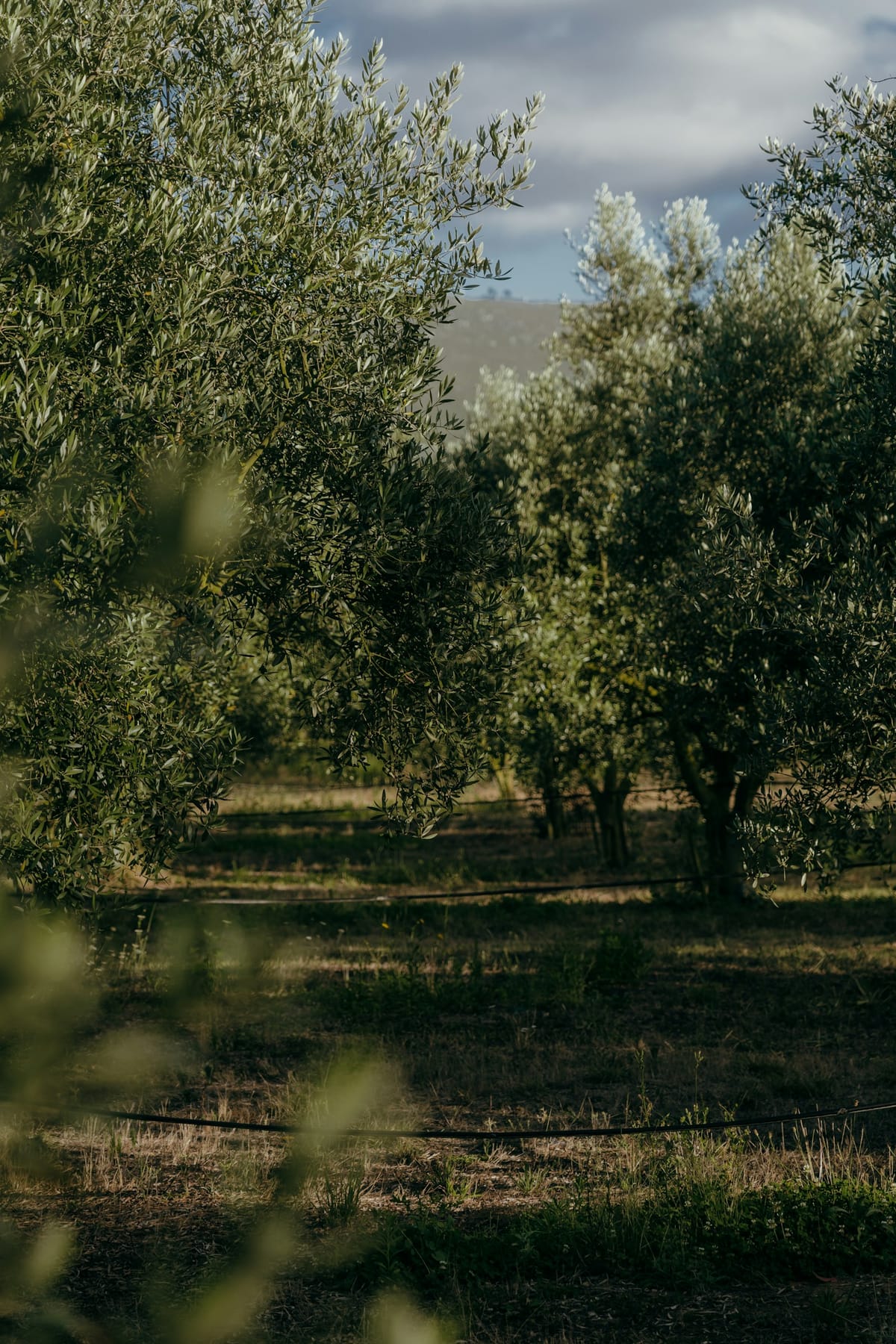
Portugal now has 3,500 hectares of olive groves, the bulk in the Baixo Alentejo and largely tied to the irrigation perimeter created by the Alqueva reservoir project. The yield revolution that came with it is the conversion from olival em vaso — the traditional pattern of up to 800 trees per hectare — to olival em sebe, the high-density hedgerow format that allows mechanical harvesting and produces a multiple of the per-hectare yield. Portugal was, as Moreira put it, the first country in the world to swap modern olive groves for even more modern olive groves.
Why bulk exports are the problem
More than 50% of the Portuguese harvest still leaves the country in bulk — sold to Spanish and Italian bottlers who put their own labels on the finished product. That is the margin CEPAAL wants to recover. The strategy is to create a chapéu brand for Portuguese olive oil that pulls value from the wholesale tier into the retail tier, with packaging and shelf placement carrying the country-of-origin signal that is currently lost when bulk leaves the lagar gate.
What is coming next on the supply side
Moreira's expansion case does not depend on more irrigation. He said the new sebe formats can be installed in sequeiro — rain-fed land — provided the terrain supports it, and there is producer interest in that pattern. That is materially significant: it removes the Alqueva perimeter as the binding constraint on growth and opens the door for olival expansion across regions of Portugal that lack the irrigation footprint of the Alentejo.
What this means for expats
- Pricing and shelf options: the push for a Portuguese brand chapéu means more nationally branded olive oils on supermarket shelves over the next two to three years. Expect more named single-estate options at the premium tier and clearer DOP/Alentejo regional labelling at the mid-tier.
- Visiting the producing region: the Baixo Alentejo lagar circuit — Moura, Serpa, Beja — is the fastest-growing oleotourism corridor in the country, and the Olivomoura fair every May is the annual showcase. The new sebe-format groves are visible from the EN255 and EN258 roads.
- If you are exporting from Portugal: the CEPAAL brand chapéu, when it lands, will offer co-packaging and certification that tells the export buyer the bottle originated and was filled in Portugal. That is a tighter spec than the EU's blended-origin labels currently allow Spanish and Italian bottlers to use.
- Investment angle: the sequeiro-sebe finding is the biggest piece of news for anyone with land outside the Alqueva irrigation perimeter. Yield-per-hectare for the new format is a multiple of the traditional vaso pattern, which changes the case for olival conversion on previously marginal terrain.
The 700-million-euro figure is what the volume is worth at current bulk prices. The CEPAAL pitch is that the same 160,000 tonnes can be worth materially more if the country stops sending half of it abroad in tankers.