Porto's Assembleia Municipal Approves Free Public Transport for the City's 252,687 Residents — €20.5 Million-a-Year Cartão Porto Will Cover the Whole Andante Network From January 2027, With a Pedro Duarte Push to Pull the Start Forward to This Summer
Porto's Assembleia Municipal voted Monday night to make public transport free for the city's 252,687 residents — a €20.5 million-a-year Cartão Porto scheme covering the entire Andante network. Legal start: 1 January 2027. Câmara president Pedro Duarte is pushing for a summer 2026 rollout.
The Assembleia Municipal do Porto voted on Monday night, 4 May 2026, to make public transport free of charge for everyone with residence registered in the city — a €20.5 million-a-year scheme that will see Porto residents ride the entire Área Metropolitana do Porto's Andante network on a Cartão Porto, with the legal start fixed at 1 January 2027 and Câmara president Pedro Duarte already lobbying to pull implementation forward to the summer of 2026. The measure carried with the votes of PS, the governing PSD/CDS-PP/IL coalition, BE and Livre. Chega voted against. CDU and the independent "Filipe Araújo: Fazer à Porto" group abstained.
What was approved, in one paragraph
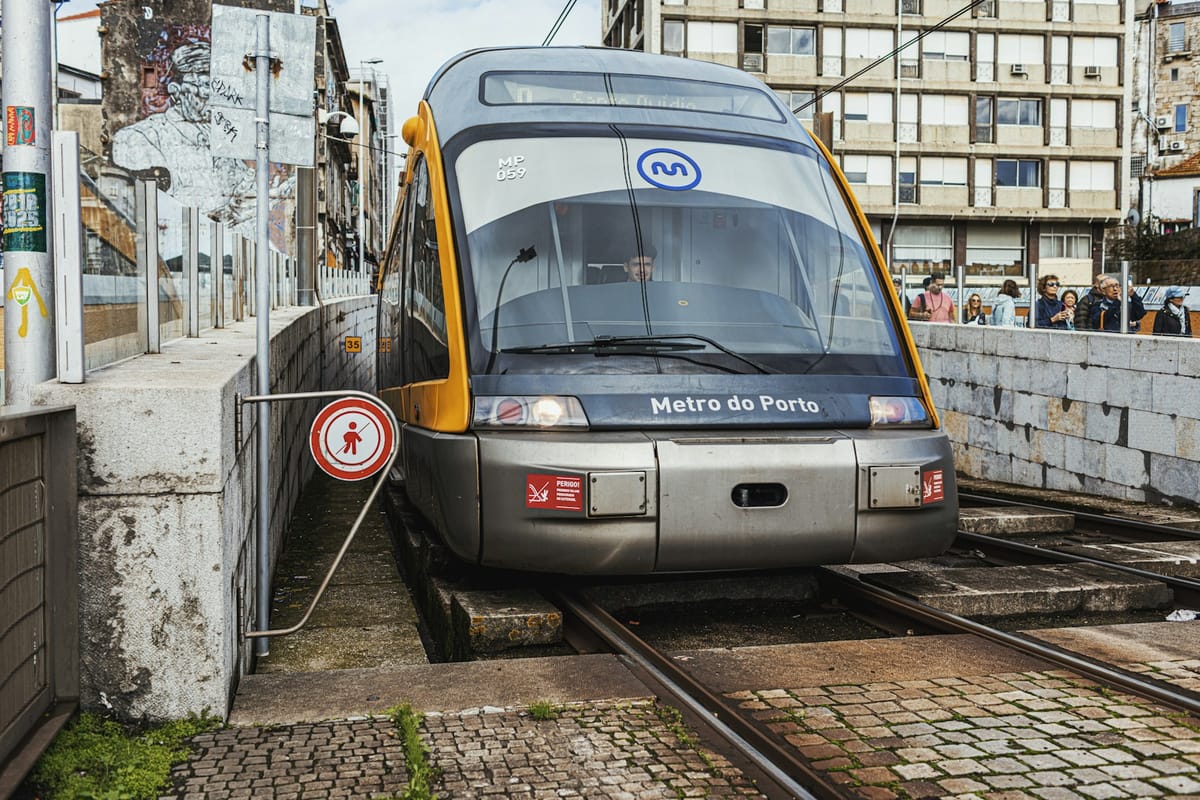
The proposal extends an integrated tariff to anyone whose residence is registered in the freguesia map of the Município do Porto and provides them with a free Cartão Porto that operates as the equivalent of the Passe Metropolitano Andante across the entire AMP territory. That means the free pass works on STCP buses inside Porto, on the six Metro do Porto lines, on CP suburban services within the metropolitan zone, and on the cross-municipal bus operators integrated into the Andante system. The Cartão Porto is the city's existing municipal-services card; the scheme adds a transport entitlement layer rather than minting a new product.
The numbers
- Annual steady-state cost: €20.5 million, the figure the Câmara presented to deputies as the run-rate once the scheme is fully operational.
- Multi-year commitment ceilings: €10.25 million for 2026, €18.7 million for 2027, €1.8 million for 2028 — the staggered envelope reflects a half-year first-year cost, a full launch year and a tail commitment for late-arriving invoices, the structure required to satisfy the Tribunal de Contas's multi-annual authorisation rules.
- Eligible population: the Câmara's 2025 estimate of 252,687 Porto residents.
- Modelled take-up: 59,381 users, or 23.5% modal share — the fraction the city believes will switch from cars or other modes once the price falls to zero.
- Financial-effects date: 1 July 2026 or the date of Tribunal de Contas approval, whichever is later — a clause that bridges the legal start of 1 January 2027 and the political ambition to roll out earlier.
The vote
Approval cut across the city's left and right blocs. PS deputy Agostinho Sousa Pinto told the chamber the Socialists "did not want to assume a position of easy rejection," even while flagging technical and financial concerns about a measure designed inside the executive of a rival political family. The PSD/CDS-PP/IL coalition voted in favour by default — the proposal is its own — and BE and Livre joined to give the measure a comfortable majority. Chega's Carlos Graça was the lone explicit no, arguing the documentation tabled with the proposal did not guarantee "sustainability, equity and legality." The CDU and the "Fazer à Porto" deputies — Filipe Araújo's independent grouping — abstained.
The metropolitan-area paradox
The structural awkwardness of the Porto vote is that the Câmara controls only the funding, not the perimeter. Pedro Duarte himself flagged it on the floor: the measure will be far more effective if every AMP municipality adopts a parallel scheme, because as drafted it produces an asymmetry where a Porto resident travels free across the whole Andante grid while a resident of Matosinhos, Gondomar, Vila Nova de Gaia, Maia or Valongo continues to pay a metropolitan pass to ride the same trains and buses. That asymmetry is politically uncomfortable for Pedro Duarte's coalition partners across the river — and it is the reason the cost line for the Câmara is €20.5 million rather than the multiples that a true metropolitan-wide free pass would carry. AMP-level coordination is now the next political move; the alternative is a Porto-only scheme that effectively subsidises Porto residents who commute out, while leaving the daily Gaia-to-Trindade or Matosinhos-to-Bolhão commuter on the standard tariff.
Timing — the 1 July 2026 wedge
The proposal nominally takes effect on 1 January 2027, but the Câmara built two earlier triggers into the text. The first is the multi-annual financial commitment, which is structured to authorise spending from 1 July 2026 onwards. The second is Pedro Duarte's stated wish to begin issuing free Cartão Porto entitlements during summer 2026, ahead of the legal start. The pinch point is the Tribunal de Contas: the multi-year envelope must clear the visto prévio process, and the start date of the financial effects clause is explicitly the later of 1 July 2026 or the visto date. A Tribunal de Contas signature in June or July would put a summer launch within reach; a slower review pushes the practical rollout into the autumn, with the legal default of January 2027 as the backstop.
What it means for residents and foreign professionals living in Porto
- If you live in the Município do Porto and are registered there: you will be eligible for a free Cartão Porto Andante entitlement once the scheme is live. The current Andante metropolitan monthly pass costs €40 for the standard product, so an adult commuter saves €480 a year. A two-zone Andante user saves around €360. Households with two working adults are looking at a €700–€960 transfer from the household budget to the municipal one.
- If you live in another AMP municipality: nothing changes — yet. Watch for parallel proposals from the câmaras of Matosinhos, Gondomar, Maia, Vila Nova de Gaia, Valongo, Santo Tirso, Trofa, Espinho, Póvoa de Varzim, Vila do Conde, Santa Maria da Feira, São João da Madeira, Oliveira de Azeméis, Arouca and Paredes, which would be the natural follow-on if the Porto scheme survives the Tribunal de Contas review.
- If you are moving to Porto: the scheme is tied to residence registration in the city's freguesias, so the standard Cartão de Cidadão address-update flow at any junta de freguesia is what activates eligibility. The Cartão Porto is requested at the city's customer service desks or online via the Câmara's portal.
- If you commute into Porto from outside the city: Andante prices do not change. The metropolitan pass remains €40 standard / €30 Sub23 / €20 social, with the Tarifário Família discounts available for households on the lowest income brackets.
The political subtext
Pedro Duarte ran on a paradigm-change agenda for Porto's transport network and presented Monday's vote as evidence the Câmara is willing to spend its own resources on it rather than wait for AMP-level alignment. The PS abstention-trend in similar past votes makes the Socialist bloc's affirmative stance noteworthy: PS does not want to be the party that tanked free transport in Porto, even where it has structural concerns. The Chega no signals the party's continuing posture against universal benefit programmes that are not means-tested. The CDU abstention is the more interesting one — the Communist bloc has historically supported free or near-free public transport but baulks at delivering it through what it views as municipal-coalition political theatre rather than a national tariff reform.
The next test for Pedro Duarte is whether the AMP — where Porto holds significant weight but does not run the show — will follow with its own scheme, and whether the Tribunal de Contas grants visto fast enough to put a Cartão Porto Andante in residents' hands before the autumn. On the rail-freight / modal-shift rail, our 20 May Medway read — the MSC-controlled rail-freight operator runs up to three block trains a week out of Palmela carrying completed Volkswagen Autoeuropa T-Roc and SEAT-CUPRA Formentor units to Leixões and Santander, with Carlos Vasconcelos reading the railway option as 'gaining strength' inside the Portuguese 23% rail-share target on inland freight tonne-kilometres by 2030 sets the latest reference. On the World Cup retail-and-society side, our 24 May read on the Panini Mundial 2026 caderneta — Lisbon tabacarias selling out within hours of every delivery, the Panini Iberia press running 24/7, the Cristiano Ronaldo base sticker listed at €2,500 on OLX as his last World Cup, and a 60-plus Portal da Queixa fraud complaint stack against fake panini-pt.com, panini-loja.lat and panini-portugal.com shops sets the latest reference. On the Norte tourism and regional-economy side of the file, our 30 May read on IPDT's 29 May counterfactual study on the Porto-and-Norte tourism footprint — €2.4 billion in VAB and 117,321 direct jobs (5.25% of regional VAB, 7.24% of regional employment), €4.2 billion and 195,000 jobs on the expanded reading that folds in indirect, induced and reputational effects, with Alto Tâmega at +8.3%, Tâmega-e-Sousa at +6.5%, Alto Minho at +6.2% and Douro at +3.9% outpacing Grande Porto on the Q1 2026 dormidas tape sets the latest reference. On the CP, Passe Ferroviário Verde, gov.pt digital-wallet and rail-mobility side of the file, our 7 June read on the Passe Ferroviário Verde migrating to the gov.pt app as one million holders shift from the €20 monthly plastic chip-card to the digital wallet alongside the Cartão de Cidadão and Carta de Condução, with CP regional and Intercidades volume drivers, AMA's QR-on-screen validation, the €18.9 million-a-year state compensation envelope, and the PNMS national intermodal pass queued for Q4 2026 sets the latest reference. On the Porto Build-to-Rent, Sonae Sierra, Solive, Tecnibuild, Porto Vivo SRU, Pedro Duarte, Campanhã, renda acessível, and Portuguese urban housing-supply side of the file, our 16 June read on Porto stamping the country's largest build-to-rent project at 331 Campanhã homes with Sonae Sierra and Solive/Tecnibuild — Porto Vivo SRU managing the €525-€950 middle-class tarifa under the Pedro Duarte public-private frame sets the latest reference. On the high-speed rail, Porto-Gaia and Douro-crossing side of the file, our read on Porto and Gaia rejecting the road deck on the new Douro high-speed rail bridge sets the latest reference. On Porto's roads and traffic, our report on Porto's weekday lorry ban across the VCI ring road sets the latest reference. On the trade-fair, Porto business and commercial-property side of the file, the €40 million sale of the Exponor fair complex sets the latest reference. On the Porto transport and heat-resilience side of the file, Porto's ageing Eurotram and their summer air-conditioning problem sets out why the metro's oldest cars struggle above 35°C. On the local-government side of the file, the new Porto to Gondomar municipal boundary sets out which parcels moved, and what a change of município does to a household's bills. On the Porto city side of the file, the Matadouro cultural centre's slip to a phased opening across 2027 sets out what the 40 million euro M-ODU will hold, and how a summer 2026 opening became a fit-out year. On the Porto municipal side of the file, the court freeze on the Mercado do Bolhão stall auction sets out the popular action a traders' association filed on 30 July, what admitting a providência cautelar actually suspends, and the July auction in which a fish stall with a €343.80 base went for €7,550 a month. On checking when the next bus actually reaches the stop, the WhatsApp channel STCP opened for real-time bus arrivals sets out the 226 158 158 number STCP now answers on, the three ways to ask (by line, by stop or by sharing your location), and the September timetable switch that ends the summer reinforcements on the beach lines.